Adult Education Center Freising: Courses & Workshops for Learning
Adult Education Center, Workshops & Courses in Freising: How to Learn Something New (Outlook 2026/2027)
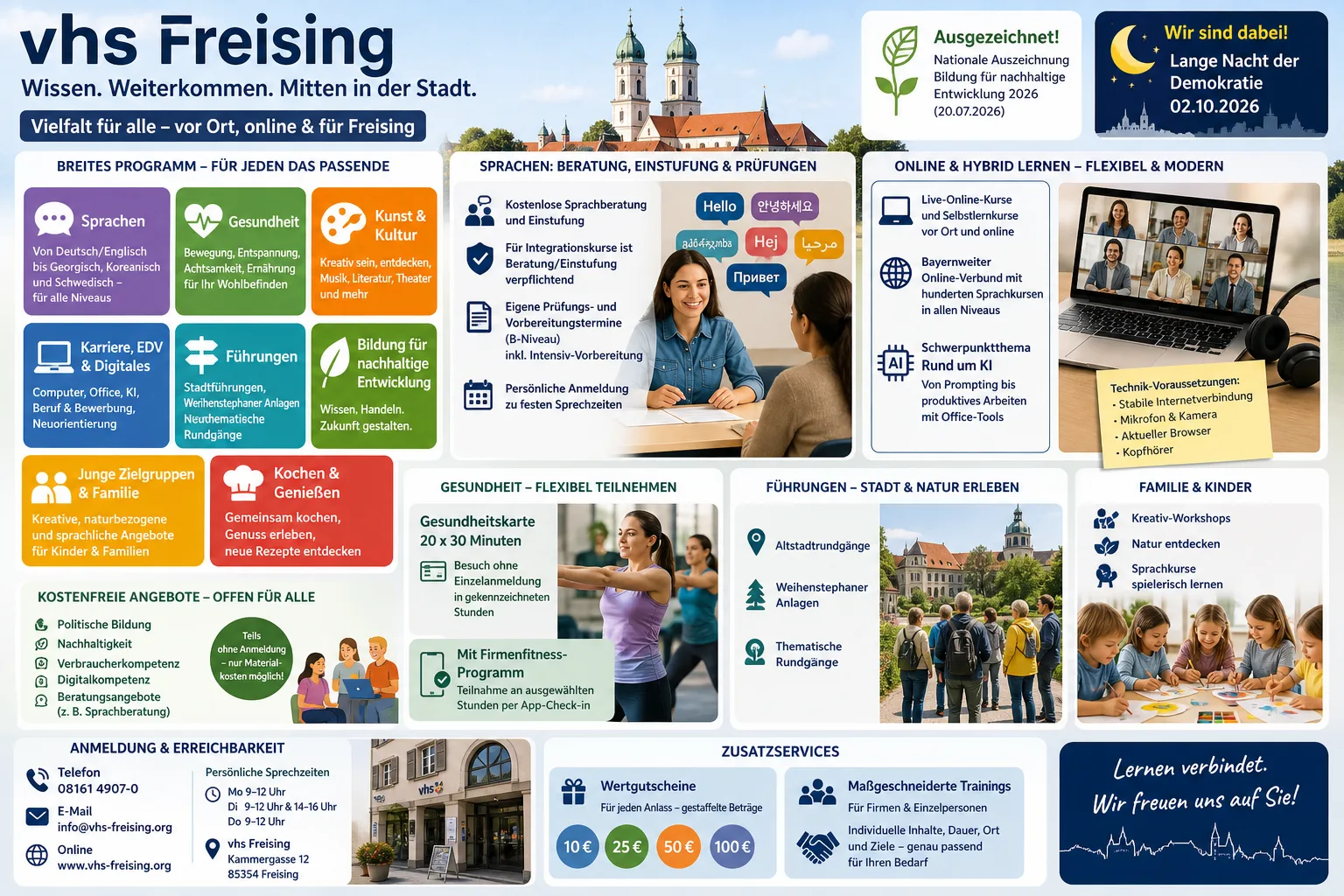
Do you want to learn something new in the coming months – a language, digital tools, creative skills, or more physical activity? In Freising, numerous courses, workshops, lectures, and guided tours are expected to start again in the 2026/2027 program year, which can be easily combined with everyday life, work, or family.
Learning Languages & German: Placement, Levels, Exams
If you want to learn a language in Freising in 2026/2027, the most important step before booking is choosing the right level. In adult education, the Common European Framework of Reference for Languages (CEFR) is often used – from A1 (beginner) to C2 (near-native).
How to Plan Your Language Course Effectively
- Define your goal: Everyday life, work, studies, or exam?
- Clarify your level: via placement test or consultation, so that pace and content fit.
- Choose a format: In-person, live online, or hybrid – depending on your time budget.
- Plan a routine: realistic study times (e.g., 2–3 sessions/week plus short reviews).
Integration and Job-Related Language Courses: What to Expect
If you are aiming for an integration course or a job-related language course in the coming months, certain requirements apply in Germany depending on the type of course (e.g., eligibility, placement, modules, and qualifications). Find out about the currently valid framework conditions in advance and have the necessary documents ready so you can register on time.
For exam goals (e.g., B1/B2 in the CEFR), preparatory courses are often particularly effective when they clearly specify:
- which exam parts are trained (reading, listening, writing, speaking),
- how many mock tests you complete before the date,
- how feedback and corrections are organized,
- which learning materials are mandatory.
Online, Hybrid & AI: How to Get Started
For 2026/2027, it is expected that many courses will be offered not only on-site but also as live online or hybrid formats. This is especially convenient if you want to save on travel or need to keep your learning schedule flexible.
Checklist: Technology & Preparation for Live Online Courses
- Stable connection: preferably Wi-Fi/LAN with sufficient bandwidth.
- Audio: A headset reduces background noise.
- Camera: helpful for interaction, depending on the course concept.
- Quiet learning environment: fixed study time, few interruptions.
- Data protection: use up-to-date software and check the settings (microphone/camera/chat).
AI Courses 2026/2027: Typical Topics
If AI offerings are planned in the upcoming program, they usually focus on practical questions for everyday life and work, for example:
- Prompting basics: how to clearly formulate tasks and check results,
- Text & office workflows: drafts, summaries, spreadsheet and presentation ideas,
- Quality assurance: fact-checking, source verification, dealing with errors (hallucinations),
- Law & responsibility: data protection, copyright, sensitive content.
Important for your learning success: Always plan a step for verification when using AI tools – especially if you use or share the results professionally.
Health, Guided Tours, Family: Learning in the Heart of City Life
In the coming months, formats can once again start in Freising that combine learning directly with everyday life, movement, and city experiences.
Health Courses: Staying Realistic
If you are planning health courses for 2026/2027, a simple strategy helps: Choose a format that you can attend regularly for at least 6–8 weeks. This way, "I'll give it a try" becomes a stable effect in everyday life. When choosing a course, pay attention to:
- Level of intensity (beginner vs. advanced),
- Contraindications and notes from the course instructor,
- Material requirements (mat, towel, comfortable clothing),
- whether you can make up sessions if you miss one.
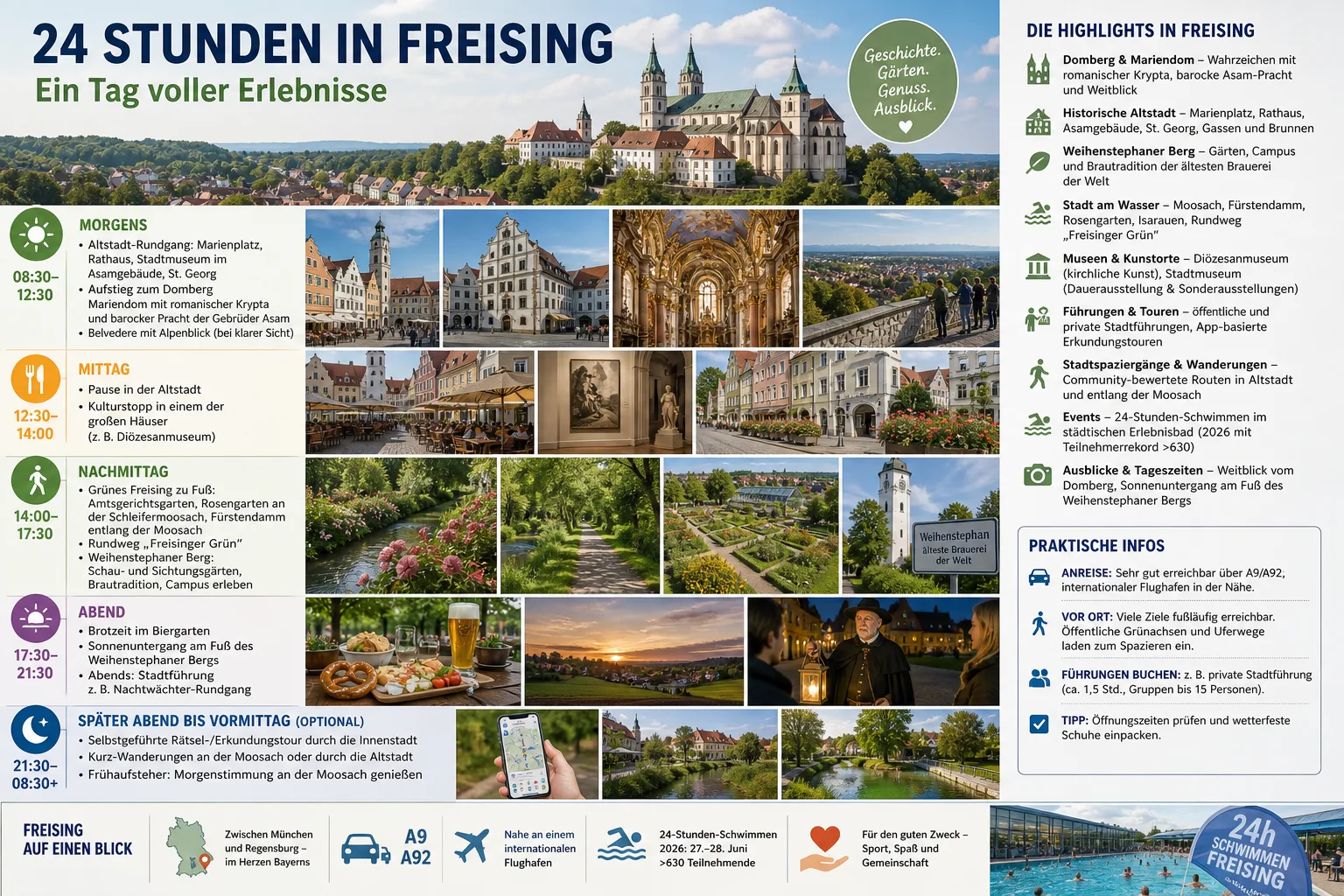
Guided Tours & Excursions: Discover Freising Anew
For the next program year, city or themed tours are also possible as usual (e.g., on history, architecture, nature, or special places). These formats are ideal for you as a participant if you:
- want to (re)discover Freising,
- have guests visiting and are looking for a shared experience,
- prefer to absorb knowledge on-site rather than at a desk.
Family and Youth Offers: Learning Together
If you are considering family courses for 2026/2027, it is worth checking age specifications, accompanying rules, and required materials early on. Formats where children actively participate and adults not only "attend" but also learn themselves are particularly attractive.
Registration, Costs & Planning: How to Find Your Course
To start the 2026/2027 program year without stress, a clear procedure helps:
- Check the program: start dates, scope, location/online, prerequisites.
- Compare: goal, level, learning format, time window.
- Register: preferably early if places are limited.
- Plan B: Note an alternative date or replacement course.
Two points are particularly important for trust and fair planning:
- Price transparency: Course fees, material costs, and possible additional costs should be clearly identifiable in advance.
- Participation conditions: Information on discounts, cancellations, minimum number of participants, and certificates should be easy to find.
Quality & Trust: How to Recognize Good Adult Education
When selecting a course for the coming months, you can often recognize quality by specific features – regardless of the topic:
- Clear learning objectives: What can you do better after the course than before?
- Comprehensible structure: Content is divided into units, with exercises and repetition.
- Competent course instructor: professionally suitable, didactically clear, with room for questions.
- Materials & practice: you receive tasks, examples, or instructions that you can use outside the course.
- Data protection & fairness: in online formats, tools and rules are communicated transparently.
Especially for digital and AI topics, an additional quality marker is whether the course explicitly teaches how to verify and responsibly use results.