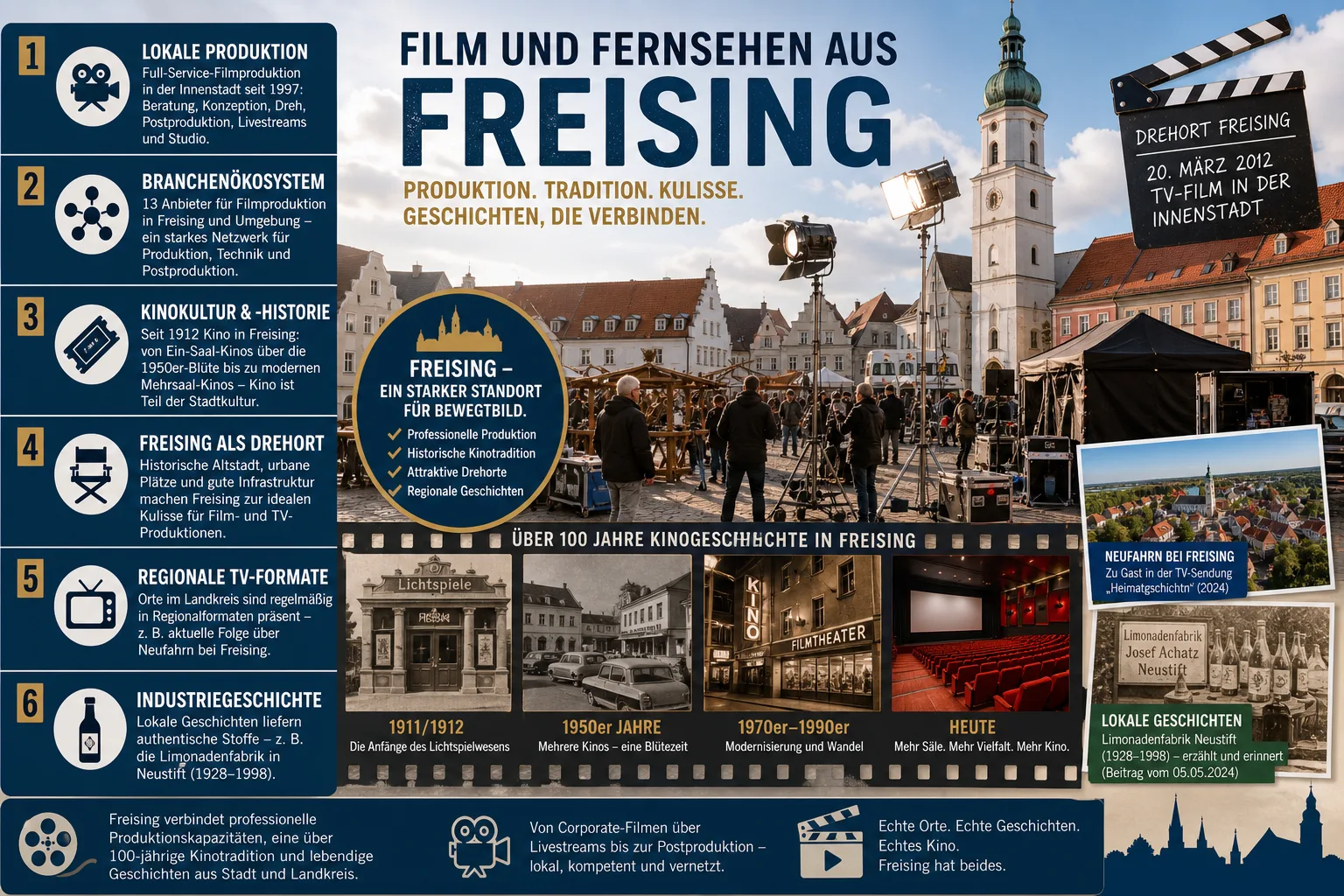
Film & Television made in Freising – Production & Cinema
Film & Television made in Freising: What Will Be Possible in the Coming Years – Production, Cinema, and Filming Locations
Freising, due to its location in the greater Munich area, proximity to the airport, and a compact, easily accessible city center, is a site that allows for particularly good planning of future moving image projects. This article shows how companies, cultural creators, and production managers can professionally prepare film, video, and livestream projects in Freising in the coming months and years – from the first idea to the screening in the cinema or online publication.
Why Freising is Interesting for Upcoming Productions
For planning future film and video formats, three factors usually count: accessibility, variety of settings, and reliable processes. Freising offers a pragmatic setup for this:
- Logistics: Short distances within the city, rail connections, and proximity to the airport make scheduling, crew travel, and equipment transport easier.
- Mix of settings: City center areas, residential neighborhoods, green spaces along the Isar, as well as institutions and companies in the vicinity, allow for different visual worlds without having to leave the city.
- Plannability: Productions benefit when permits, requirements, traffic management, and communication with residents are coordinated early – this is exactly where it is decided whether a shoot runs smoothly.
Important: Whether a specific shoot in public space is possible always depends on the responsible authorities, the type of shoot, the scope (e.g., closures), and the respective requirements. However, for the basic logic of planning (application, safety concept, liability, rights), largely comparable standards apply in Germany.
Future Production Workflows: From Conception to Postproduction
In the coming years, productions in Freising – as everywhere – will be organized more according to modular workflows: Content will be conceived in variants (e.g., 16:9, 9:16, 1:1), distribution channels will be planned in parallel (website, social, internal platforms), and shooting days will be designed to cover several formats at once.
1) Conception & Briefing (crucial for 2026/2027)
- Goal & Measurability: What should the video achieve in 30 days (e.g., applications, ticket sales, internal training rate)?
- Format decision: Image film, reportage, interview series, event film, recruiting clip, or documentary – each format has different shooting and approval processes.
- Roles & Approvals: Who approves content (technical, legal, brand)? A clean approval plan saves costs later.
2) Production: Plan Shoots to Scale
If you shoot (or have shoots) in Freising in the future, it is worthwhile to think about multiple uses already in the shooting plan:
- Master interview + micro-content: A well-planned interview can end up as a main film, social snippets, and quote graphics.
- Systematically collect B-roll: City atmosphere, routes, details, workflows – as an image library for future updates.
- Prioritize sound: Good images are quickly shot; understandable sound is the bottleneck. Microphone setup and quiet locations are crucial.
3) Postproduction: Speed Without Loss of Quality
For 2026/2027, it is expected that timelines will become shorter and at the same time more versions will be needed. The following have proven effective:
- Versioning: Clear naming (e.g., “v03_client”, “v04_final”) and a clear approval status.
- Subtitles & Accessibility: Subtitles (at least for social and internal training) increase comprehensibility and reach.
- Archiving: Store raw data, project files, music licenses, and approvals so that follow-up productions can start quickly.
Livestream & Hybrid Events: Standards That Will Prevail in 2026/2027
Hybrid events are expected to continue to grow: Conferences, panels, cultural formats, or internal town halls will take place both on-site and online. For Freising, this means: Those who invest early in plannable livestream setups (or purchase them) can scale events more flexibly.
Technical Expectations You Should Plan for in the Future
- Multi-camera standard: At least 2 perspectives (wide shot + close-up/detail) for a professional effect.
- Stable upload: Redundant internet strategy (e.g., second line or mobile backup) so that the event does not fail due to the connection.
- Audio mix: Clean mix of room sound and speaker microphones; monitoring and test runs are mandatory.
- Data protection & consents: Clear notices for audience and participants (recording, publication, contact for withdrawal).
Platforms and transmission standards continue to evolve, but the foundation remains: good audio quality, clear video direction, reliable redundancy, and a legally secure framework.
Freising as a Filming Location: How to Plan Shoots with Foresight
If the city center, squares, or public paths are to be used as a backdrop in the future, planning is the decisive lever. Especially for productions that visibly intervene in the urban space (e.g., lighting setup, tripods, small closures), these steps are common:
Preparation
- Choice of setting: Determine time of day, light, noise level, public traffic, and possible alternatives.
- Check permit requirements: Use of public spaces, parking needs, setups, drones, special use.
- Safety & traffic planning: Barriers, escape routes, fire protection, possibly stewards.
On the Day of Shooting
- Resident and public friendliness: Clear signage, short distances, respectful interaction – this reduces conflicts and speeds up processes.
- Data protection in public spaces: If passers-by are identifiable, consents or other legal bases are required depending on use.
- Weather and contingency plans: Plan alternative settings and indoor options to avoid cancellation costs.
For productions that want to portray Freising as a “real” city (rather than just a backdrop), good coordination with local authorities and realistic time planning are especially valuable.
Cinema & Evaluation: How Films Will Find Their Audience Locally in the Future
Even though streaming dominates, the cinema remains an important stage for many projects – especially for premieres, special screenings, discussion evenings, and local topics. In the coming years, these formats are likely to become further established:
- Premieres with discussion: Director/production or protagonists in the audience increase relevance and press potential.
- Themed series: Collaborations with education, culture, and associations enable recurring dates and plannable reach.
- Local short film blocks: Ideal when several actors (e.g., initiatives, university projects, companies) contribute content.
Those who produce today should consider evaluation from the outset: cinema (event), online (reach), internal use (training/communication), and archive (long-term value).
Quality, Rights, Data Protection: What Makes Future Projects Legally Secure
Trust is created not only through good images, but through clean processes. For future productions in Freising (as in all of Germany), these points are central:
Rights & Licenses
- Music: Usage rights must match the planned publication (web, social, cinema, internal use, duration, regions).
- Image rights: Consents from identifiable persons, especially for interviews and testimonials.
- Locations: Filming permits and, if necessary, private owner consents for interiors and private areas.
Data Protection (GDPR)
For recordings, livestreams, and publications, personal data is regularly processed (image, voice, names, chat data). The GDPR requires transparency, purpose limitation, and appropriate protective measures. Those responsible should therefore clarify before shooting:
- Who is the controller for the processing?
- What information obligations (notices) apply to participants and the audience?
- How is data stored, for how long, and who has access?
Journalistic Diligence & Fact-Checking
If a film claims, explains, or documents something, the demand for traceability increases. For 2026/2027, more than ever: sources, figures, and quotes should be internally verifiable; correction loops and approvals are part of quality assurance.
Checklist for Your Next Shoots in Freising
- Define goal & target group: What should the video achieve, and on which channels will it be published?
- Create a shortlist of settings: Main setting + 2 alternatives (weather, noise, permit).
- Check permits early: Public space, parking, setups, possibly drones.
- Clarify rights: Consents, music, logos, private areas.
- Define sound concept: Microphone setup, room acoustics, sources of interference, backup recording.
- Livestream (if planned): Upload tests, backup connection, overlays, moderation and chat rules.
- Plan postproduction: Delivery formats, subtitles, versions, approval process.
- Create archive: Raw material, project files, approvals, license proofs.