Discover Pilgrimage Routes & Quiet Places around Freising
Pilgrimage Routes & Quiet Places around Freising: Preview of Upcoming Tours (Autumn 2026 to Summer 2027)
Several suitable formats are planned around Freising for the coming months: long pilgrimage stages, short evening rounds, and quiet nature stops. This overview bundles tour ideas and seasonal time windows so you can plan your next time-outs in advance.
How to Use the Preview
This article is intended as a planning basis for future time-outs (from autumn 2026). Instead of "this is how it is," the focus here is: When each route is likely to feel best, how you can integrate it into your everyday life, and what you should pay attention to when traveling quietly.
Because markings, closures, and nature conservation rules can change, a quick check on official sites (see sources) and current maps is recommended before each tour.
Munich Way of St. James: Planned Day Stage Domberg–Ampermoching
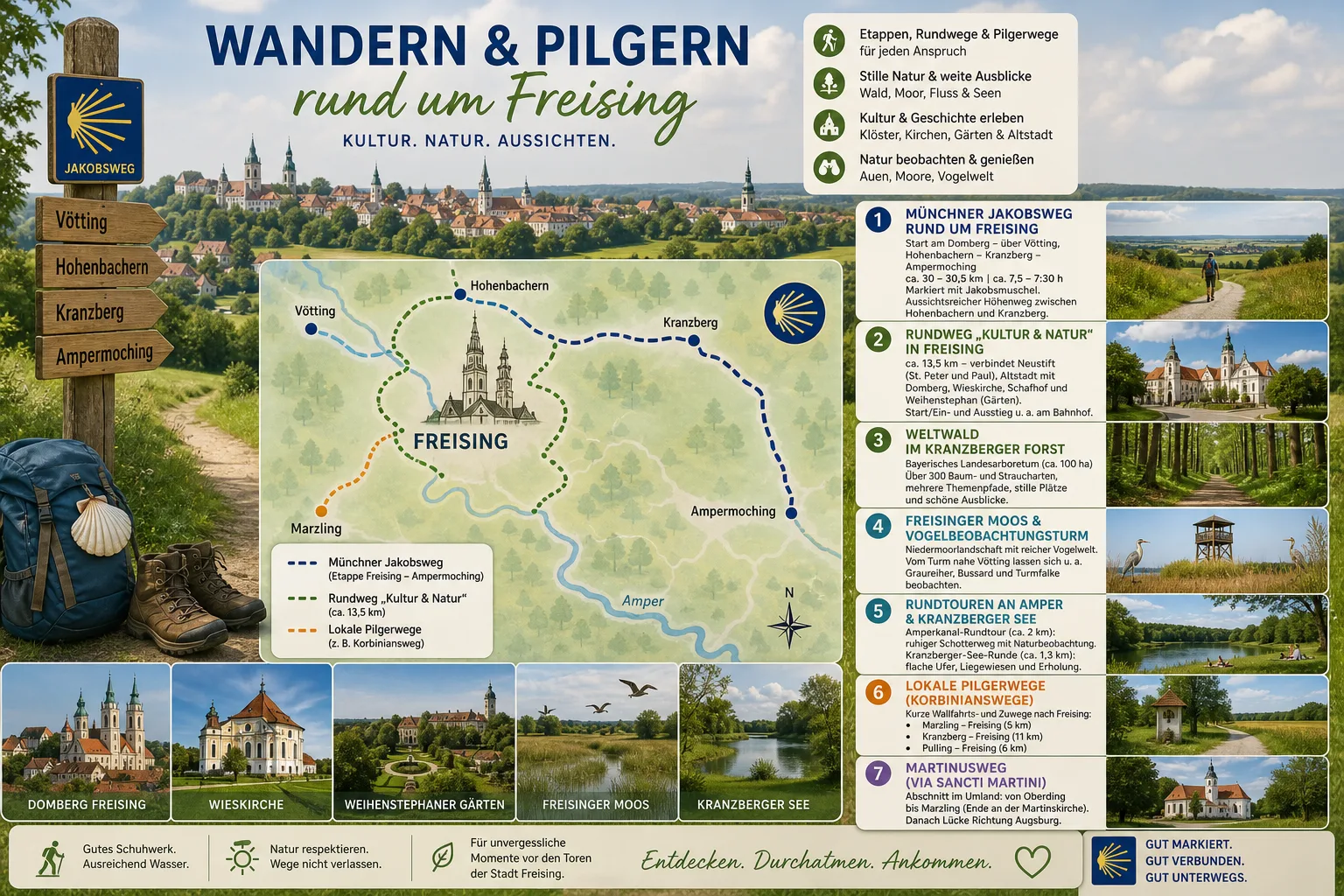
For the period September to November 2026, a "small pilgrimage day" is usually suitable around Freising: a longer, steady stage with an early start, breaks at quiet spots, and a clear destination. As a planning option, the connection Domberg Freising → Ampermoching is often mentioned, which is listed in route descriptions as a section/connection in the area of the Munich Way of St. James.
What is Well Plannable for Autumn 2026
- Time window: ideal on clear days in early autumn; for October/November, plan for an earlier start and buffer time.
- Character: longer day hike with pilgrimage logic (rhythm, markings, short quiet stops instead of many destinations).
- Orientation: For Ways of St. James, shell symbols are usually used; check in advance which marking variant is indicated on your specific section.
Suggestion for a Quiet Process (Future)
- Morning: Start at Domberg with 5–10 minutes of arrival (without music/phone).
- On the way: a short standing break every 60–90 minutes (water, look at the landscape, a few calm breaths).
- Late afternoon: Plan arrival so that there is still daylight for a quiet finish (no "final sprint").
Safety note: A long stage is a physical challenge. Plan food, weather changes, blister prevention, and an abort option (public transport/pick-up) in advance.
"Culture & Nature" Circular Route: Urban Landscape as a Quiet Loop
For evenings from late summer 2026 and mild weekends, a circular route is often the best form of "quiet without much effort": start and end are flexible, and you can shorten the loop at any time. Under the label "Culture & Nature", a route is described in Freising that connects important places (old town/Domberg, slopes and facilities towards Weihenstephan, further cultural points).
Why This Loop Works Well in the Coming Season
- Low entry barrier: In the future, you will probably be able to start at several points (e.g., near the train station or city center) and do not have to "push through" anything.
- Make quiet moments plannable: Instead of "as far as possible," the focus is on "as consciously as possible": 1–2 fixed stops (bench, viewpoint, garden section) are often enough.
- Year-round suitability: Especially good in spring 2027 (gardens/greenery) and in autumn 2026 (clearer air, calmer pace).
If you want to use the circular route as "mini-pilgrimage" in the future: Walk the first fifteen minutes consciously slowly and only then let the route transition into your natural pace.
World Forest & Kranzberg Forest: Themed Trails for Forest Silence
For autumn walks 2026 and spring/early summer 2027, the area World Forest (Bavarian State Arboretum) in Kranzberg Forest is a particularly suitable option if you are looking for "silence with structure": signposted themed trails, recurring waypoints, and yet many sections that feel like real retreat.
This Is How the World Forest Becomes a "Quiet Place" in the Future
- Choose a focus: better to complete one themed trail than to just touch several.
- Plan sitting time: 15 minutes of sitting without distraction makes the difference between "walk" and "recharging".
- Quiet rules: Keep conversations deliberately short, prioritize nature observation over speed.
For groups (clubs, teams, circles of friends), a format can be planned for 2026/2027 that requires little organizational effort: joint arrival, a fixed loop, then stopping for refreshments—with the quiet phase clearly agreed upon in advance.
Freisinger Moos & Waterways: Quiet Observation and Short Loops
If you want to be "far-seeing" rather than "going far" for the coming season, the open landscape in Freisinger Moos is particularly suitable. For late summer and autumn 2026, you can choose times when it is quiet there (early morning or late afternoon) and the light emphasizes the expanse.
Planned Ritual: Observe Instead of Collecting Distance
Instead of aiming for a large number of kilometers, plan an observation time for your next visit: 20–40 minutes at a suitable point (e.g., at a designated viewpoint or observation area). Bring binoculars, stay on paths, and respect sensitive zones.
Short Loops by the Water (Especially Suitable for Everyday Life in 2026/2027)
- Short canal/river loop: suitable for 30–60 minutes, with a steady rhythm and little distraction.
- Lake loop: ideal as a "reset" after work or on warm days in summer 2027; best at times of day that are less busy.
Nature conservation in mind: Fen and floodplain areas are sensitive. For the next tours: do not leave paths, keep dogs on a leash (where required), respect breeding and retreat times.
Korbinians Paths & Martinusweg: Short Pilgrimage Formats in the Surroundings
In addition to long pilgrimage stages, short, easily plannable formats can also be used for 2026/2027 that are associated with the theme of pilgrimage/pilgrimage in the region—for example, the Korbinians Paths towards Freising and sections of the Martinusweg (Via Sancti Martini), which is run as a European network of paths.
This Is How Short Pilgrimage Routes Can Work in the Future
- Half-day format: 2–4 hours of walking plus breaks—ideal for beginners.
- Group-friendly: easier to coordinate than a 30-km stage; especially suitable for parish teams, circles of friends, or open meetings.
- Spiritual or secular: You can frame the journey religiously (e.g., with a short impulse) or design it as a mindful nature and suburban walk.
If you want to try "pilgrimage on your doorstep" in 2027, short access routes are often the best entry: less pressure, more space for perception.
Practical Tips for the Coming Season (Autumn 2026 to Summer 2027)
1) Planning That Enables Calm
- Fewer goals, more time: Consciously plan 1–2 quiet stops per tour (sitting, view, nature observation).
- Build in a buffer: For autumn 2026 and winter days (short daylight), plan shorter and finish on time.
- Clarify outward and return journey: Whether circular route, public transport, or pick-up—a clear return option reduces internal stress.
2) Equipment That Doesn't Disturb
- Keep it light: Water, small snack, rain protection, plasters—that's all you need for many loops.
- Navigation: Offline map or printout as backup; battery reserve if navigating digitally.
- Quiet presence: Phone on silent; leave headphones off if you are seeking silence.
3) Consideration as a Basic Principle
- Stay on paths: especially in fen and floodplain areas.
- Do not disturb wildlife: Keep your distance, make observation time calm.
- Lead groups quietly: For planned group rounds 2026/2027, a short "quiet agreement" at the beginning is worthwhile.
Note (Liability/Responsibility): This preview does not replace current tour and safety planning. Before each future tour, check weather, path condition, local rules, and your personal fitness.
Sources
- Ways of St. James in Europe (Overview) — Background on Ways of St. James/Markings (accessed 2026-08-05)
- Via Sancti Martini (Martinusweg) — European network of paths and project information (accessed 2026-08-05)
- Bavarian State Forests: World Forest / Bavarian State Arboretum — Information on area and paths (accessed 2026-08-05)
- City of Freising (official information) — Current information on paths, nature and city offers (accessed 2026-08-05)
- Bavarian State Office for the Environment (LfU) — Basics on nature and moor protection in Bavaria (accessed 2026-08-05)