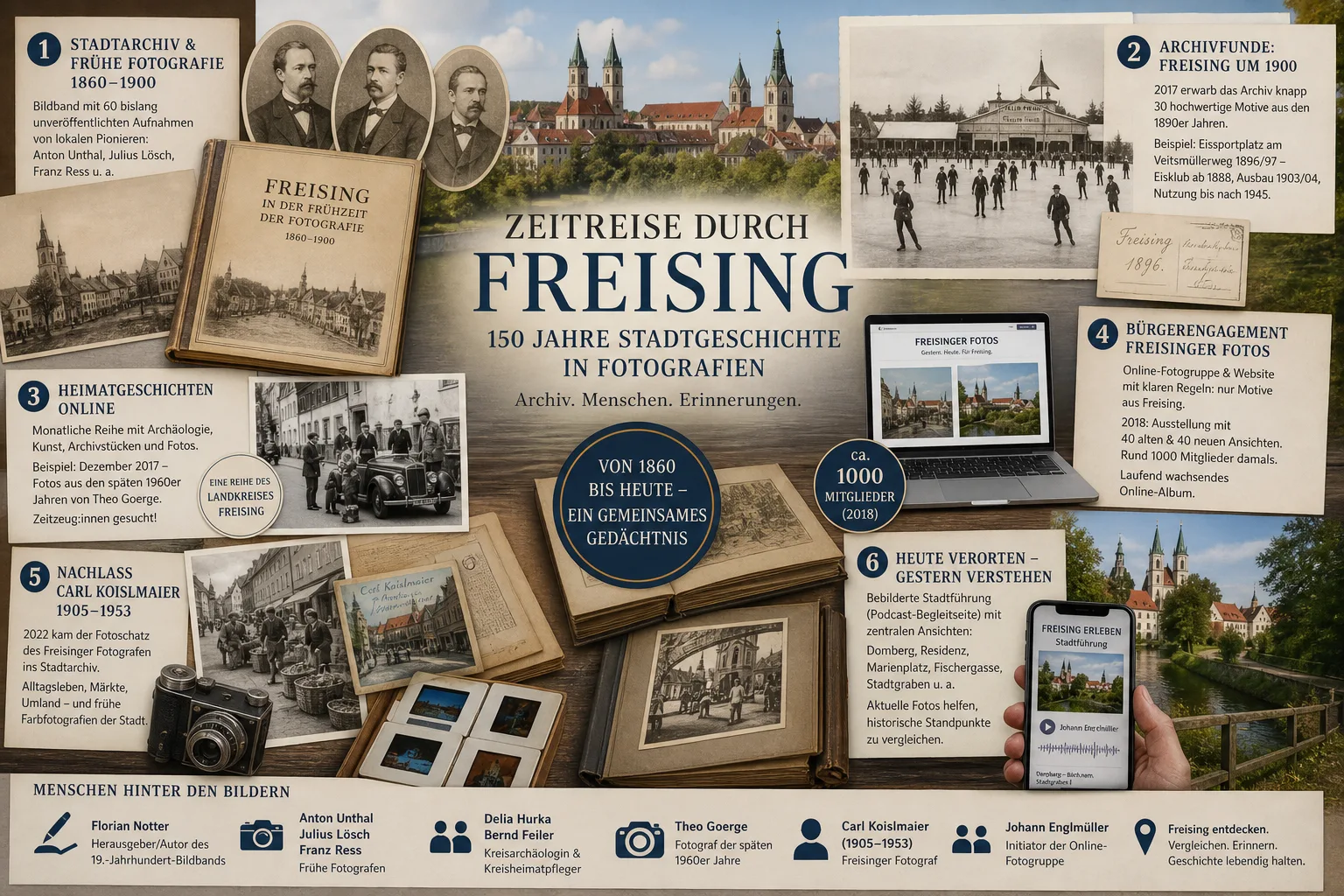
Time Travel through Freising: Old Photos & Stories
Time Travel through Freising: Old Photos, Stories & People – Your Upcoming Discoveries
A future guide for everyone who wants to rediscover Freising in the coming months and years through historical images: digitally, in the archive, on guided tours, and in participatory formats.
Researching in the City Archive: How to Plan Your Visit
If you want to delve deeper in the coming weeks or months, a planned visit to the city archive is a sensible next step. There, depending on the state of cataloguing and user regulations, you can use image collections, finding aids, and accompanying information that provide context: Who took the photo? In what context was the image created? Are there captions, signatures, or provenance notes?
How to Get More Out of an Archive Visit in the Future
- Define your question: Do you want to trace a place (e.g., Marienplatz), a theme (e.g., leisure/winter), or a person/family?
- Inform yourself in advance: Check opening hours, user conditions, and possible appointment requirements on the archive's website in good time.
- Clarify reproduction requests: If you want to use images later (e.g., for a lecture, a website, or a print), ask about usage rights and fee regulations in advance.
- Note instead of guessing: Record signatures, captions, and dates; this makes later source references easier.
Also plan for the fact that some holdings may be restricted for conservation reasons. This is a sign of trust: it shows that originals are to be protected and preserved permanently.
Discover Online: Series, Collections, and New Contributions
Your time travel doesn't have to start in the reading room. In the coming months, you can start with digital offerings – ideal for collecting motifs, developing questions, and preparing a later tour.
1) Ongoing Online Series and Editorial Contributions
If you want regular inspiration, it's worth keeping an eye on editorially curated series from regional institutions in the future. Such formats continuously publish new contributions, often with images, object stories, and short classifications. The advantage: content is curated, sources are more likely to be named, and reader submissions are often systematically reviewed.
2) Digital Portals for Cultural and Archival Assets
For the next research stage, you can also use national and regional portals where digitized holdings from archives, libraries, and museums are brought together. There you can filter results by location, period, photographer, or keywords. In the future, pay particular attention to:
- Metadata (dating, title, author, collection/signature)
- License and rights notices (e.g., "for private use only" or "free reuse")
- Quality levels (preview vs. high resolution)
3) Local Community Projects
In many cities, digital community archives are emerging and growing (e.g., photo groups or thematic websites). If you use these in the future, it's best to use them as a source of discovery and hints – and then check the origin of particularly interesting images (original, reproduction, source, rights). This way, you combine curiosity with reliable documentation.
On the Move with Images: Your Future Photo Tour through Freising
To turn images into a real time travel, plan a route for your next Freising walk that allows you to make comparisons. The goal is not to photograph "perfect" replicas, but to consciously rediscover perspectives and make changes visible.
A Practical Route for Your Next Visit
- Choose a starting point with a wide view: Start at a place where perspectives can be well compared over decades (e.g., a central square or a distinctive street).
- Save 3–5 historical motifs in advance: Take only a few images with you, but choose them deliberately. This keeps you flexible on site.
- Look for a viewpoint, don't force it: If a building or tree blocks the view today, document exactly that – it's part of the change.
- Make short notes: Time, weather, location description, and image source will help you later to explain the comparison clearly.
- Finish with reflection: At the end, note two observations: What has remained? What has changed the most (use, traffic, green spaces, facades)?
Participate: How You Can Contribute Memories in the Future (Without Legal Pitfalls)
Many photo projects thrive on citizens contributing images, hints, or names in the future. To keep this fair and legally secure for everyone, these basic rules help:
Before You Upload or Share a Photo
- Check copyright: A photo "from the family album" is not automatically free to use. Clarify who took the photo and whether publication is permitted.
- Respect personal rights: For recognizable people, publication rules apply depending on the context. If possible, obtain consent or choose a use limited to private/archival purposes.
- Document the source: For the future, note: origin (album/estate), approximate date, location, names (if certain), and your own role (ownership, scan, transmission).
- Protect originals: Scan gently, avoid adhesives/markers, and store photos dry and dark.
If you plan to collaborate with an institution in the future, it is often advisable to first contact them with a selection of digitized images and a brief context description. This way, it can be clarified whether and how acquisition, digitization, or publication is possible.
Quality & Trust: What to Look Out for in Historical Photos
So that your upcoming time travel through Freising doesn't turn into a chain of rumors, a simple quality check is worthwhile. Historical images look "authentic," but can be wrongly dated, miscaptioned, or taken out of context.
A Short E-E-A-T Check for Your Next Use
- Context: Are there details about location, time, photographer, or collection?
- Source: Does the image come from an archive/museum/portal with metadata or from an unchecked forwarding?
- Traceability: Can you support the statement you derive from the photo with at least one other piece of evidence (caption, newspaper note, map, official document)?
- Transparency: Honestly indicate uncertainties in the future ("probably," "not clearly datable") instead of cementing a claim.
Mnemonic for the future: A beautiful photo is not yet a reliable source – but a photo with clear origin, dating, and signature becomes a solid trace.
Note (not legal advice)
This article provides general guidance for future projects with historical photos and does not replace individual legal advice. For publications (print, website, social media, exhibition), please check the applicable terms of use and legal bases.
Sources
- Deutsche Digitale Bibliothek (DDB) — Portal for digitized cultural assets, research, and metadata (accessed 2026-06-03)
- Archivportal-D — Central search portal for archival material in Germany (accessed 2026-06-03)
- City of Freising (official website) — Entry point to municipal institutions and information (accessed 2026-06-03)
- Freising District (official website) — Information on institutions and regional offers (accessed 2026-06-03)