Heavenly Reunion at the Diocesan Museum Freising: Art from the 19th Century to the Blue Rider
Date and Time
Location
Price
About this Event
Mood
Venue Type
Heavenly Image Worlds between Romanticism and Modernity
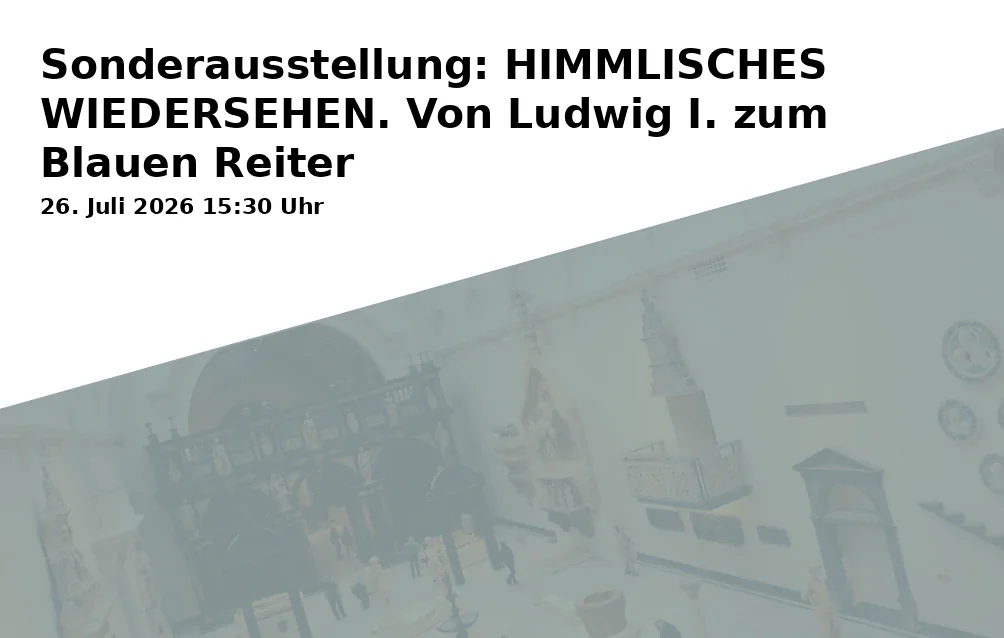
The Diocesan Museum of Freising invites you to a widely ranged art-historical special exhibition that traces the developments of Munich art in the 19th century up to the threshold of modernity. Heavenly Reunion. From Ludwig I. to the Blue Rider connects religious painting, artist biographies, stylistic changes, and societal upheavals into a multifaceted artistic experience on the Dome Hill.
A Century in Transition
Between secularization, revolution, romanticism, and the new conditions of a free art market, the role of art fundamentally changes. The exhibition shows how from the first half of the century, shaped by Ludwig I., an open, pluralized art landscape develops. Late Nazarene, realism, naturalism, impressionism, symbolism, art nouveau, and expressionism do not appear here as loose buzzwords, but as vibrant movements of an era in which the relationship between faith, society, and aesthetics is redefined.
More than 120 Works, Many Voices of Art History
With more than 120 works from over 30 museums and private collections, the exhibition offers an extraordinarily dense view of the 19th century. Featured are works by Friedrich Overbeck, Peter von Cornelius, Emilie Linder, Marie Ellenrieder, Wilhelm von Kaulbach, Franz von Lenbach, Carl Spitzweg, Franz von Stuck, Lovis Corinth, Wassily Kandinsky, Franz Marc, Gabriele Münter, and other influential artists. The exploration of works ranges from religious painting to symbolic imagery to expressive forms of early modernity.
From Sacred Image to the Awakening Spirit of the Blue Rider
Particularly appealing is the curation of the transition: The exhibition makes visible how a new, freer understanding of art evolves from the religious image tradition. The tension between contemplation and expression, between historical attachment and modern search, characterizes the exhibition's atmosphere. Those who engage with the exhibits experience not only art history but also an aesthetic experience of consolidation, movement, and intellectual openness.
Guided Tour as a Deepening Encounter with Works
The public guided tour offers a solid approach to themes, language of images, and art-historical context. It is aimed at visitors who want to not only look but also understand: What role did Ludwig I. play in Munich art? How did religious image formulas change? Why does the Blue Rider mark such a radical departure? This is where cultural education unfolds in the best sense.
Why Visiting is Worthwhile
This exhibition is more than a journey through time. It is a precisely composed art experience that sharpens the view for continuities and breaks. Those wanting to discover religious painting, modernity, 19th-century art, and the great names of Munich's art scene will find a particularly rich access here. A visit to the Diocesan Museum of Freising is worthwhile for all who want to not only view art but experience it in its historical depth.
Conclusion: Heavenly Reunion impressively leads from the art of Ludwig I. to the Blue Rider and makes the transition to modernity immediately tangible. A must-see for art lovers who wish to see great names, powerful images, and art-historical insights combined in one visit.
Official Channels of the Diocesan Museum of Freising:
- Instagram: no official profile found
- Facebook: no official profile found
- YouTube: no official profile found
- Website: https://www.dimu-freising.de/