
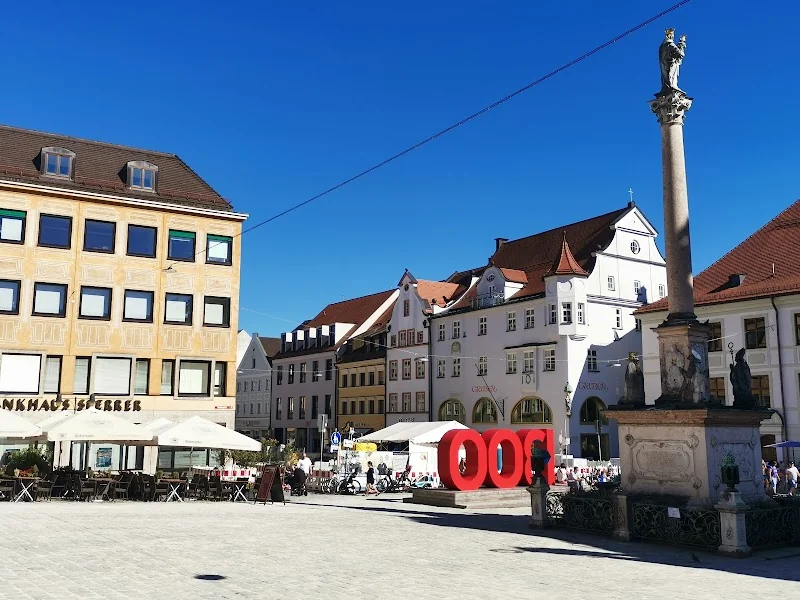
Freising
Ob. Hauptstraße, 85354 Freising, Deutschland
Old Town Freising | Parking & Attractions
The Old Town of Freising is not just a postcard motif, but the historical heart of a city that makes its history visible, walkable, and tangible in everyday life. Between the Cathedral Hill and Weihenstephan Hill, an urban space opens up where magnificent bourgeois and cathedral lord houses, narrow alleys, open watercourses, and lively squares combine to form a distinctive ensemble. At the center is the Marienplatz with the Marian Column from 1674, which, together with the town hall, market stalls, and the main axis of Upper and Lower Main Street, shapes the character of the Old Town. Those who arrive here do not experience an isolated museum space, but a city center where shopping, strolling, gastronomy, culture, and everyday life intertwine. This very mix makes Freising's Old Town as interesting for visitors as it is for locals, who have their paths, their market, their cafés, and their favorite places here. ([tourismus.freising.de](https://tourismus.freising.de/sehenswert/historische-altstadt?utm_source=openai))
The atmosphere thrives on contrasts: historical facades meet a modern, vibrant city center, traditional market structures meet new qualities of stay, and the view of the Cathedral Hill meets the short path into the shopping and enjoyment world of the Upper Old Town. Also striking is the strong identity of the place, as the city designates the listed Old Town ensemble as an identity-forming center that requires special care and attention. At the same time, the Old Town today is much more than a historical heritage: it is a market location, a meeting point, a cultural address, and a starting point for walks in all directions. Those who want to understand Freising begin in the Old Town, as here city history, urban space, and the present condense within a few hundred meters. ([freising.de](https://www.freising.de/leben-wohnen/bauen/sanierungsgebiet-altstadt?utm_source=openai))
Parking in Old Town Freising: Parking Garages, Large Parking Lots, and Short Distances
Those arriving by car will find a remarkably broad parking infrastructure for a historical city center in Freising. The city offers around 3,500 centrally located public parking spaces and additionally provides a city guide with all parking options. The most important parking garages include the Parkhaus Am Wörth with 300 spaces, the Altstadt-Parkhaus with 800 spaces, the Parkhaus Untere Altstadt with 203 spaces, and the Parkhaus Sparkasse in Weizengasse with 60 spaces. This offer is complemented by free large parking lots such as Luitpoldanlage, Luitpoldstraße, and Park & Ride at the train station, as well as by other paid areas in the immediate city center. This is particularly helpful for specific planning, as visits can be flexibly started depending on the destination in the Old Town. ([freising.de](https://www.freising.de/leben-wohnen/mobilitaet-verkehrswende/parkplatzangebot?utm_source=openai))
It is also practical that the city supports digital parking tickets via an app and continuously informs about parking machines, rates, and locations on its pages. According to the tourism site, the Parkhaus Untere Altstadt is open 24 hours, and for parking in the vicinity of the Old Town, the city also refers to overview maps with opening hours and prices. Those planning a visit in the area of Marienplatz, Upper Main Street, or Cathedral Hill also benefit from clear barrier-free pathways. For example, the city describes the route from the Parkhaus Am Wörth to the center as a short, paved, and almost level path that leads directly to Upper Main Street. Separate stopping options and drop-off points are provided for tour buses, such as in front of the Altstadtparkhaus or on Dr.-von-Daller-Straße. This combination of central parking garages, short-term spaces, and clear orientation makes parking in Old Town Freising significantly less stressful than is often expected in a historical city center. ([freising.de](https://www.freising.de/leben-wohnen/mobilitaet-verkehrswende/parkplatzangebot?utm_source=openai))
For visitors who only want to stay briefly in the city center, the paid large parking lots are particularly interesting because they are close enough to the Old Town to reach the destination quickly on foot while relieving the historical core zone. Those staying longer are more likely to use the large parking garages, especially the Altstadt-Parkhaus with its many spaces. Thus, the Old Town is not a place where one desperately searches for a parking space, but an urban space that deliberately directs mobility and considers different visitor profiles. People with disabilities also find designated parking spaces, for example at central points like Cathedral Hill, Bahnhofplatz, or Altstadtgalerie. This way, the historical center remains accessible for different needs despite its developed structure. ([freising.de](https://www.freising.de/leben-wohnen/mobilitaet-verkehrswende/parkplatzangebot?utm_source=openai))
Attractions in Freising Old Town: Marienplatz, Cathedral Hill, and Open Moosach
The most important attractions of Freising's Old Town are surprisingly close to each other, and this proximity is what makes a stroll through the city so appealing. At the center is Marienplatz, the historical center of the citizen city and today's meeting point. From here, the view extends into the main street, where magnificent bourgeois houses, former breweries, and craftsmen's houses shape the image. Nearby, the miniature model of Freising's Old Town reminds us how much the city thrives on its topography. The short path up to Cathedral Hill leads from the bustling city center into a space of tranquility and scholarship. There, the Mariendom with its distinctive towers, the Romanesque beast column, and the diocesan museum with a significant art collection await. The tourism site emphasizes that it is only a short walk from the lively Old Town up to Cathedral Hill. This closeness between everyday city life and church art makes Freising unique. ([tourismus.freising.de](https://tourismus.freising.de/sehenswert/historische-altstadt?utm_source=openai))
Particularly influential for today's perception of the Old Town is the open Moosach. The city has partially uncovered the Moosach in Upper Main Street as part of the redesign and has made the area barrier-free. Today, the visibly open stream is described as an attraction at any time of day and year and has become a popular place to linger. Cultural traces can also be found in the Old Town at many corners, such as at the war memorial or the sculpture in honor of Karl Obermayr, which lies along the open Moosach. The historical Old Town is thus not only beautiful to look at but also tells the story of Freising within the urban space itself. Those who walk attentively will see how medieval, baroque, and modern elements intertwine. This makes the Old Town walk a kind of open city exhibition where architecture, water, squares, and monuments work together. ([tourismus.freising.de](https://tourismus.freising.de/sehenswert/historische-altstadt?utm_source=openai))
Additionally, the special effect of the facades plays a role. The tourism information describes the ensemble as a sequence from Gothic to Baroque, flanked by lively market streets and colorful houses with intricate decorations. This is important because the Old Town of Freising does not function solely through individual highlights but through the interplay of cityscape and pathway. Marienplatz, Upper Main Street, Lower Main Street, and the side streets together form a tightly defined city core that can be easily explored on foot. Those seeking attractions will find not just one or two photo spots but a whole succession of motifs. This is precisely why the Old Town is suitable for both short visits and longer city walks. ([tourismus.freising.de](https://tourismus.freising.de/sehenswert/historische-altstadt?utm_source=openai))
Christmas Market and Weekly Market in Freising's Old Town
Freising's Old Town has always been a market space, and this character is still clearly felt today. The Green Weekly Market takes place year-round on Wednesdays and Saturdays from 7:00 AM to 1:00 PM at Marienplatz. Thus, the Old Town remains a place of exchange, enjoyment, and encounter even in everyday life. The city emphasizes that the market atmosphere is shaped by regional vendors and makes Marienplatz a lively meeting point. Those walking through the Old Town on market days experience not only shopping but also rhythm: setup, conversations, the scent of fresh products, small breaks at the stalls, and the social life of a city center that is not just a backdrop. This is an important hint for search queries like Freising Old Town map or Freising Old Town food, as the market is right in the middle of the city's everyday life. ([freising.de](https://www.freising.de/leben-wohnen/maerkte-in-freising?utm_source=openai))
During the Advent season, the Old Town gains an additional emotional focus. The charitable Christmas market at Marienplatz is described by the city as a Christmas market with heart and traditionally takes place on the third Advent weekend. Around the large Christmas tree, festively decorated stalls transform the historic square into a festive backdrop. The city points out that the market has been organized in collaboration with local partners for many years and serves a good cause. The large Christmas tree at Marienplatz is also part of this winter staging and shapes the image of the Old Town during the pre-Christmas season. So, anyone searching for Old Town Christmas market Freising 2025 will not find a random event but a long-standing Freising tradition closely linked to Marienplatz, the town hall, and the social life of the city. ([freising.de](https://www.freising.de/leben-wohnen/maerkte-in-freising?utm_source=openai))
The special charm of these markets lies in the fact that they do not take place at an anonymous event location but right in the historical core. This makes the atmosphere tangible: Marienplatz is not just a market area but the center of the city, and the surrounding facades enhance the effect of the stalls, lights, and encounters. For visitors, this means that a market stroll can be easily combined with shopping, café visits, or a short walk to Cathedral Hill. Especially during the Advent season, this combination of history, craftsmanship, enjoyment, and festive atmosphere is a central part of the Freising Old Town experience. ([tourismus.freising.de](https://tourismus.freising.de/sehenswert/historische-altstadt?utm_source=openai))
Freising Old Town Renovation: Upper Main Street, Moosach, and New Quality of Stay
The current quality of the Old Town is also the result of a long-term renovation strategy. The city of Freising designates the historical center as a renovation area II Old Town and emphasizes the importance of the listed Old Town ensemble for identity, use, and urban development. The objective explicitly includes maintaining and strengthening the functional mix of the city center, i.e., thinking together housing, administration, education, church, public facilities, gastronomy, culture, and commerce. Particularly important in this context is Upper Main Street, which the city classifies as an urban area. This shows that the Old Town is not only about monument protection but also about a lively, contemporary urban concept. ([freising.de](https://www.freising.de/leben-wohnen/bauen/sanierungsgebiet-altstadt?utm_source=openai))
The redesign of the Upper Old Town has been prepared and implemented over the years. Work on barrier-free paving and the renewal of utilities began in 2017, followed by the opening of the Moosach in several sections. A citizens' decision in 2014 voted overwhelmingly for the uncovering of the Stadtmoosach, and the city incorporated this wish into its planning. By the end of 2022, most of the work on the redesign was largely completed, while further sections were finished in 2023. This not only gave the Old Town an optical upgrade but also improved the quality of stay, increased barrier-free access, and created an urban space that is more focused on pedestrians. The open Moosach is more than just a design element: it is a visible symbol of the connection between tradition, urban ecology, and modern city development. ([freising.de](https://www.freising.de/rathaus/online-dabei/neugestaltung-obere-altstadt/?utm_source=openai))
For visitors, the renovation is also relevant because it makes the Old Town more experienceable. The city emphasizes that the new design aims to strengthen the city center as a shopping city and as a living and experiential space. This concerns not only the surfaces and paving but also the visibility of historical elements such as the war memorial or the new spatial effect along the open Moosach. As a result, pathways, seating areas, and sightlines have become clearer. Today, those walking through Upper Main Street experience an Old Town that takes its history seriously but does not remain stuck in it. This is important for SEO and user interest: Freising Old Town renovation does not stand for construction site aesthetics but for the successful further development of a historical city center. ([freising.de](https://www.freising.de/rathaus/thema-des-monats/umbau-obere-altstadt-vor-fertigstellung?utm_source=openai))
Shops, Cafés, and Restaurants in Old Town Freising
Freising's Old Town is a place for shopping, lingering, and enjoying. The tourism site explicitly describes beautiful boutiques, shops with individual offerings, cozy cafés, and restaurants that invite you to stay. This mix is precisely what makes the center appealing: the Old Town is not just a historical backdrop but a functioning commercial and gastronomic space. Those searching for Freising Old Town shops or Freising Old Town restaurants will find not isolated individual addresses but a vibrant environment with diverse offerings. The city center is designed so that a short stroll is just as worthwhile as a longer stay with coffee, lunch, or shopping breaks. At the same time, former breweries, craftsmen's houses, and representative bourgeois houses contribute to the special atmosphere that one does not find in classic shopping centers. ([tourismus.freising.de](https://tourismus.freising.de/sehenswert/historische-altstadt?utm_source=openai))
The culinary and commercial profile of the Old Town is also strengthened by the fact that the weekly market takes place right in the center and that the surroundings are particularly lively on market days. This creates a natural connection between regional shopping, gastronomy, and city visits. For search terms like Freising Old Town café, Freising Old Town food, or Upper Old Town Freising, it is therefore important that everyday life and experience overlap here. Those walking in Upper Old Town will find not only seating and market stalls but also small shops, sightlines, and places to linger by the open stream. The city describes the zone as a place where housing, administration, education, church, services, culture, and gastronomy should come together. This is precisely what gives the district its current quality: the Old Town is not a topic for a quick headline but for an entire visit plan. ([freising.de](https://www.freising.de/leben-wohnen/bauen/sanierungsgebiet-altstadt?utm_source=openai))
The Altstadtgalerie also fits into this picture as it appears as a point of orientation in the city center and is also taken into account with designated parking spaces. For visitors, this means that shopping, gastronomy, and parking are closer together in Freising than one might expect in many other historical cities. This is particularly relevant for guests who are not only planning to see attractions but also practical errands or a relaxed shopping stroll. Those interested in the Old Town should therefore not only see it as a historical ensemble but as a contemporary living space. Especially where shops, cafés, and gastronomic businesses fit into a listed environment, the typical Freising mix of urban proximity, Bavarian atmosphere, and regional identity emerges. ([freising.de](https://www.freising.de/leben-wohnen/mobilitaet-verkehrswende/parkplatzangebot?utm_source=openai))
Map, Photos, and Orientation in Freising's Old Town
For good orientation, it helps to view the Old Town as a clearly readable network of paths. The central entry point is almost always Marienplatz, from which Upper Main Street, Lower Main Street, Cathedral Hill, and the adjacent alleys can be accessed. The city and the tourism information offer city walks, maps, and barrier-free routes for this purpose. Particularly useful is the miniature model of Freising's Old Town, which stands next to the fountain on Lower Main Street and marks attractions and streets in normal and Braille script. This model is not only a nice detail but a practical tool for spatially grasping the city center. Those searching for Freising Old Town map will receive a real orientation system instead of an abstract description. ([tourismus.freising.de](https://tourismus.freising.de/sehenswert/historische-altstadt?utm_source=openai))
Also, for Freising Old Town photos, the city center is ideal because very different motifs can be found in a small space: Marian Column, town hall, historical facades, open Moosach, small bridges, the path to Cathedral Hill, and the lively market areas. The tourism site emphasizes that the Old Town is characterized by richly decorated houses and open watercourses, while the city walks lead visitors from the town hall through Upper Old Town up to Cathedral Hill. This creates many perspectives for short and longer walks, even if one does not want to discover all attractions in a single day. Those who truly want to experience the city should not just walk straight through but take time for the sightlines. The combination of historical space, open watercourses, and urban use makes Freising photogenic and authentic at the same time. ([tourismus.freising.de](https://tourismus.freising.de/sehenswert/historische-altstadt?utm_source=openai))
It is also practical that Freising designates parts of barrier-free paths and explicitly describes the route between the city center and Cathedral Hill. This makes planning the Old Town easier for guests with strollers, walking aids, or limited mobility. For tourist search queries, this is important because Freising is not only beautiful but also well accessible. The city thus offers an Old Town that combines historical quality with modern accessibility. Those who want to keep an overview should best start with a short walk around Marienplatz and Upper Main Street, then visit the open Moosach, look at the model of the Old Town, and then take the short path towards Cathedral Hill. In this way, a mere map becomes a real city tour. ([tourismus.freising.de](https://tourismus.freising.de/tourismus/user_upload/images/Fuehrungen/Stadtspaziergaenge/PDF_Stadtspaziergaenge/stadtspaziergang-freising-grenzenlos.pdf?utm_source=openai))
Sources:
Show moreShow less
Old Town Freising | Parking & Attractions
The Old Town of Freising is not just a postcard motif, but the historical heart of a city that makes its history visible, walkable, and tangible in everyday life. Between the Cathedral Hill and Weihenstephan Hill, an urban space opens up where magnificent bourgeois and cathedral lord houses, narrow alleys, open watercourses, and lively squares combine to form a distinctive ensemble. At the center is the Marienplatz with the Marian Column from 1674, which, together with the town hall, market stalls, and the main axis of Upper and Lower Main Street, shapes the character of the Old Town. Those who arrive here do not experience an isolated museum space, but a city center where shopping, strolling, gastronomy, culture, and everyday life intertwine. This very mix makes Freising's Old Town as interesting for visitors as it is for locals, who have their paths, their market, their cafés, and their favorite places here. ([tourismus.freising.de](https://tourismus.freising.de/sehenswert/historische-altstadt?utm_source=openai))
The atmosphere thrives on contrasts: historical facades meet a modern, vibrant city center, traditional market structures meet new qualities of stay, and the view of the Cathedral Hill meets the short path into the shopping and enjoyment world of the Upper Old Town. Also striking is the strong identity of the place, as the city designates the listed Old Town ensemble as an identity-forming center that requires special care and attention. At the same time, the Old Town today is much more than a historical heritage: it is a market location, a meeting point, a cultural address, and a starting point for walks in all directions. Those who want to understand Freising begin in the Old Town, as here city history, urban space, and the present condense within a few hundred meters. ([freising.de](https://www.freising.de/leben-wohnen/bauen/sanierungsgebiet-altstadt?utm_source=openai))
Parking in Old Town Freising: Parking Garages, Large Parking Lots, and Short Distances
Those arriving by car will find a remarkably broad parking infrastructure for a historical city center in Freising. The city offers around 3,500 centrally located public parking spaces and additionally provides a city guide with all parking options. The most important parking garages include the Parkhaus Am Wörth with 300 spaces, the Altstadt-Parkhaus with 800 spaces, the Parkhaus Untere Altstadt with 203 spaces, and the Parkhaus Sparkasse in Weizengasse with 60 spaces. This offer is complemented by free large parking lots such as Luitpoldanlage, Luitpoldstraße, and Park & Ride at the train station, as well as by other paid areas in the immediate city center. This is particularly helpful for specific planning, as visits can be flexibly started depending on the destination in the Old Town. ([freising.de](https://www.freising.de/leben-wohnen/mobilitaet-verkehrswende/parkplatzangebot?utm_source=openai))
It is also practical that the city supports digital parking tickets via an app and continuously informs about parking machines, rates, and locations on its pages. According to the tourism site, the Parkhaus Untere Altstadt is open 24 hours, and for parking in the vicinity of the Old Town, the city also refers to overview maps with opening hours and prices. Those planning a visit in the area of Marienplatz, Upper Main Street, or Cathedral Hill also benefit from clear barrier-free pathways. For example, the city describes the route from the Parkhaus Am Wörth to the center as a short, paved, and almost level path that leads directly to Upper Main Street. Separate stopping options and drop-off points are provided for tour buses, such as in front of the Altstadtparkhaus or on Dr.-von-Daller-Straße. This combination of central parking garages, short-term spaces, and clear orientation makes parking in Old Town Freising significantly less stressful than is often expected in a historical city center. ([freising.de](https://www.freising.de/leben-wohnen/mobilitaet-verkehrswende/parkplatzangebot?utm_source=openai))
For visitors who only want to stay briefly in the city center, the paid large parking lots are particularly interesting because they are close enough to the Old Town to reach the destination quickly on foot while relieving the historical core zone. Those staying longer are more likely to use the large parking garages, especially the Altstadt-Parkhaus with its many spaces. Thus, the Old Town is not a place where one desperately searches for a parking space, but an urban space that deliberately directs mobility and considers different visitor profiles. People with disabilities also find designated parking spaces, for example at central points like Cathedral Hill, Bahnhofplatz, or Altstadtgalerie. This way, the historical center remains accessible for different needs despite its developed structure. ([freising.de](https://www.freising.de/leben-wohnen/mobilitaet-verkehrswende/parkplatzangebot?utm_source=openai))
Attractions in Freising Old Town: Marienplatz, Cathedral Hill, and Open Moosach
The most important attractions of Freising's Old Town are surprisingly close to each other, and this proximity is what makes a stroll through the city so appealing. At the center is Marienplatz, the historical center of the citizen city and today's meeting point. From here, the view extends into the main street, where magnificent bourgeois houses, former breweries, and craftsmen's houses shape the image. Nearby, the miniature model of Freising's Old Town reminds us how much the city thrives on its topography. The short path up to Cathedral Hill leads from the bustling city center into a space of tranquility and scholarship. There, the Mariendom with its distinctive towers, the Romanesque beast column, and the diocesan museum with a significant art collection await. The tourism site emphasizes that it is only a short walk from the lively Old Town up to Cathedral Hill. This closeness between everyday city life and church art makes Freising unique. ([tourismus.freising.de](https://tourismus.freising.de/sehenswert/historische-altstadt?utm_source=openai))
Particularly influential for today's perception of the Old Town is the open Moosach. The city has partially uncovered the Moosach in Upper Main Street as part of the redesign and has made the area barrier-free. Today, the visibly open stream is described as an attraction at any time of day and year and has become a popular place to linger. Cultural traces can also be found in the Old Town at many corners, such as at the war memorial or the sculpture in honor of Karl Obermayr, which lies along the open Moosach. The historical Old Town is thus not only beautiful to look at but also tells the story of Freising within the urban space itself. Those who walk attentively will see how medieval, baroque, and modern elements intertwine. This makes the Old Town walk a kind of open city exhibition where architecture, water, squares, and monuments work together. ([tourismus.freising.de](https://tourismus.freising.de/sehenswert/historische-altstadt?utm_source=openai))
Additionally, the special effect of the facades plays a role. The tourism information describes the ensemble as a sequence from Gothic to Baroque, flanked by lively market streets and colorful houses with intricate decorations. This is important because the Old Town of Freising does not function solely through individual highlights but through the interplay of cityscape and pathway. Marienplatz, Upper Main Street, Lower Main Street, and the side streets together form a tightly defined city core that can be easily explored on foot. Those seeking attractions will find not just one or two photo spots but a whole succession of motifs. This is precisely why the Old Town is suitable for both short visits and longer city walks. ([tourismus.freising.de](https://tourismus.freising.de/sehenswert/historische-altstadt?utm_source=openai))
Christmas Market and Weekly Market in Freising's Old Town
Freising's Old Town has always been a market space, and this character is still clearly felt today. The Green Weekly Market takes place year-round on Wednesdays and Saturdays from 7:00 AM to 1:00 PM at Marienplatz. Thus, the Old Town remains a place of exchange, enjoyment, and encounter even in everyday life. The city emphasizes that the market atmosphere is shaped by regional vendors and makes Marienplatz a lively meeting point. Those walking through the Old Town on market days experience not only shopping but also rhythm: setup, conversations, the scent of fresh products, small breaks at the stalls, and the social life of a city center that is not just a backdrop. This is an important hint for search queries like Freising Old Town map or Freising Old Town food, as the market is right in the middle of the city's everyday life. ([freising.de](https://www.freising.de/leben-wohnen/maerkte-in-freising?utm_source=openai))
During the Advent season, the Old Town gains an additional emotional focus. The charitable Christmas market at Marienplatz is described by the city as a Christmas market with heart and traditionally takes place on the third Advent weekend. Around the large Christmas tree, festively decorated stalls transform the historic square into a festive backdrop. The city points out that the market has been organized in collaboration with local partners for many years and serves a good cause. The large Christmas tree at Marienplatz is also part of this winter staging and shapes the image of the Old Town during the pre-Christmas season. So, anyone searching for Old Town Christmas market Freising 2025 will not find a random event but a long-standing Freising tradition closely linked to Marienplatz, the town hall, and the social life of the city. ([freising.de](https://www.freising.de/leben-wohnen/maerkte-in-freising?utm_source=openai))
The special charm of these markets lies in the fact that they do not take place at an anonymous event location but right in the historical core. This makes the atmosphere tangible: Marienplatz is not just a market area but the center of the city, and the surrounding facades enhance the effect of the stalls, lights, and encounters. For visitors, this means that a market stroll can be easily combined with shopping, café visits, or a short walk to Cathedral Hill. Especially during the Advent season, this combination of history, craftsmanship, enjoyment, and festive atmosphere is a central part of the Freising Old Town experience. ([tourismus.freising.de](https://tourismus.freising.de/sehenswert/historische-altstadt?utm_source=openai))
Freising Old Town Renovation: Upper Main Street, Moosach, and New Quality of Stay
The current quality of the Old Town is also the result of a long-term renovation strategy. The city of Freising designates the historical center as a renovation area II Old Town and emphasizes the importance of the listed Old Town ensemble for identity, use, and urban development. The objective explicitly includes maintaining and strengthening the functional mix of the city center, i.e., thinking together housing, administration, education, church, public facilities, gastronomy, culture, and commerce. Particularly important in this context is Upper Main Street, which the city classifies as an urban area. This shows that the Old Town is not only about monument protection but also about a lively, contemporary urban concept. ([freising.de](https://www.freising.de/leben-wohnen/bauen/sanierungsgebiet-altstadt?utm_source=openai))
The redesign of the Upper Old Town has been prepared and implemented over the years. Work on barrier-free paving and the renewal of utilities began in 2017, followed by the opening of the Moosach in several sections. A citizens' decision in 2014 voted overwhelmingly for the uncovering of the Stadtmoosach, and the city incorporated this wish into its planning. By the end of 2022, most of the work on the redesign was largely completed, while further sections were finished in 2023. This not only gave the Old Town an optical upgrade but also improved the quality of stay, increased barrier-free access, and created an urban space that is more focused on pedestrians. The open Moosach is more than just a design element: it is a visible symbol of the connection between tradition, urban ecology, and modern city development. ([freising.de](https://www.freising.de/rathaus/online-dabei/neugestaltung-obere-altstadt/?utm_source=openai))
For visitors, the renovation is also relevant because it makes the Old Town more experienceable. The city emphasizes that the new design aims to strengthen the city center as a shopping city and as a living and experiential space. This concerns not only the surfaces and paving but also the visibility of historical elements such as the war memorial or the new spatial effect along the open Moosach. As a result, pathways, seating areas, and sightlines have become clearer. Today, those walking through Upper Main Street experience an Old Town that takes its history seriously but does not remain stuck in it. This is important for SEO and user interest: Freising Old Town renovation does not stand for construction site aesthetics but for the successful further development of a historical city center. ([freising.de](https://www.freising.de/rathaus/thema-des-monats/umbau-obere-altstadt-vor-fertigstellung?utm_source=openai))
Shops, Cafés, and Restaurants in Old Town Freising
Freising's Old Town is a place for shopping, lingering, and enjoying. The tourism site explicitly describes beautiful boutiques, shops with individual offerings, cozy cafés, and restaurants that invite you to stay. This mix is precisely what makes the center appealing: the Old Town is not just a historical backdrop but a functioning commercial and gastronomic space. Those searching for Freising Old Town shops or Freising Old Town restaurants will find not isolated individual addresses but a vibrant environment with diverse offerings. The city center is designed so that a short stroll is just as worthwhile as a longer stay with coffee, lunch, or shopping breaks. At the same time, former breweries, craftsmen's houses, and representative bourgeois houses contribute to the special atmosphere that one does not find in classic shopping centers. ([tourismus.freising.de](https://tourismus.freising.de/sehenswert/historische-altstadt?utm_source=openai))
The culinary and commercial profile of the Old Town is also strengthened by the fact that the weekly market takes place right in the center and that the surroundings are particularly lively on market days. This creates a natural connection between regional shopping, gastronomy, and city visits. For search terms like Freising Old Town café, Freising Old Town food, or Upper Old Town Freising, it is therefore important that everyday life and experience overlap here. Those walking in Upper Old Town will find not only seating and market stalls but also small shops, sightlines, and places to linger by the open stream. The city describes the zone as a place where housing, administration, education, church, services, culture, and gastronomy should come together. This is precisely what gives the district its current quality: the Old Town is not a topic for a quick headline but for an entire visit plan. ([freising.de](https://www.freising.de/leben-wohnen/bauen/sanierungsgebiet-altstadt?utm_source=openai))
The Altstadtgalerie also fits into this picture as it appears as a point of orientation in the city center and is also taken into account with designated parking spaces. For visitors, this means that shopping, gastronomy, and parking are closer together in Freising than one might expect in many other historical cities. This is particularly relevant for guests who are not only planning to see attractions but also practical errands or a relaxed shopping stroll. Those interested in the Old Town should therefore not only see it as a historical ensemble but as a contemporary living space. Especially where shops, cafés, and gastronomic businesses fit into a listed environment, the typical Freising mix of urban proximity, Bavarian atmosphere, and regional identity emerges. ([freising.de](https://www.freising.de/leben-wohnen/mobilitaet-verkehrswende/parkplatzangebot?utm_source=openai))
Map, Photos, and Orientation in Freising's Old Town
For good orientation, it helps to view the Old Town as a clearly readable network of paths. The central entry point is almost always Marienplatz, from which Upper Main Street, Lower Main Street, Cathedral Hill, and the adjacent alleys can be accessed. The city and the tourism information offer city walks, maps, and barrier-free routes for this purpose. Particularly useful is the miniature model of Freising's Old Town, which stands next to the fountain on Lower Main Street and marks attractions and streets in normal and Braille script. This model is not only a nice detail but a practical tool for spatially grasping the city center. Those searching for Freising Old Town map will receive a real orientation system instead of an abstract description. ([tourismus.freising.de](https://tourismus.freising.de/sehenswert/historische-altstadt?utm_source=openai))
Also, for Freising Old Town photos, the city center is ideal because very different motifs can be found in a small space: Marian Column, town hall, historical facades, open Moosach, small bridges, the path to Cathedral Hill, and the lively market areas. The tourism site emphasizes that the Old Town is characterized by richly decorated houses and open watercourses, while the city walks lead visitors from the town hall through Upper Old Town up to Cathedral Hill. This creates many perspectives for short and longer walks, even if one does not want to discover all attractions in a single day. Those who truly want to experience the city should not just walk straight through but take time for the sightlines. The combination of historical space, open watercourses, and urban use makes Freising photogenic and authentic at the same time. ([tourismus.freising.de](https://tourismus.freising.de/sehenswert/historische-altstadt?utm_source=openai))
It is also practical that Freising designates parts of barrier-free paths and explicitly describes the route between the city center and Cathedral Hill. This makes planning the Old Town easier for guests with strollers, walking aids, or limited mobility. For tourist search queries, this is important because Freising is not only beautiful but also well accessible. The city thus offers an Old Town that combines historical quality with modern accessibility. Those who want to keep an overview should best start with a short walk around Marienplatz and Upper Main Street, then visit the open Moosach, look at the model of the Old Town, and then take the short path towards Cathedral Hill. In this way, a mere map becomes a real city tour. ([tourismus.freising.de](https://tourismus.freising.de/tourismus/user_upload/images/Fuehrungen/Stadtspaziergaenge/PDF_Stadtspaziergaenge/stadtspaziergang-freising-grenzenlos.pdf?utm_source=openai))
Sources:
Old Town Freising | Parking & Attractions
The Old Town of Freising is not just a postcard motif, but the historical heart of a city that makes its history visible, walkable, and tangible in everyday life. Between the Cathedral Hill and Weihenstephan Hill, an urban space opens up where magnificent bourgeois and cathedral lord houses, narrow alleys, open watercourses, and lively squares combine to form a distinctive ensemble. At the center is the Marienplatz with the Marian Column from 1674, which, together with the town hall, market stalls, and the main axis of Upper and Lower Main Street, shapes the character of the Old Town. Those who arrive here do not experience an isolated museum space, but a city center where shopping, strolling, gastronomy, culture, and everyday life intertwine. This very mix makes Freising's Old Town as interesting for visitors as it is for locals, who have their paths, their market, their cafés, and their favorite places here. ([tourismus.freising.de](https://tourismus.freising.de/sehenswert/historische-altstadt?utm_source=openai))
The atmosphere thrives on contrasts: historical facades meet a modern, vibrant city center, traditional market structures meet new qualities of stay, and the view of the Cathedral Hill meets the short path into the shopping and enjoyment world of the Upper Old Town. Also striking is the strong identity of the place, as the city designates the listed Old Town ensemble as an identity-forming center that requires special care and attention. At the same time, the Old Town today is much more than a historical heritage: it is a market location, a meeting point, a cultural address, and a starting point for walks in all directions. Those who want to understand Freising begin in the Old Town, as here city history, urban space, and the present condense within a few hundred meters. ([freising.de](https://www.freising.de/leben-wohnen/bauen/sanierungsgebiet-altstadt?utm_source=openai))
Parking in Old Town Freising: Parking Garages, Large Parking Lots, and Short Distances
Those arriving by car will find a remarkably broad parking infrastructure for a historical city center in Freising. The city offers around 3,500 centrally located public parking spaces and additionally provides a city guide with all parking options. The most important parking garages include the Parkhaus Am Wörth with 300 spaces, the Altstadt-Parkhaus with 800 spaces, the Parkhaus Untere Altstadt with 203 spaces, and the Parkhaus Sparkasse in Weizengasse with 60 spaces. This offer is complemented by free large parking lots such as Luitpoldanlage, Luitpoldstraße, and Park & Ride at the train station, as well as by other paid areas in the immediate city center. This is particularly helpful for specific planning, as visits can be flexibly started depending on the destination in the Old Town. ([freising.de](https://www.freising.de/leben-wohnen/mobilitaet-verkehrswende/parkplatzangebot?utm_source=openai))
It is also practical that the city supports digital parking tickets via an app and continuously informs about parking machines, rates, and locations on its pages. According to the tourism site, the Parkhaus Untere Altstadt is open 24 hours, and for parking in the vicinity of the Old Town, the city also refers to overview maps with opening hours and prices. Those planning a visit in the area of Marienplatz, Upper Main Street, or Cathedral Hill also benefit from clear barrier-free pathways. For example, the city describes the route from the Parkhaus Am Wörth to the center as a short, paved, and almost level path that leads directly to Upper Main Street. Separate stopping options and drop-off points are provided for tour buses, such as in front of the Altstadtparkhaus or on Dr.-von-Daller-Straße. This combination of central parking garages, short-term spaces, and clear orientation makes parking in Old Town Freising significantly less stressful than is often expected in a historical city center. ([freising.de](https://www.freising.de/leben-wohnen/mobilitaet-verkehrswende/parkplatzangebot?utm_source=openai))
For visitors who only want to stay briefly in the city center, the paid large parking lots are particularly interesting because they are close enough to the Old Town to reach the destination quickly on foot while relieving the historical core zone. Those staying longer are more likely to use the large parking garages, especially the Altstadt-Parkhaus with its many spaces. Thus, the Old Town is not a place where one desperately searches for a parking space, but an urban space that deliberately directs mobility and considers different visitor profiles. People with disabilities also find designated parking spaces, for example at central points like Cathedral Hill, Bahnhofplatz, or Altstadtgalerie. This way, the historical center remains accessible for different needs despite its developed structure. ([freising.de](https://www.freising.de/leben-wohnen/mobilitaet-verkehrswende/parkplatzangebot?utm_source=openai))
Attractions in Freising Old Town: Marienplatz, Cathedral Hill, and Open Moosach
The most important attractions of Freising's Old Town are surprisingly close to each other, and this proximity is what makes a stroll through the city so appealing. At the center is Marienplatz, the historical center of the citizen city and today's meeting point. From here, the view extends into the main street, where magnificent bourgeois houses, former breweries, and craftsmen's houses shape the image. Nearby, the miniature model of Freising's Old Town reminds us how much the city thrives on its topography. The short path up to Cathedral Hill leads from the bustling city center into a space of tranquility and scholarship. There, the Mariendom with its distinctive towers, the Romanesque beast column, and the diocesan museum with a significant art collection await. The tourism site emphasizes that it is only a short walk from the lively Old Town up to Cathedral Hill. This closeness between everyday city life and church art makes Freising unique. ([tourismus.freising.de](https://tourismus.freising.de/sehenswert/historische-altstadt?utm_source=openai))
Particularly influential for today's perception of the Old Town is the open Moosach. The city has partially uncovered the Moosach in Upper Main Street as part of the redesign and has made the area barrier-free. Today, the visibly open stream is described as an attraction at any time of day and year and has become a popular place to linger. Cultural traces can also be found in the Old Town at many corners, such as at the war memorial or the sculpture in honor of Karl Obermayr, which lies along the open Moosach. The historical Old Town is thus not only beautiful to look at but also tells the story of Freising within the urban space itself. Those who walk attentively will see how medieval, baroque, and modern elements intertwine. This makes the Old Town walk a kind of open city exhibition where architecture, water, squares, and monuments work together. ([tourismus.freising.de](https://tourismus.freising.de/sehenswert/historische-altstadt?utm_source=openai))
Additionally, the special effect of the facades plays a role. The tourism information describes the ensemble as a sequence from Gothic to Baroque, flanked by lively market streets and colorful houses with intricate decorations. This is important because the Old Town of Freising does not function solely through individual highlights but through the interplay of cityscape and pathway. Marienplatz, Upper Main Street, Lower Main Street, and the side streets together form a tightly defined city core that can be easily explored on foot. Those seeking attractions will find not just one or two photo spots but a whole succession of motifs. This is precisely why the Old Town is suitable for both short visits and longer city walks. ([tourismus.freising.de](https://tourismus.freising.de/sehenswert/historische-altstadt?utm_source=openai))
Christmas Market and Weekly Market in Freising's Old Town
Freising's Old Town has always been a market space, and this character is still clearly felt today. The Green Weekly Market takes place year-round on Wednesdays and Saturdays from 7:00 AM to 1:00 PM at Marienplatz. Thus, the Old Town remains a place of exchange, enjoyment, and encounter even in everyday life. The city emphasizes that the market atmosphere is shaped by regional vendors and makes Marienplatz a lively meeting point. Those walking through the Old Town on market days experience not only shopping but also rhythm: setup, conversations, the scent of fresh products, small breaks at the stalls, and the social life of a city center that is not just a backdrop. This is an important hint for search queries like Freising Old Town map or Freising Old Town food, as the market is right in the middle of the city's everyday life. ([freising.de](https://www.freising.de/leben-wohnen/maerkte-in-freising?utm_source=openai))
During the Advent season, the Old Town gains an additional emotional focus. The charitable Christmas market at Marienplatz is described by the city as a Christmas market with heart and traditionally takes place on the third Advent weekend. Around the large Christmas tree, festively decorated stalls transform the historic square into a festive backdrop. The city points out that the market has been organized in collaboration with local partners for many years and serves a good cause. The large Christmas tree at Marienplatz is also part of this winter staging and shapes the image of the Old Town during the pre-Christmas season. So, anyone searching for Old Town Christmas market Freising 2025 will not find a random event but a long-standing Freising tradition closely linked to Marienplatz, the town hall, and the social life of the city. ([freising.de](https://www.freising.de/leben-wohnen/maerkte-in-freising?utm_source=openai))
The special charm of these markets lies in the fact that they do not take place at an anonymous event location but right in the historical core. This makes the atmosphere tangible: Marienplatz is not just a market area but the center of the city, and the surrounding facades enhance the effect of the stalls, lights, and encounters. For visitors, this means that a market stroll can be easily combined with shopping, café visits, or a short walk to Cathedral Hill. Especially during the Advent season, this combination of history, craftsmanship, enjoyment, and festive atmosphere is a central part of the Freising Old Town experience. ([tourismus.freising.de](https://tourismus.freising.de/sehenswert/historische-altstadt?utm_source=openai))
Freising Old Town Renovation: Upper Main Street, Moosach, and New Quality of Stay
The current quality of the Old Town is also the result of a long-term renovation strategy. The city of Freising designates the historical center as a renovation area II Old Town and emphasizes the importance of the listed Old Town ensemble for identity, use, and urban development. The objective explicitly includes maintaining and strengthening the functional mix of the city center, i.e., thinking together housing, administration, education, church, public facilities, gastronomy, culture, and commerce. Particularly important in this context is Upper Main Street, which the city classifies as an urban area. This shows that the Old Town is not only about monument protection but also about a lively, contemporary urban concept. ([freising.de](https://www.freising.de/leben-wohnen/bauen/sanierungsgebiet-altstadt?utm_source=openai))
The redesign of the Upper Old Town has been prepared and implemented over the years. Work on barrier-free paving and the renewal of utilities began in 2017, followed by the opening of the Moosach in several sections. A citizens' decision in 2014 voted overwhelmingly for the uncovering of the Stadtmoosach, and the city incorporated this wish into its planning. By the end of 2022, most of the work on the redesign was largely completed, while further sections were finished in 2023. This not only gave the Old Town an optical upgrade but also improved the quality of stay, increased barrier-free access, and created an urban space that is more focused on pedestrians. The open Moosach is more than just a design element: it is a visible symbol of the connection between tradition, urban ecology, and modern city development. ([freising.de](https://www.freising.de/rathaus/online-dabei/neugestaltung-obere-altstadt/?utm_source=openai))
For visitors, the renovation is also relevant because it makes the Old Town more experienceable. The city emphasizes that the new design aims to strengthen the city center as a shopping city and as a living and experiential space. This concerns not only the surfaces and paving but also the visibility of historical elements such as the war memorial or the new spatial effect along the open Moosach. As a result, pathways, seating areas, and sightlines have become clearer. Today, those walking through Upper Main Street experience an Old Town that takes its history seriously but does not remain stuck in it. This is important for SEO and user interest: Freising Old Town renovation does not stand for construction site aesthetics but for the successful further development of a historical city center. ([freising.de](https://www.freising.de/rathaus/thema-des-monats/umbau-obere-altstadt-vor-fertigstellung?utm_source=openai))
Shops, Cafés, and Restaurants in Old Town Freising
Freising's Old Town is a place for shopping, lingering, and enjoying. The tourism site explicitly describes beautiful boutiques, shops with individual offerings, cozy cafés, and restaurants that invite you to stay. This mix is precisely what makes the center appealing: the Old Town is not just a historical backdrop but a functioning commercial and gastronomic space. Those searching for Freising Old Town shops or Freising Old Town restaurants will find not isolated individual addresses but a vibrant environment with diverse offerings. The city center is designed so that a short stroll is just as worthwhile as a longer stay with coffee, lunch, or shopping breaks. At the same time, former breweries, craftsmen's houses, and representative bourgeois houses contribute to the special atmosphere that one does not find in classic shopping centers. ([tourismus.freising.de](https://tourismus.freising.de/sehenswert/historische-altstadt?utm_source=openai))
The culinary and commercial profile of the Old Town is also strengthened by the fact that the weekly market takes place right in the center and that the surroundings are particularly lively on market days. This creates a natural connection between regional shopping, gastronomy, and city visits. For search terms like Freising Old Town café, Freising Old Town food, or Upper Old Town Freising, it is therefore important that everyday life and experience overlap here. Those walking in Upper Old Town will find not only seating and market stalls but also small shops, sightlines, and places to linger by the open stream. The city describes the zone as a place where housing, administration, education, church, services, culture, and gastronomy should come together. This is precisely what gives the district its current quality: the Old Town is not a topic for a quick headline but for an entire visit plan. ([freising.de](https://www.freising.de/leben-wohnen/bauen/sanierungsgebiet-altstadt?utm_source=openai))
The Altstadtgalerie also fits into this picture as it appears as a point of orientation in the city center and is also taken into account with designated parking spaces. For visitors, this means that shopping, gastronomy, and parking are closer together in Freising than one might expect in many other historical cities. This is particularly relevant for guests who are not only planning to see attractions but also practical errands or a relaxed shopping stroll. Those interested in the Old Town should therefore not only see it as a historical ensemble but as a contemporary living space. Especially where shops, cafés, and gastronomic businesses fit into a listed environment, the typical Freising mix of urban proximity, Bavarian atmosphere, and regional identity emerges. ([freising.de](https://www.freising.de/leben-wohnen/mobilitaet-verkehrswende/parkplatzangebot?utm_source=openai))
Map, Photos, and Orientation in Freising's Old Town
For good orientation, it helps to view the Old Town as a clearly readable network of paths. The central entry point is almost always Marienplatz, from which Upper Main Street, Lower Main Street, Cathedral Hill, and the adjacent alleys can be accessed. The city and the tourism information offer city walks, maps, and barrier-free routes for this purpose. Particularly useful is the miniature model of Freising's Old Town, which stands next to the fountain on Lower Main Street and marks attractions and streets in normal and Braille script. This model is not only a nice detail but a practical tool for spatially grasping the city center. Those searching for Freising Old Town map will receive a real orientation system instead of an abstract description. ([tourismus.freising.de](https://tourismus.freising.de/sehenswert/historische-altstadt?utm_source=openai))
Also, for Freising Old Town photos, the city center is ideal because very different motifs can be found in a small space: Marian Column, town hall, historical facades, open Moosach, small bridges, the path to Cathedral Hill, and the lively market areas. The tourism site emphasizes that the Old Town is characterized by richly decorated houses and open watercourses, while the city walks lead visitors from the town hall through Upper Old Town up to Cathedral Hill. This creates many perspectives for short and longer walks, even if one does not want to discover all attractions in a single day. Those who truly want to experience the city should not just walk straight through but take time for the sightlines. The combination of historical space, open watercourses, and urban use makes Freising photogenic and authentic at the same time. ([tourismus.freising.de](https://tourismus.freising.de/sehenswert/historische-altstadt?utm_source=openai))
It is also practical that Freising designates parts of barrier-free paths and explicitly describes the route between the city center and Cathedral Hill. This makes planning the Old Town easier for guests with strollers, walking aids, or limited mobility. For tourist search queries, this is important because Freising is not only beautiful but also well accessible. The city thus offers an Old Town that combines historical quality with modern accessibility. Those who want to keep an overview should best start with a short walk around Marienplatz and Upper Main Street, then visit the open Moosach, look at the model of the Old Town, and then take the short path towards Cathedral Hill. In this way, a mere map becomes a real city tour. ([tourismus.freising.de](https://tourismus.freising.de/tourismus/user_upload/images/Fuehrungen/Stadtspaziergaenge/PDF_Stadtspaziergaenge/stadtspaziergang-freising-grenzenlos.pdf?utm_source=openai))
Sources:
Upcoming Events
No events found
Frequently Asked Questions
Reviews
Stan Pan
21. September 2025
The old town of Freising enchants with its historical charm. Narrow streets, colorful facades, and cozy squares invite you to linger. The Mariendom and the baroque buildings that shape the cityscape are particularly impressive. Numerous cafés, small shops, and traditional inns make the visit lively. The mix of history, culture, and Bavarian coziness makes Freising's old town unique and absolutely worth seeing.
B.y10
10. November 2025
For people who aren't exactly 95 years old, this place is really dead. So much potential, a beautiful old town, but now it's just shocking. There's hardly any city life anymore. It's already hard to find something good to eat or drink. There's almost nothing in the city except retirees drinking Aperol in front of a museum. No markets or anything else, really just very, very rare.
Andrea Seidel
8. March 2026
Very beautiful city. A visit is definitely worth it. There are plenty of free parking spaces available.
Klaus B
29. October 2025
The construction site in the shopping street is getting annoying.
Paulo Veloso
4. December 2025
No comment