
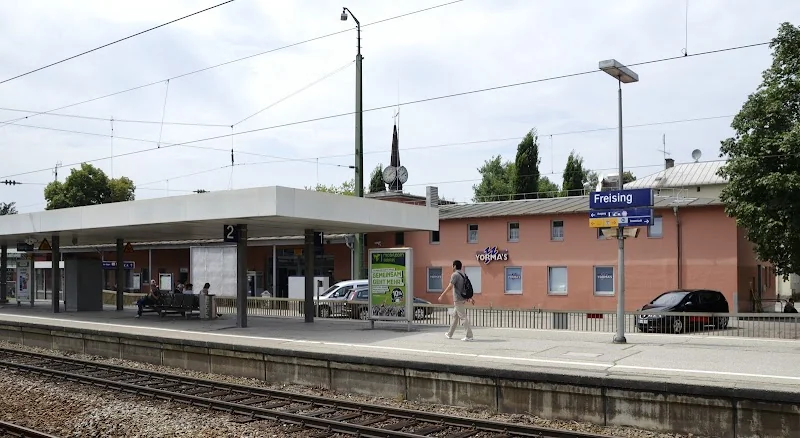
Freising
85354 Freising, Deutschland
Freising Station | Timetable & Parking
The Freising Station is centrally located at Bahnhofsplatz 4 in 85354 Freising and is the most important starting point for many routes in the city. On the official DB site, travelers can find live departures and arrivals, timetables as PDF, information about replacement services, elevators, and orientation plans for the station, platform, and surroundings. Additionally, the site has toilets, bicycle parking, and a taxi stand; the station itself is not staffed but can be well utilized through the DB Travel Center and the Video Travel Center. For a quick coffee, snack, newspaper, or a short service stop, there are several offerings in the building, including a bakery, press, gastronomy, and a 24-hour toilet center. This makes the location interesting not only for commuters but also for visitors arriving in Freising, transferring, or having little time but still needing clear orientation. ([bahnhof.de](https://www.bahnhof.de/freising))
Timetable, Arrival, and Platforms at Freising Station
Freising is very well connected: The city is located on the Munich – Regensburg railway line, and in addition to the S-Bahn, numerous regional trains operate at the station. According to the city, Munich Hbf can be reached from Freising more than 40 times a day in just 27 minutes. The city also mentions direct connections to Landshut, Regensburg, Passau, Nuremberg, and Prague. This shows why the station is much more than just a local stop. For commuters, it is the quick way into the Munich area, and for travelers from other regions, it is a hub between the airport, Upper Bavaria, Lower Bavaria, and the regional network. Those planning their stay should keep an eye on the regular timetables, as Freising is heavily focused on scheduled traffic and different types of trains. Therefore, the official station site not only offers live departures but also PDF timetables and information about replacement services. This is particularly valuable in case of last-minute changes, as one can quickly see whether the connection is via S-Bahn, regional train, or requires a transfer. ([freising.de](https://www.freising.de/leben-wohnen/mobilitaet-verkehrswende/oeffentlicher-nahverkehr))
Regarding platforms, the situation in Freising is similar to many well-frequented stations: The specific platform depends on the type of train, time of day, and timetable situation. The regular timetable of DB includes the respective platform information directly with the departures, and in the current documents, different platforms are indicated depending on the connection. This is particularly important because Freising bundles both S-Bahn and regional traffic. Therefore, those using the station for the first time will find the right position most quickly through live departures, PDF timetables, and the platform orientation plan. DB explicitly provides these orientation aids, including a map, platform, and surrounding area layout plan, as well as information about possible elevators. It is also practical that the orientation does not remain only on paper: Those leaving the train or needing to transfer can directly compare the current platform situation on-site with the digital displays. This keeps the station clear, even when departures are delayed or a platform change is necessary. For all those who frequently commute between Munich, the airport, and regional destinations, this mix of digital display and clear planning structure is a real advantage. ([bahnhof.de](https://www.bahnhof.de/downloads/schedule/Regeltafel_1908.pdf))
Parking and Access: How to Reach the Station Stress-Free
For drivers, DB mentions an open parking option at Münchner Straße 2 with a total of 4 parking spaces at Freising Station. This is especially helpful for short stops, pickups, or small errands when one does not want to search longer in the station area. For those needing more options, additional offerings can be found in the vicinity: The city of Freising refers to a Park & Ride option at the station as well as other parking garages and spaces in the city center. This makes the station well integrated for quick transfers as well as visits to the old town. Those wishing to park digitally can use the Parkster app according to the city; at the same time, the machines and classic payment methods remain available. This mix is convenient for everyday life, as one can flexibly choose between short-term parking, P&R, and city center garage depending on duration and destination. Especially at a station that connects commuter traffic and city visits, this variety is more important than a single large parking garage directly in front of the entrance. ([bahnhof.de](https://www.bahnhof.de/freising/parkplaetze))
The station is also very well integrated into the city on foot. The barrier-free route of the city of Freising starts at Bahnhofsplatz, initially leads about 70 meters to Münchner Straße, then over Bahnhofstraße about 400 meters to Obere Hauptstraße, and from there another approximately 170 meters to the center. The maximum incline is 2 percent, averaging 0 percent, making the path manageable even with luggage or for people with limited mobility. Those wishing to go further to Domberg will also find a specific route with clear distances. However, it is important to keep an eye on the current situation for bus travel: During construction work in the Münchner Straße area, several lines are temporarily diverted or partially taken out of service. Therefore, those combining bus and train travel should briefly check which line is currently operating before the trip. This is especially useful for day visitors who want to connect the station, old town, and cultural destinations in one visit. ([freising.de](https://www.freising.de/rathaus/stadtentwicklung/barrierefreie-wegfuehrung/bahnhof-freising?utm_source=openai))
Opening Hours, Ticket Counter, and DB Travel Center
Those needing tickets, reservations, or information at Freising Station usually use the DB Travel Center. According to the official DB site, it is open Monday to Friday from 07:00 to 18:30, Saturday from 08:00 to 13:30, and closed on Sundays and holidays. Accepted payment methods include cash, Girocard, MasterCard, Visa, and American Express. In the Travel Center, you can obtain tickets and reservations until shortly before departure, time tickets and DB monthly tickets on subscription, as well as information about BahnCard offers and national and international timetables. This is particularly helpful when it comes to connection questions, seat requests, or a last-minute change of travel plans. Unlike purely digital stations, travelers have a point of contact on-site that combines classic counter service with personal advice. For many users, this is the difference between merely purchasing a ticket and real travel accompaniment, especially when several people, luggage, or transfers need to be coordinated. ([bahnhof.de](https://www.bahnhof.de/freising/reisen/db-reisezentrum))
In addition to the Travel Center, there is a Video Travel Center in Freising, where personal advice via video conference is possible. The hours are weekdays from 07:00 to 20:00 and on weekends and holidays from 08:00 to 18:00. It is important that the station itself is not staffed: There is no classic station staff on-site, but the most important travel and service channels are still accessible. The nearest stations with mobile service staff, according to DB, are Munich Airport, Munich Marienplatz, Munich Hbf, and Munich Ost. Those with general questions about service, safety, or cleanliness can also contact the 3-S-Central Munich Hbf. Thus, while the station is not permanently staffed, it is clearly integrated into central DB service chains. This is reassuring for travelers because even in case of problems, the paths to help, advice, and contact are not far away. ([bahnhof.de](https://www.bahnhof.de/freising))
For finding a ticket counter or a phone number, the correct order is therefore crucial: First the DB travel information, then the Travel Center, then the central service channels. DB does not publish a specific station phone number for Freising. Instead, the general station feedback number and the 3-S-Central take over the classic contact function, while the Travel Center covers ticket and fare topics. Those departing early in the morning or spontaneously coming to Freising on the weekend can still plan reliably because the most important service hours are clearly defined and do not depend on local counter staffing. ([bahnhof.de](https://www.bahnhof.de/freising))
Food, Magazines, and Small Services On-Site
Regarding food and press, Freising Station is better equipped than one might expect at a smaller regional station. Currently, four offerings are listed on bahnhof.de. YORMA'S is a bakery with coffee, baguettes, salads, fruits, drinks, and snacks and has very long opening hours on weekdays. Ganter Presse & Buch complements the offering with press, books, sweets, drinks, cards, lottery, and small gift items. This is particularly practical for commuters, as travel needs and everyday small items can be taken care of directly at the station. Those needing a newspaper, a small gift, or a light breakfast on the way to the train do not have to detour into the city center. The mix of baked goods, press, and travel articles makes the location practical and quickly usable without long searching. ([bahnhof.de](https://www.bahnhof.de/freising/einkaufen-und-essen/yormas?utm_source=openai))
For hunger on the go, there is also POMMES FREUNDE at platform 1, which is open daily and brings a more modern snack character to the station world with fresh snacks, burgers, and fries. This is complemented by a rail&fresh WC-Center, which is accessible around the clock and covers the sanitary area at the station. Together, this creates a very everyday-friendly picture: coffee, newspapers, small snacks, and toilets are bundled in one place. This makes Freising Station significantly more comfortable for short stops, longer waiting times, and early departures than a purely functional stop. So, if you just want to quickly grab something in the morning or need a snack after arrival, you will find a compact but meaningful offering at the station. ([bahnhof.de](https://www.bahnhof.de/freising/einkaufen-und-essen/pommes-freunde?utm_source=openai))
The opening hours of these shops are also designed for short distances: YORMA'S opens on weekdays at 05:00 and stays open until 22:00, on weekends from 07:00 to 21:00. Ganter Presse & Buch starts on weekdays at 05:30, Saturdays at 06:30, and Sundays at 08:00; the store remains open until 19:30 each time. POMMES FREUNDE is available from Monday to Sunday from 10:00 to 22:00, but closed on holidays. This means the station's offerings fit well with the early and late train times that characterize Freising as a commuter and transfer station. This is not only convenient but also realistically tailored to the usage at the location. Those needing coffee before the first connection or arriving late after the evening commute thus have several reliable points of contact at Freising Station. ([bahnhof.de](https://www.bahnhof.de/freising/einkaufen-und-essen/yormas?utm_source=openai))
Lockers, Luggage Storage, and Accessibility
Many travelers specifically look for lockers or luggage storage at Freising Station. However, such offerings are not listed on the official DB station page for Freising. This is an important difference: While toilets, bicycle parking, taxi, parking, Wi-Fi, and the orientation plan are clearly mentioned, lockers do not appear in the service overview. Therefore, those relying on a classic luggage storage should plan an alternative solution in advance and not assume that such a service is spontaneously available at the station itself. This clarity is useful for frequent train travelers as it keeps expectations for the location realistic and avoids unnecessary searching. The station focuses more on basic services, clarity, and quick accessibility than on a broad infrastructure for longer storage. ([bahnhof.de](https://www.bahnhof.de/freising))
On the other hand, accessibility is much better documented. DB offers an orientation plan for the station, platform, and surroundings, as well as information about elevators and accessibility. The Mobility Service Center answers questions about accessibility, takes support requests, and books tickets and reservations if needed. For the way into the city center, the city of Freising has also published a barrier-free route that has a maximum incline of 2 percent. The interplay of train and city information is valuable because travelers can not only find the platform but also better plan the transition into the surroundings. This is a real advantage for people with strollers, heavy luggage, or limited mobility, as the station thus becomes not only a transfer point but also a well-connected starting point for the urban area. ([bahnhof.de](https://www.bahnhof.de/freising))
Additionally, the existing bicycle parking and taxi stand are particularly valuable at a station with commuter traffic. Those arriving by bike find an easy transfer option; those arriving late or traveling with heavy luggage can continue directly. Even if Freising does not need an extensive lounge infrastructure, the service mix of the station clearly shows the direction: pragmatic, easily accessible, and designed for quick routes. This mix is more important for most everyday situations than pompous equipment. The station is therefore particularly interesting for users who value function, orientation, and short distances. ([bahnhof.de](https://www.bahnhof.de/freising))
History and Location of Freising Station
The history of Freising Station begins with the railway expansion of the 19th century. According to the city's monument preservation report, Freising was connected to the railway between 1856 and 1858; by autumn 1858, the connection from Munich to Landshut was completed as the first section of the East Railway network. Due to the risk of flooding, the station had to be raised. The Freising station was fully completed in 1878 but soon proved to be too small. Thus, the location was early on more than just a stop: it became a traffic hub at a strategically important location south of the old town. This historical development also explains why the station is so closely linked to urban development today. It is no coincidence that it is located in an area that forms the transition between the railway, old town, and large-scale mobility. ([freising.de](https://www.freising.de/media/user_upload/61_Stadtplanung_Umwelt/Bauleitplanung/Sanierungsgebiet-Altstadt/plan-denkmalpflege-freising-teil1-bericht.pdf))
The city's report also states that the station lost its older structural stock due to destruction in 1944. At the same time, it points out that Freising received its own airport connection in 1992 because Munich Airport is only a few kilometers south of the historic old town. This explains why Freising plays an important role today not only for urban traffic but also for regional and long-distance traffic. The location between the old town, station, and airport is particularly exciting for visitors because train travel, city visits, and further mobility steps can be well connected. History, reconstruction, and modern transport connections intertwine here. Therefore, those looking closely at the station recognize not only a functional place but also a point where Freising's development has condensed over more than a century and a half. ([freising.de](https://www.freising.de/media/user_upload/61_Stadtplanung_Umwelt/Bauleitplanung/Sanierungsgebiet-Altstadt/plan-denkmalpflege-freising-teil1-bericht.pdf))
Today, the station is the central connection point of Freising. The city emphasizes that both S-Bahn connections and numerous regional trains run through the station and that there are direct connections to several major centers from there. For travelers, this means: The station is not a peripheral point but the control center between the city, district, airport, and the Munich area. Those visiting Freising for the first time often experience the typical mix of commuter dynamics, regional traffic, and short distances to the old town already at the station. This combination continues to shape the relevance of the location today. The station is thus not only a transport location but also a defining part of the urban landscape and daily movement in Freising. ([freising.de](https://www.freising.de/leben-wohnen/mobilitaet-verkehrswende/oeffentlicher-nahverkehr))
Sources:
Show moreShow less
Freising Station | Timetable & Parking
The Freising Station is centrally located at Bahnhofsplatz 4 in 85354 Freising and is the most important starting point for many routes in the city. On the official DB site, travelers can find live departures and arrivals, timetables as PDF, information about replacement services, elevators, and orientation plans for the station, platform, and surroundings. Additionally, the site has toilets, bicycle parking, and a taxi stand; the station itself is not staffed but can be well utilized through the DB Travel Center and the Video Travel Center. For a quick coffee, snack, newspaper, or a short service stop, there are several offerings in the building, including a bakery, press, gastronomy, and a 24-hour toilet center. This makes the location interesting not only for commuters but also for visitors arriving in Freising, transferring, or having little time but still needing clear orientation. ([bahnhof.de](https://www.bahnhof.de/freising))
Timetable, Arrival, and Platforms at Freising Station
Freising is very well connected: The city is located on the Munich – Regensburg railway line, and in addition to the S-Bahn, numerous regional trains operate at the station. According to the city, Munich Hbf can be reached from Freising more than 40 times a day in just 27 minutes. The city also mentions direct connections to Landshut, Regensburg, Passau, Nuremberg, and Prague. This shows why the station is much more than just a local stop. For commuters, it is the quick way into the Munich area, and for travelers from other regions, it is a hub between the airport, Upper Bavaria, Lower Bavaria, and the regional network. Those planning their stay should keep an eye on the regular timetables, as Freising is heavily focused on scheduled traffic and different types of trains. Therefore, the official station site not only offers live departures but also PDF timetables and information about replacement services. This is particularly valuable in case of last-minute changes, as one can quickly see whether the connection is via S-Bahn, regional train, or requires a transfer. ([freising.de](https://www.freising.de/leben-wohnen/mobilitaet-verkehrswende/oeffentlicher-nahverkehr))
Regarding platforms, the situation in Freising is similar to many well-frequented stations: The specific platform depends on the type of train, time of day, and timetable situation. The regular timetable of DB includes the respective platform information directly with the departures, and in the current documents, different platforms are indicated depending on the connection. This is particularly important because Freising bundles both S-Bahn and regional traffic. Therefore, those using the station for the first time will find the right position most quickly through live departures, PDF timetables, and the platform orientation plan. DB explicitly provides these orientation aids, including a map, platform, and surrounding area layout plan, as well as information about possible elevators. It is also practical that the orientation does not remain only on paper: Those leaving the train or needing to transfer can directly compare the current platform situation on-site with the digital displays. This keeps the station clear, even when departures are delayed or a platform change is necessary. For all those who frequently commute between Munich, the airport, and regional destinations, this mix of digital display and clear planning structure is a real advantage. ([bahnhof.de](https://www.bahnhof.de/downloads/schedule/Regeltafel_1908.pdf))
Parking and Access: How to Reach the Station Stress-Free
For drivers, DB mentions an open parking option at Münchner Straße 2 with a total of 4 parking spaces at Freising Station. This is especially helpful for short stops, pickups, or small errands when one does not want to search longer in the station area. For those needing more options, additional offerings can be found in the vicinity: The city of Freising refers to a Park & Ride option at the station as well as other parking garages and spaces in the city center. This makes the station well integrated for quick transfers as well as visits to the old town. Those wishing to park digitally can use the Parkster app according to the city; at the same time, the machines and classic payment methods remain available. This mix is convenient for everyday life, as one can flexibly choose between short-term parking, P&R, and city center garage depending on duration and destination. Especially at a station that connects commuter traffic and city visits, this variety is more important than a single large parking garage directly in front of the entrance. ([bahnhof.de](https://www.bahnhof.de/freising/parkplaetze))
The station is also very well integrated into the city on foot. The barrier-free route of the city of Freising starts at Bahnhofsplatz, initially leads about 70 meters to Münchner Straße, then over Bahnhofstraße about 400 meters to Obere Hauptstraße, and from there another approximately 170 meters to the center. The maximum incline is 2 percent, averaging 0 percent, making the path manageable even with luggage or for people with limited mobility. Those wishing to go further to Domberg will also find a specific route with clear distances. However, it is important to keep an eye on the current situation for bus travel: During construction work in the Münchner Straße area, several lines are temporarily diverted or partially taken out of service. Therefore, those combining bus and train travel should briefly check which line is currently operating before the trip. This is especially useful for day visitors who want to connect the station, old town, and cultural destinations in one visit. ([freising.de](https://www.freising.de/rathaus/stadtentwicklung/barrierefreie-wegfuehrung/bahnhof-freising?utm_source=openai))
Opening Hours, Ticket Counter, and DB Travel Center
Those needing tickets, reservations, or information at Freising Station usually use the DB Travel Center. According to the official DB site, it is open Monday to Friday from 07:00 to 18:30, Saturday from 08:00 to 13:30, and closed on Sundays and holidays. Accepted payment methods include cash, Girocard, MasterCard, Visa, and American Express. In the Travel Center, you can obtain tickets and reservations until shortly before departure, time tickets and DB monthly tickets on subscription, as well as information about BahnCard offers and national and international timetables. This is particularly helpful when it comes to connection questions, seat requests, or a last-minute change of travel plans. Unlike purely digital stations, travelers have a point of contact on-site that combines classic counter service with personal advice. For many users, this is the difference between merely purchasing a ticket and real travel accompaniment, especially when several people, luggage, or transfers need to be coordinated. ([bahnhof.de](https://www.bahnhof.de/freising/reisen/db-reisezentrum))
In addition to the Travel Center, there is a Video Travel Center in Freising, where personal advice via video conference is possible. The hours are weekdays from 07:00 to 20:00 and on weekends and holidays from 08:00 to 18:00. It is important that the station itself is not staffed: There is no classic station staff on-site, but the most important travel and service channels are still accessible. The nearest stations with mobile service staff, according to DB, are Munich Airport, Munich Marienplatz, Munich Hbf, and Munich Ost. Those with general questions about service, safety, or cleanliness can also contact the 3-S-Central Munich Hbf. Thus, while the station is not permanently staffed, it is clearly integrated into central DB service chains. This is reassuring for travelers because even in case of problems, the paths to help, advice, and contact are not far away. ([bahnhof.de](https://www.bahnhof.de/freising))
For finding a ticket counter or a phone number, the correct order is therefore crucial: First the DB travel information, then the Travel Center, then the central service channels. DB does not publish a specific station phone number for Freising. Instead, the general station feedback number and the 3-S-Central take over the classic contact function, while the Travel Center covers ticket and fare topics. Those departing early in the morning or spontaneously coming to Freising on the weekend can still plan reliably because the most important service hours are clearly defined and do not depend on local counter staffing. ([bahnhof.de](https://www.bahnhof.de/freising))
Food, Magazines, and Small Services On-Site
Regarding food and press, Freising Station is better equipped than one might expect at a smaller regional station. Currently, four offerings are listed on bahnhof.de. YORMA'S is a bakery with coffee, baguettes, salads, fruits, drinks, and snacks and has very long opening hours on weekdays. Ganter Presse & Buch complements the offering with press, books, sweets, drinks, cards, lottery, and small gift items. This is particularly practical for commuters, as travel needs and everyday small items can be taken care of directly at the station. Those needing a newspaper, a small gift, or a light breakfast on the way to the train do not have to detour into the city center. The mix of baked goods, press, and travel articles makes the location practical and quickly usable without long searching. ([bahnhof.de](https://www.bahnhof.de/freising/einkaufen-und-essen/yormas?utm_source=openai))
For hunger on the go, there is also POMMES FREUNDE at platform 1, which is open daily and brings a more modern snack character to the station world with fresh snacks, burgers, and fries. This is complemented by a rail&fresh WC-Center, which is accessible around the clock and covers the sanitary area at the station. Together, this creates a very everyday-friendly picture: coffee, newspapers, small snacks, and toilets are bundled in one place. This makes Freising Station significantly more comfortable for short stops, longer waiting times, and early departures than a purely functional stop. So, if you just want to quickly grab something in the morning or need a snack after arrival, you will find a compact but meaningful offering at the station. ([bahnhof.de](https://www.bahnhof.de/freising/einkaufen-und-essen/pommes-freunde?utm_source=openai))
The opening hours of these shops are also designed for short distances: YORMA'S opens on weekdays at 05:00 and stays open until 22:00, on weekends from 07:00 to 21:00. Ganter Presse & Buch starts on weekdays at 05:30, Saturdays at 06:30, and Sundays at 08:00; the store remains open until 19:30 each time. POMMES FREUNDE is available from Monday to Sunday from 10:00 to 22:00, but closed on holidays. This means the station's offerings fit well with the early and late train times that characterize Freising as a commuter and transfer station. This is not only convenient but also realistically tailored to the usage at the location. Those needing coffee before the first connection or arriving late after the evening commute thus have several reliable points of contact at Freising Station. ([bahnhof.de](https://www.bahnhof.de/freising/einkaufen-und-essen/yormas?utm_source=openai))
Lockers, Luggage Storage, and Accessibility
Many travelers specifically look for lockers or luggage storage at Freising Station. However, such offerings are not listed on the official DB station page for Freising. This is an important difference: While toilets, bicycle parking, taxi, parking, Wi-Fi, and the orientation plan are clearly mentioned, lockers do not appear in the service overview. Therefore, those relying on a classic luggage storage should plan an alternative solution in advance and not assume that such a service is spontaneously available at the station itself. This clarity is useful for frequent train travelers as it keeps expectations for the location realistic and avoids unnecessary searching. The station focuses more on basic services, clarity, and quick accessibility than on a broad infrastructure for longer storage. ([bahnhof.de](https://www.bahnhof.de/freising))
On the other hand, accessibility is much better documented. DB offers an orientation plan for the station, platform, and surroundings, as well as information about elevators and accessibility. The Mobility Service Center answers questions about accessibility, takes support requests, and books tickets and reservations if needed. For the way into the city center, the city of Freising has also published a barrier-free route that has a maximum incline of 2 percent. The interplay of train and city information is valuable because travelers can not only find the platform but also better plan the transition into the surroundings. This is a real advantage for people with strollers, heavy luggage, or limited mobility, as the station thus becomes not only a transfer point but also a well-connected starting point for the urban area. ([bahnhof.de](https://www.bahnhof.de/freising))
Additionally, the existing bicycle parking and taxi stand are particularly valuable at a station with commuter traffic. Those arriving by bike find an easy transfer option; those arriving late or traveling with heavy luggage can continue directly. Even if Freising does not need an extensive lounge infrastructure, the service mix of the station clearly shows the direction: pragmatic, easily accessible, and designed for quick routes. This mix is more important for most everyday situations than pompous equipment. The station is therefore particularly interesting for users who value function, orientation, and short distances. ([bahnhof.de](https://www.bahnhof.de/freising))
History and Location of Freising Station
The history of Freising Station begins with the railway expansion of the 19th century. According to the city's monument preservation report, Freising was connected to the railway between 1856 and 1858; by autumn 1858, the connection from Munich to Landshut was completed as the first section of the East Railway network. Due to the risk of flooding, the station had to be raised. The Freising station was fully completed in 1878 but soon proved to be too small. Thus, the location was early on more than just a stop: it became a traffic hub at a strategically important location south of the old town. This historical development also explains why the station is so closely linked to urban development today. It is no coincidence that it is located in an area that forms the transition between the railway, old town, and large-scale mobility. ([freising.de](https://www.freising.de/media/user_upload/61_Stadtplanung_Umwelt/Bauleitplanung/Sanierungsgebiet-Altstadt/plan-denkmalpflege-freising-teil1-bericht.pdf))
The city's report also states that the station lost its older structural stock due to destruction in 1944. At the same time, it points out that Freising received its own airport connection in 1992 because Munich Airport is only a few kilometers south of the historic old town. This explains why Freising plays an important role today not only for urban traffic but also for regional and long-distance traffic. The location between the old town, station, and airport is particularly exciting for visitors because train travel, city visits, and further mobility steps can be well connected. History, reconstruction, and modern transport connections intertwine here. Therefore, those looking closely at the station recognize not only a functional place but also a point where Freising's development has condensed over more than a century and a half. ([freising.de](https://www.freising.de/media/user_upload/61_Stadtplanung_Umwelt/Bauleitplanung/Sanierungsgebiet-Altstadt/plan-denkmalpflege-freising-teil1-bericht.pdf))
Today, the station is the central connection point of Freising. The city emphasizes that both S-Bahn connections and numerous regional trains run through the station and that there are direct connections to several major centers from there. For travelers, this means: The station is not a peripheral point but the control center between the city, district, airport, and the Munich area. Those visiting Freising for the first time often experience the typical mix of commuter dynamics, regional traffic, and short distances to the old town already at the station. This combination continues to shape the relevance of the location today. The station is thus not only a transport location but also a defining part of the urban landscape and daily movement in Freising. ([freising.de](https://www.freising.de/leben-wohnen/mobilitaet-verkehrswende/oeffentlicher-nahverkehr))
Sources:
Freising Station | Timetable & Parking
The Freising Station is centrally located at Bahnhofsplatz 4 in 85354 Freising and is the most important starting point for many routes in the city. On the official DB site, travelers can find live departures and arrivals, timetables as PDF, information about replacement services, elevators, and orientation plans for the station, platform, and surroundings. Additionally, the site has toilets, bicycle parking, and a taxi stand; the station itself is not staffed but can be well utilized through the DB Travel Center and the Video Travel Center. For a quick coffee, snack, newspaper, or a short service stop, there are several offerings in the building, including a bakery, press, gastronomy, and a 24-hour toilet center. This makes the location interesting not only for commuters but also for visitors arriving in Freising, transferring, or having little time but still needing clear orientation. ([bahnhof.de](https://www.bahnhof.de/freising))
Timetable, Arrival, and Platforms at Freising Station
Freising is very well connected: The city is located on the Munich – Regensburg railway line, and in addition to the S-Bahn, numerous regional trains operate at the station. According to the city, Munich Hbf can be reached from Freising more than 40 times a day in just 27 minutes. The city also mentions direct connections to Landshut, Regensburg, Passau, Nuremberg, and Prague. This shows why the station is much more than just a local stop. For commuters, it is the quick way into the Munich area, and for travelers from other regions, it is a hub between the airport, Upper Bavaria, Lower Bavaria, and the regional network. Those planning their stay should keep an eye on the regular timetables, as Freising is heavily focused on scheduled traffic and different types of trains. Therefore, the official station site not only offers live departures but also PDF timetables and information about replacement services. This is particularly valuable in case of last-minute changes, as one can quickly see whether the connection is via S-Bahn, regional train, or requires a transfer. ([freising.de](https://www.freising.de/leben-wohnen/mobilitaet-verkehrswende/oeffentlicher-nahverkehr))
Regarding platforms, the situation in Freising is similar to many well-frequented stations: The specific platform depends on the type of train, time of day, and timetable situation. The regular timetable of DB includes the respective platform information directly with the departures, and in the current documents, different platforms are indicated depending on the connection. This is particularly important because Freising bundles both S-Bahn and regional traffic. Therefore, those using the station for the first time will find the right position most quickly through live departures, PDF timetables, and the platform orientation plan. DB explicitly provides these orientation aids, including a map, platform, and surrounding area layout plan, as well as information about possible elevators. It is also practical that the orientation does not remain only on paper: Those leaving the train or needing to transfer can directly compare the current platform situation on-site with the digital displays. This keeps the station clear, even when departures are delayed or a platform change is necessary. For all those who frequently commute between Munich, the airport, and regional destinations, this mix of digital display and clear planning structure is a real advantage. ([bahnhof.de](https://www.bahnhof.de/downloads/schedule/Regeltafel_1908.pdf))
Parking and Access: How to Reach the Station Stress-Free
For drivers, DB mentions an open parking option at Münchner Straße 2 with a total of 4 parking spaces at Freising Station. This is especially helpful for short stops, pickups, or small errands when one does not want to search longer in the station area. For those needing more options, additional offerings can be found in the vicinity: The city of Freising refers to a Park & Ride option at the station as well as other parking garages and spaces in the city center. This makes the station well integrated for quick transfers as well as visits to the old town. Those wishing to park digitally can use the Parkster app according to the city; at the same time, the machines and classic payment methods remain available. This mix is convenient for everyday life, as one can flexibly choose between short-term parking, P&R, and city center garage depending on duration and destination. Especially at a station that connects commuter traffic and city visits, this variety is more important than a single large parking garage directly in front of the entrance. ([bahnhof.de](https://www.bahnhof.de/freising/parkplaetze))
The station is also very well integrated into the city on foot. The barrier-free route of the city of Freising starts at Bahnhofsplatz, initially leads about 70 meters to Münchner Straße, then over Bahnhofstraße about 400 meters to Obere Hauptstraße, and from there another approximately 170 meters to the center. The maximum incline is 2 percent, averaging 0 percent, making the path manageable even with luggage or for people with limited mobility. Those wishing to go further to Domberg will also find a specific route with clear distances. However, it is important to keep an eye on the current situation for bus travel: During construction work in the Münchner Straße area, several lines are temporarily diverted or partially taken out of service. Therefore, those combining bus and train travel should briefly check which line is currently operating before the trip. This is especially useful for day visitors who want to connect the station, old town, and cultural destinations in one visit. ([freising.de](https://www.freising.de/rathaus/stadtentwicklung/barrierefreie-wegfuehrung/bahnhof-freising?utm_source=openai))
Opening Hours, Ticket Counter, and DB Travel Center
Those needing tickets, reservations, or information at Freising Station usually use the DB Travel Center. According to the official DB site, it is open Monday to Friday from 07:00 to 18:30, Saturday from 08:00 to 13:30, and closed on Sundays and holidays. Accepted payment methods include cash, Girocard, MasterCard, Visa, and American Express. In the Travel Center, you can obtain tickets and reservations until shortly before departure, time tickets and DB monthly tickets on subscription, as well as information about BahnCard offers and national and international timetables. This is particularly helpful when it comes to connection questions, seat requests, or a last-minute change of travel plans. Unlike purely digital stations, travelers have a point of contact on-site that combines classic counter service with personal advice. For many users, this is the difference between merely purchasing a ticket and real travel accompaniment, especially when several people, luggage, or transfers need to be coordinated. ([bahnhof.de](https://www.bahnhof.de/freising/reisen/db-reisezentrum))
In addition to the Travel Center, there is a Video Travel Center in Freising, where personal advice via video conference is possible. The hours are weekdays from 07:00 to 20:00 and on weekends and holidays from 08:00 to 18:00. It is important that the station itself is not staffed: There is no classic station staff on-site, but the most important travel and service channels are still accessible. The nearest stations with mobile service staff, according to DB, are Munich Airport, Munich Marienplatz, Munich Hbf, and Munich Ost. Those with general questions about service, safety, or cleanliness can also contact the 3-S-Central Munich Hbf. Thus, while the station is not permanently staffed, it is clearly integrated into central DB service chains. This is reassuring for travelers because even in case of problems, the paths to help, advice, and contact are not far away. ([bahnhof.de](https://www.bahnhof.de/freising))
For finding a ticket counter or a phone number, the correct order is therefore crucial: First the DB travel information, then the Travel Center, then the central service channels. DB does not publish a specific station phone number for Freising. Instead, the general station feedback number and the 3-S-Central take over the classic contact function, while the Travel Center covers ticket and fare topics. Those departing early in the morning or spontaneously coming to Freising on the weekend can still plan reliably because the most important service hours are clearly defined and do not depend on local counter staffing. ([bahnhof.de](https://www.bahnhof.de/freising))
Food, Magazines, and Small Services On-Site
Regarding food and press, Freising Station is better equipped than one might expect at a smaller regional station. Currently, four offerings are listed on bahnhof.de. YORMA'S is a bakery with coffee, baguettes, salads, fruits, drinks, and snacks and has very long opening hours on weekdays. Ganter Presse & Buch complements the offering with press, books, sweets, drinks, cards, lottery, and small gift items. This is particularly practical for commuters, as travel needs and everyday small items can be taken care of directly at the station. Those needing a newspaper, a small gift, or a light breakfast on the way to the train do not have to detour into the city center. The mix of baked goods, press, and travel articles makes the location practical and quickly usable without long searching. ([bahnhof.de](https://www.bahnhof.de/freising/einkaufen-und-essen/yormas?utm_source=openai))
For hunger on the go, there is also POMMES FREUNDE at platform 1, which is open daily and brings a more modern snack character to the station world with fresh snacks, burgers, and fries. This is complemented by a rail&fresh WC-Center, which is accessible around the clock and covers the sanitary area at the station. Together, this creates a very everyday-friendly picture: coffee, newspapers, small snacks, and toilets are bundled in one place. This makes Freising Station significantly more comfortable for short stops, longer waiting times, and early departures than a purely functional stop. So, if you just want to quickly grab something in the morning or need a snack after arrival, you will find a compact but meaningful offering at the station. ([bahnhof.de](https://www.bahnhof.de/freising/einkaufen-und-essen/pommes-freunde?utm_source=openai))
The opening hours of these shops are also designed for short distances: YORMA'S opens on weekdays at 05:00 and stays open until 22:00, on weekends from 07:00 to 21:00. Ganter Presse & Buch starts on weekdays at 05:30, Saturdays at 06:30, and Sundays at 08:00; the store remains open until 19:30 each time. POMMES FREUNDE is available from Monday to Sunday from 10:00 to 22:00, but closed on holidays. This means the station's offerings fit well with the early and late train times that characterize Freising as a commuter and transfer station. This is not only convenient but also realistically tailored to the usage at the location. Those needing coffee before the first connection or arriving late after the evening commute thus have several reliable points of contact at Freising Station. ([bahnhof.de](https://www.bahnhof.de/freising/einkaufen-und-essen/yormas?utm_source=openai))
Lockers, Luggage Storage, and Accessibility
Many travelers specifically look for lockers or luggage storage at Freising Station. However, such offerings are not listed on the official DB station page for Freising. This is an important difference: While toilets, bicycle parking, taxi, parking, Wi-Fi, and the orientation plan are clearly mentioned, lockers do not appear in the service overview. Therefore, those relying on a classic luggage storage should plan an alternative solution in advance and not assume that such a service is spontaneously available at the station itself. This clarity is useful for frequent train travelers as it keeps expectations for the location realistic and avoids unnecessary searching. The station focuses more on basic services, clarity, and quick accessibility than on a broad infrastructure for longer storage. ([bahnhof.de](https://www.bahnhof.de/freising))
On the other hand, accessibility is much better documented. DB offers an orientation plan for the station, platform, and surroundings, as well as information about elevators and accessibility. The Mobility Service Center answers questions about accessibility, takes support requests, and books tickets and reservations if needed. For the way into the city center, the city of Freising has also published a barrier-free route that has a maximum incline of 2 percent. The interplay of train and city information is valuable because travelers can not only find the platform but also better plan the transition into the surroundings. This is a real advantage for people with strollers, heavy luggage, or limited mobility, as the station thus becomes not only a transfer point but also a well-connected starting point for the urban area. ([bahnhof.de](https://www.bahnhof.de/freising))
Additionally, the existing bicycle parking and taxi stand are particularly valuable at a station with commuter traffic. Those arriving by bike find an easy transfer option; those arriving late or traveling with heavy luggage can continue directly. Even if Freising does not need an extensive lounge infrastructure, the service mix of the station clearly shows the direction: pragmatic, easily accessible, and designed for quick routes. This mix is more important for most everyday situations than pompous equipment. The station is therefore particularly interesting for users who value function, orientation, and short distances. ([bahnhof.de](https://www.bahnhof.de/freising))
History and Location of Freising Station
The history of Freising Station begins with the railway expansion of the 19th century. According to the city's monument preservation report, Freising was connected to the railway between 1856 and 1858; by autumn 1858, the connection from Munich to Landshut was completed as the first section of the East Railway network. Due to the risk of flooding, the station had to be raised. The Freising station was fully completed in 1878 but soon proved to be too small. Thus, the location was early on more than just a stop: it became a traffic hub at a strategically important location south of the old town. This historical development also explains why the station is so closely linked to urban development today. It is no coincidence that it is located in an area that forms the transition between the railway, old town, and large-scale mobility. ([freising.de](https://www.freising.de/media/user_upload/61_Stadtplanung_Umwelt/Bauleitplanung/Sanierungsgebiet-Altstadt/plan-denkmalpflege-freising-teil1-bericht.pdf))
The city's report also states that the station lost its older structural stock due to destruction in 1944. At the same time, it points out that Freising received its own airport connection in 1992 because Munich Airport is only a few kilometers south of the historic old town. This explains why Freising plays an important role today not only for urban traffic but also for regional and long-distance traffic. The location between the old town, station, and airport is particularly exciting for visitors because train travel, city visits, and further mobility steps can be well connected. History, reconstruction, and modern transport connections intertwine here. Therefore, those looking closely at the station recognize not only a functional place but also a point where Freising's development has condensed over more than a century and a half. ([freising.de](https://www.freising.de/media/user_upload/61_Stadtplanung_Umwelt/Bauleitplanung/Sanierungsgebiet-Altstadt/plan-denkmalpflege-freising-teil1-bericht.pdf))
Today, the station is the central connection point of Freising. The city emphasizes that both S-Bahn connections and numerous regional trains run through the station and that there are direct connections to several major centers from there. For travelers, this means: The station is not a peripheral point but the control center between the city, district, airport, and the Munich area. Those visiting Freising for the first time often experience the typical mix of commuter dynamics, regional traffic, and short distances to the old town already at the station. This combination continues to shape the relevance of the location today. The station is thus not only a transport location but also a defining part of the urban landscape and daily movement in Freising. ([freising.de](https://www.freising.de/leben-wohnen/mobilitaet-verkehrswende/oeffentlicher-nahverkehr))
Sources:
Frequently Asked Questions
Reviews
No reviews found