
Freising
Domberg 36, 85354 Freising, Deutschland
Cathedral of St. Mary and St. Korbinian | Photos & Directions
The Cathedral of St. Mary and St. Korbinian is much more than a landmark of Freising: it is a co-cathedral, the spiritual center of the cathedral hill, and a place where architecture, liturgy, music, and city history come together to this day. Those looking for photos, impressions, or reliable orientation will find here a building that impresses from the outside with its towers, its portal, and its location above the city, and surprises inside with artworks, a crypt, and baroque design. A visit is worthwhile for both culture-interested guests and for anyone wanting to experience the cathedral hill as a special viewpoint and historical urban space. Particularly pleasant is that the cathedral is embedded in an ensemble of other facilities, making it easy to combine with a walk over the hill. For arrival, the S1, the footpath from the train station, the funicular, and several parking options are available, ensuring that the visit remains well-planned despite the elevated location. ([freisinger-dom.de](https://www.freisinger-dom.de/stellenangebote/?utm_source=openai))
Photos and First Impressions of the Freising Cathedral
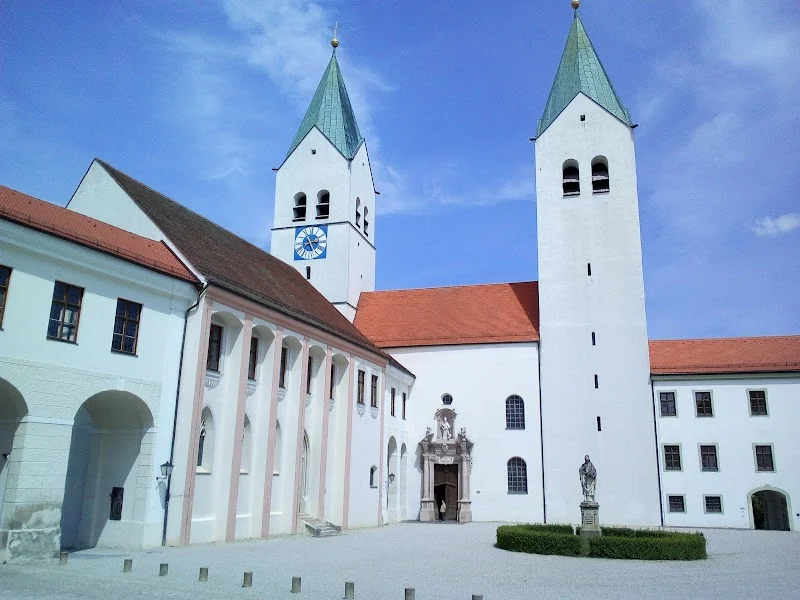
Those looking for photos of the Cathedral of St. Mary and St. Korbinian quickly discover why this place is among the most striking buildings in Upper Bavaria. Even the exterior conveys presence: the massive towers dominate the cathedral hill, the baroque portal is attached to the westwork, and the figure of St. Korbinian stands in the broken gable. At the same time, the round arch portal with its Romanesque form language points to the long construction history. This very contrast between medieval structure and later modifications makes the cathedral photogenic, as it provides not just a single motif, but many image axes: towers, portal, forecourt, cathedral square, and the view of the plateau. The path up to the cathedral hill is also part of the experience, as the building gradually detaches itself from the urban space and unfolds its effect as a spiritual center. ([freisinger-dom.de](https://www.freisinger-dom.de/architektur/))
Inside, this impression continues, only much finer and richer in art history. The delicate stucco work of the Asam brothers, the ceiling design, the high altar painting in the tradition of Peter Paul Rubens, and the Gothic choir create a tension field of brilliance, color, and depth. For photos and visual impressions, this is particularly appealing, as different epochs overlap in the same space: Romanesque starting form, Gothic spatial effect, baroque furnishings, and later restorations. The official presentation emphasizes this aesthetic richness and describes the interior as a unique interplay of art and architecture. Those who want to see the cathedral not only as a religious place but as a visual total work of art should take their time to notice details in the choir, on the walls, and in the forecourt. This makes it understandable why the cathedral hill in Freising is a worthwhile destination not only for pilgrims and believers but also for people interested in architecture and visual language. ([tourismus.freising.de](https://tourismus.freising.de/en/sights/domberg-cathedral-hill/st-marys-cathedral))
The special charm of the exterior view should not be underestimated either. The cathedral appears differently from several viewpoints: frontally monumental, laterally compact, representative from the cathedral square, and from a distance almost like a crown over the city. This variability is an important reason why the search for photos and impressions is so often associated with the cathedral hill. The official tourism presentation speaks of the characteristic towers as a monument of faith and a symbol of hope, while the architectural side emphasizes the medieval effect of the building despite many renovations. For visitors, this means: the cathedral is not just an object to look at, but a place where light, perspective, and materiality constantly create new impressions. Those who want to understand the atmosphere should view the building at different times of the day and also include the view from above on the cathedral hill, as the location above the old town enhances the special effect of the ensemble. ([tourismus.freising.de](https://tourismus.freising.de/en/sights/domberg-cathedral-hill/st-marys-cathedral))
History of the Cathedral of St. Mary and St. Korbinian
The history of the Freising Cathedral reaches deep into Bavarian church history. The present church stands on a site where a Marian church has existed since the early 8th century; later, it became the cathedral church on the cathedral hill. The official presentation also points out that the current cathedral was built in the 9th century. A devastating fire destroyed the cathedral and the city in 1159, after which the larger successor building was constructed, which has seen numerous stylistic epochs since the High Middle Ages. Therefore, those visiting the cathedral today see no building from a single time, but a grown monument in which Romanesque, Gothic, Baroque, and later interventions intertwine. This layering makes the building history so worthwhile to read and explains why the cathedral can be perceived not only as a church but also as a historical archive of stone. ([tourismus.freising.de](https://tourismus.freising.de/en/sights/domberg-cathedral-hill/st-marys-cathedral))
Particularly formative was the baroque redesign in the 18th century. For the thousand-year celebration of the diocese in 1724, the church was newly equipped with stucco and frescoes, and for this, the Asam brothers, who were among the most important artists of old Bavaria at the time, were brought in. The high altar painting also has a remarkable history: Prince-Bishop Veit Adam von Gepeckh commissioned a painting from Peter Paul Rubens in the 17th century, depicting the end-time church in the form of the apocalyptic woman while honoring Mary as the patroness of the cathedral. The original is now in the Alte Pinakothek in Munich; a copy from 1926 can be seen in the cathedral. The connection between prince-bishops, art politics, and spiritual aspirations explains why the cathedral stands out not only liturgically but also culturally historically. Additionally, the massive cathedral towers have preserved their medieval appearance despite many renovations, and the baroque portal from 1681 gives the westwork a representative order. Thus, the building itself becomes a visible memory of the city and the diocese. ([tourismus.freising.de](https://tourismus.freising.de/en/sights/domberg-cathedral-hill/st-marys-cathedral))
An important historical reference point is also St. Korbinian. The Freising representation of the cathedral closely connects the place with the founder of the diocese, whose relics are venerated in the crypt and in the cathedral. The city of Freising explains in its tours and thematic walks that Korbinian continues to shape the history and image of the city to this day. This makes it clear that the cathedral cannot be viewed in isolation: it belongs to a larger historical network of cathedral hill, city history, veneration of saints, and promotion of art. For visitors seeking background knowledge, this connection is crucial, as it explains why the Cathedral of St. Mary and St. Korbinian is known far beyond Freising. It is a building that makes the changes of the centuries visible while simultaneously forming a vibrant religious center. ([freising.de](https://www.freising.de/rathaus/thema-des-monats/auf-korbinians-spuren-durch-freising?utm_source=openai))
Crypt, Beast Column, and Korbinian Shrine
Among the most impressive areas of the Freising Cathedral is the Romanesque crypt. It was begun with the new construction of the cathedral in 1159 and still forms the spiritual center of the Mary Cathedral today. In 2023 and 2024, the crypt was extensively renovated and has since presented itself in fresh condition. This makes this part of the building not only historically significant but also particularly pleasant as a place to visit. In the crypt, the relics of the founder of the diocese, Korbinian, rest in a precious shrine on a massive stone sarcophagus. Additionally, there are other relics, such as the shrine of St. Lantpert and the burial place of St. Nonnosus. For those interested in sacred spaces, the crypt is therefore more than a basement: it is the place where memory, veneration, and architecture meet directly. ([tourismus.freising.de](https://tourismus.freising.de/sehenswert/domberg/mariendom.html))
Particularly famous is the so-called Beast Column. It is considered a design highlight and is described as a unique feature in Central Europe. It depicts knights in battle with dragon-like creatures, while on the east side, a female figure with a flower towers over the combatants. The imagery connects the medieval narrative world, Christian interpretation, and a strong symbolic condensation of good and evil. Thus, the column becomes not only an art-historical object but also a key to understanding the space of the crypt as a whole. Those visiting the cathedral should not treat this area as a mere side attraction but as one of the most important reasons why the Freising Cathedral stands out culturally historically. The combination of Romanesque architecture, plastic imagery, and liturgical significance is extraordinarily dense and makes the crypt one of those places where the centuries overlap like layers. ([tourismus.freising.de](https://tourismus.freising.de/sehenswert/domberg/mariendom.html))
Connected to the crypt is also the Maximilian Chapel, where the Korbinian shrine is now venerated. The shrine was commissioned after the rescue of the relics during the secularization in 1861 and was made in the neo-Gothic style by Ferdinand von Harrach. On the long sides, Korbinian and Sigismund appear among other saints associated with the cathedral or the Archdiocese of Munich and Freising. For many visitors, this spot is precisely the emotional core of the tour, as here the history of the saint and the identity of the place converge. Those searching for Korbinian, his role for Freising, and the visible traces of his veneration will find the most concentrated answers in the crypt and chapel. The official page of the cathedral foundation explicitly recommends these areas as highlights of a tour, further emphasizing their prominent position. ([freising.de](https://www.freisinger-dom.de/kunstwerke/))
Directions, Parking, and Barrier-Free Access at the Cathedral Hill
The directions to the Cathedral of St. Mary and St. Korbinian are well described and comparatively easy to plan for visitors. You can reach Freising via the S1 from Munich; from the train station, it is about a 15-minute walk up to the cathedral hill. Those who do not wish to walk or rely on barrier-free access can use the funicular or the cathedral hill railway, which leads from the Bahnhofstraße area to the cathedral hill plateau. This connection is particularly important because the cathedral hill, as an elevated urban area, is a topographically special place that has nevertheless been made accessible to as many people as possible. The city of Freising explicitly describes the elevator as a fast, comfortable, and barrier-free way to reach the buildings and institutions there. Thus, the cathedral is well connected not only as a historical site but also as a practical place to visit. ([freisinger-dom.de](https://www.freisinger-dom.de/anfahrt/?utm_source=openai))
When it comes to parking, the city points out that there are several options in the old town and surrounding area. Among others, the parking garage at Wörth/Cathedral Hill, the Old Town parking garage, and other central parking spaces are mentioned. There are also designated stops and parking spaces for buses, such as at the Korbinian Bridge or the Luitpoldanlage. At the same time, one should pay attention to the notices regarding closure times and height restrictions: access to the cathedral hill by car is only limited, and access is possible for vehicles up to 2.80 meters in height. During larger cultural events, some parking areas may be closed. Therefore, it is always worthwhile for travel groups to take a close look at the current information from the city and the cathedral foundation to ensure a smooth start to the visit. ([tourismus.freising.de](https://tourismus.freising.de/service/anreise-parken))
The barrier-free access is also well documented. The cathedral foundation mentions the barrier-free entrance on the south side of the cathedral and refers to the funicular at the south slope of the cathedral hill. Additionally, the city describes a barrier-free route from the parking garage at Wörth/Cathedral Hill to the cathedral hill with paved paths and very gentle slopes. This is an important plus for a historical site, as it shows that visitor comfort and monument protection can be combined. Therefore, those looking for directions, parking, or the easiest access to the Freising Cathedral will find a surprisingly clear infrastructure today. This is relevant for individual visits as well as for families, older guests, or groups wanting to explore the cathedral hill with multiple stations. ([freisinger-dom.de](https://www.freisinger-dom.de/offnungszeiten/?utm_source=openai))
Opening Hours, Tours, and Cathedral Music
Planning a visit to the Freising Cathedral is uncomplicated when you know the official opening hours. During the summer, the cathedral is open daily from 7:30 AM to 6:00 PM, and during the winter, it is open daily from 7:30 AM to 5:00 PM. At the same time, the operators point out that visits are not possible during services and concerts. This is important because the cathedral is not just a museum but a living sacred space with regular liturgical and musical life. Those who want to experience the building in peace should either come outside of service times or plan the visit specifically with a tour. The practical note about the barrier-free access on the south side also helps with orientation on site and shows that the cathedral consciously connects visit and devotion. ([freisinger-dom.de](https://www.freisinger-dom.de/offnungszeiten/?utm_source=openai))
For those who want to delve deeper, the authorized tours are particularly recommended. Private and unregistered tours are not possible; instead, there are fixed group tours with a maximum of 20 people that last about 60 minutes and cost 90 euros. For children and youth groups, shorter tours of 45 minutes are available for 60 euros. Additionally, themed tours are offered, including the sky over Freising with the ceiling paintings of the Asam brothers, Korbinian shines to the saint of Freising in the cathedral, and Bel Ètage to the ceremonial rooms in the Freising Cathedral. This structure shows that the cathedral cannot only be visited at specific points but is explored as a thematically rich ensemble. This is a great advantage for school classes, cultural groups, and interested individuals, as the individual art and space themes can be specifically deepened. ([freisinger-dom.de](https://www.freisinger-dom.de/fuhrungen/))
The visit experience also includes cathedral music. The official website emphasizes that here, services, spiritual impulses, festivals, and an extensive concert culture come together. The homepage regularly displays services and cultural events, including cathedral concerts and spiritual events. The cathedral music itself also refers to a long tradition; the official history mentions, for example, the Petruslied, which originated around 900 as the oldest known spiritual song in the German language, and describes the development of musical work at the Freising Cathedral over centuries. For visitors, this means: the cathedral is not only a place for quiet contemplation but also for sound and liturgical experience. Therefore, those looking for not only architecture but also atmosphere after a visit should consider a service, a concert, or at least the musical imprint of the house. Together with the cathedral hill ensemble of the diocesan museum, cathedral academy, city church Freising, Renovabis, and cathedral high school, a vibrant cultural and faith space emerges that goes far beyond a single church. ([freisinger-dom.de](https://www.freisinger-dom.de/))
Sources:
Show moreShow less
Cathedral of St. Mary and St. Korbinian | Photos & Directions
The Cathedral of St. Mary and St. Korbinian is much more than a landmark of Freising: it is a co-cathedral, the spiritual center of the cathedral hill, and a place where architecture, liturgy, music, and city history come together to this day. Those looking for photos, impressions, or reliable orientation will find here a building that impresses from the outside with its towers, its portal, and its location above the city, and surprises inside with artworks, a crypt, and baroque design. A visit is worthwhile for both culture-interested guests and for anyone wanting to experience the cathedral hill as a special viewpoint and historical urban space. Particularly pleasant is that the cathedral is embedded in an ensemble of other facilities, making it easy to combine with a walk over the hill. For arrival, the S1, the footpath from the train station, the funicular, and several parking options are available, ensuring that the visit remains well-planned despite the elevated location. ([freisinger-dom.de](https://www.freisinger-dom.de/stellenangebote/?utm_source=openai))
Photos and First Impressions of the Freising Cathedral
Those looking for photos of the Cathedral of St. Mary and St. Korbinian quickly discover why this place is among the most striking buildings in Upper Bavaria. Even the exterior conveys presence: the massive towers dominate the cathedral hill, the baroque portal is attached to the westwork, and the figure of St. Korbinian stands in the broken gable. At the same time, the round arch portal with its Romanesque form language points to the long construction history. This very contrast between medieval structure and later modifications makes the cathedral photogenic, as it provides not just a single motif, but many image axes: towers, portal, forecourt, cathedral square, and the view of the plateau. The path up to the cathedral hill is also part of the experience, as the building gradually detaches itself from the urban space and unfolds its effect as a spiritual center. ([freisinger-dom.de](https://www.freisinger-dom.de/architektur/))
Inside, this impression continues, only much finer and richer in art history. The delicate stucco work of the Asam brothers, the ceiling design, the high altar painting in the tradition of Peter Paul Rubens, and the Gothic choir create a tension field of brilliance, color, and depth. For photos and visual impressions, this is particularly appealing, as different epochs overlap in the same space: Romanesque starting form, Gothic spatial effect, baroque furnishings, and later restorations. The official presentation emphasizes this aesthetic richness and describes the interior as a unique interplay of art and architecture. Those who want to see the cathedral not only as a religious place but as a visual total work of art should take their time to notice details in the choir, on the walls, and in the forecourt. This makes it understandable why the cathedral hill in Freising is a worthwhile destination not only for pilgrims and believers but also for people interested in architecture and visual language. ([tourismus.freising.de](https://tourismus.freising.de/en/sights/domberg-cathedral-hill/st-marys-cathedral))
The special charm of the exterior view should not be underestimated either. The cathedral appears differently from several viewpoints: frontally monumental, laterally compact, representative from the cathedral square, and from a distance almost like a crown over the city. This variability is an important reason why the search for photos and impressions is so often associated with the cathedral hill. The official tourism presentation speaks of the characteristic towers as a monument of faith and a symbol of hope, while the architectural side emphasizes the medieval effect of the building despite many renovations. For visitors, this means: the cathedral is not just an object to look at, but a place where light, perspective, and materiality constantly create new impressions. Those who want to understand the atmosphere should view the building at different times of the day and also include the view from above on the cathedral hill, as the location above the old town enhances the special effect of the ensemble. ([tourismus.freising.de](https://tourismus.freising.de/en/sights/domberg-cathedral-hill/st-marys-cathedral))
History of the Cathedral of St. Mary and St. Korbinian
The history of the Freising Cathedral reaches deep into Bavarian church history. The present church stands on a site where a Marian church has existed since the early 8th century; later, it became the cathedral church on the cathedral hill. The official presentation also points out that the current cathedral was built in the 9th century. A devastating fire destroyed the cathedral and the city in 1159, after which the larger successor building was constructed, which has seen numerous stylistic epochs since the High Middle Ages. Therefore, those visiting the cathedral today see no building from a single time, but a grown monument in which Romanesque, Gothic, Baroque, and later interventions intertwine. This layering makes the building history so worthwhile to read and explains why the cathedral can be perceived not only as a church but also as a historical archive of stone. ([tourismus.freising.de](https://tourismus.freising.de/en/sights/domberg-cathedral-hill/st-marys-cathedral))
Particularly formative was the baroque redesign in the 18th century. For the thousand-year celebration of the diocese in 1724, the church was newly equipped with stucco and frescoes, and for this, the Asam brothers, who were among the most important artists of old Bavaria at the time, were brought in. The high altar painting also has a remarkable history: Prince-Bishop Veit Adam von Gepeckh commissioned a painting from Peter Paul Rubens in the 17th century, depicting the end-time church in the form of the apocalyptic woman while honoring Mary as the patroness of the cathedral. The original is now in the Alte Pinakothek in Munich; a copy from 1926 can be seen in the cathedral. The connection between prince-bishops, art politics, and spiritual aspirations explains why the cathedral stands out not only liturgically but also culturally historically. Additionally, the massive cathedral towers have preserved their medieval appearance despite many renovations, and the baroque portal from 1681 gives the westwork a representative order. Thus, the building itself becomes a visible memory of the city and the diocese. ([tourismus.freising.de](https://tourismus.freising.de/en/sights/domberg-cathedral-hill/st-marys-cathedral))
An important historical reference point is also St. Korbinian. The Freising representation of the cathedral closely connects the place with the founder of the diocese, whose relics are venerated in the crypt and in the cathedral. The city of Freising explains in its tours and thematic walks that Korbinian continues to shape the history and image of the city to this day. This makes it clear that the cathedral cannot be viewed in isolation: it belongs to a larger historical network of cathedral hill, city history, veneration of saints, and promotion of art. For visitors seeking background knowledge, this connection is crucial, as it explains why the Cathedral of St. Mary and St. Korbinian is known far beyond Freising. It is a building that makes the changes of the centuries visible while simultaneously forming a vibrant religious center. ([freising.de](https://www.freising.de/rathaus/thema-des-monats/auf-korbinians-spuren-durch-freising?utm_source=openai))
Crypt, Beast Column, and Korbinian Shrine
Among the most impressive areas of the Freising Cathedral is the Romanesque crypt. It was begun with the new construction of the cathedral in 1159 and still forms the spiritual center of the Mary Cathedral today. In 2023 and 2024, the crypt was extensively renovated and has since presented itself in fresh condition. This makes this part of the building not only historically significant but also particularly pleasant as a place to visit. In the crypt, the relics of the founder of the diocese, Korbinian, rest in a precious shrine on a massive stone sarcophagus. Additionally, there are other relics, such as the shrine of St. Lantpert and the burial place of St. Nonnosus. For those interested in sacred spaces, the crypt is therefore more than a basement: it is the place where memory, veneration, and architecture meet directly. ([tourismus.freising.de](https://tourismus.freising.de/sehenswert/domberg/mariendom.html))
Particularly famous is the so-called Beast Column. It is considered a design highlight and is described as a unique feature in Central Europe. It depicts knights in battle with dragon-like creatures, while on the east side, a female figure with a flower towers over the combatants. The imagery connects the medieval narrative world, Christian interpretation, and a strong symbolic condensation of good and evil. Thus, the column becomes not only an art-historical object but also a key to understanding the space of the crypt as a whole. Those visiting the cathedral should not treat this area as a mere side attraction but as one of the most important reasons why the Freising Cathedral stands out culturally historically. The combination of Romanesque architecture, plastic imagery, and liturgical significance is extraordinarily dense and makes the crypt one of those places where the centuries overlap like layers. ([tourismus.freising.de](https://tourismus.freising.de/sehenswert/domberg/mariendom.html))
Connected to the crypt is also the Maximilian Chapel, where the Korbinian shrine is now venerated. The shrine was commissioned after the rescue of the relics during the secularization in 1861 and was made in the neo-Gothic style by Ferdinand von Harrach. On the long sides, Korbinian and Sigismund appear among other saints associated with the cathedral or the Archdiocese of Munich and Freising. For many visitors, this spot is precisely the emotional core of the tour, as here the history of the saint and the identity of the place converge. Those searching for Korbinian, his role for Freising, and the visible traces of his veneration will find the most concentrated answers in the crypt and chapel. The official page of the cathedral foundation explicitly recommends these areas as highlights of a tour, further emphasizing their prominent position. ([freising.de](https://www.freisinger-dom.de/kunstwerke/))
Directions, Parking, and Barrier-Free Access at the Cathedral Hill
The directions to the Cathedral of St. Mary and St. Korbinian are well described and comparatively easy to plan for visitors. You can reach Freising via the S1 from Munich; from the train station, it is about a 15-minute walk up to the cathedral hill. Those who do not wish to walk or rely on barrier-free access can use the funicular or the cathedral hill railway, which leads from the Bahnhofstraße area to the cathedral hill plateau. This connection is particularly important because the cathedral hill, as an elevated urban area, is a topographically special place that has nevertheless been made accessible to as many people as possible. The city of Freising explicitly describes the elevator as a fast, comfortable, and barrier-free way to reach the buildings and institutions there. Thus, the cathedral is well connected not only as a historical site but also as a practical place to visit. ([freisinger-dom.de](https://www.freisinger-dom.de/anfahrt/?utm_source=openai))
When it comes to parking, the city points out that there are several options in the old town and surrounding area. Among others, the parking garage at Wörth/Cathedral Hill, the Old Town parking garage, and other central parking spaces are mentioned. There are also designated stops and parking spaces for buses, such as at the Korbinian Bridge or the Luitpoldanlage. At the same time, one should pay attention to the notices regarding closure times and height restrictions: access to the cathedral hill by car is only limited, and access is possible for vehicles up to 2.80 meters in height. During larger cultural events, some parking areas may be closed. Therefore, it is always worthwhile for travel groups to take a close look at the current information from the city and the cathedral foundation to ensure a smooth start to the visit. ([tourismus.freising.de](https://tourismus.freising.de/service/anreise-parken))
The barrier-free access is also well documented. The cathedral foundation mentions the barrier-free entrance on the south side of the cathedral and refers to the funicular at the south slope of the cathedral hill. Additionally, the city describes a barrier-free route from the parking garage at Wörth/Cathedral Hill to the cathedral hill with paved paths and very gentle slopes. This is an important plus for a historical site, as it shows that visitor comfort and monument protection can be combined. Therefore, those looking for directions, parking, or the easiest access to the Freising Cathedral will find a surprisingly clear infrastructure today. This is relevant for individual visits as well as for families, older guests, or groups wanting to explore the cathedral hill with multiple stations. ([freisinger-dom.de](https://www.freisinger-dom.de/offnungszeiten/?utm_source=openai))
Opening Hours, Tours, and Cathedral Music
Planning a visit to the Freising Cathedral is uncomplicated when you know the official opening hours. During the summer, the cathedral is open daily from 7:30 AM to 6:00 PM, and during the winter, it is open daily from 7:30 AM to 5:00 PM. At the same time, the operators point out that visits are not possible during services and concerts. This is important because the cathedral is not just a museum but a living sacred space with regular liturgical and musical life. Those who want to experience the building in peace should either come outside of service times or plan the visit specifically with a tour. The practical note about the barrier-free access on the south side also helps with orientation on site and shows that the cathedral consciously connects visit and devotion. ([freisinger-dom.de](https://www.freisinger-dom.de/offnungszeiten/?utm_source=openai))
For those who want to delve deeper, the authorized tours are particularly recommended. Private and unregistered tours are not possible; instead, there are fixed group tours with a maximum of 20 people that last about 60 minutes and cost 90 euros. For children and youth groups, shorter tours of 45 minutes are available for 60 euros. Additionally, themed tours are offered, including the sky over Freising with the ceiling paintings of the Asam brothers, Korbinian shines to the saint of Freising in the cathedral, and Bel Ètage to the ceremonial rooms in the Freising Cathedral. This structure shows that the cathedral cannot only be visited at specific points but is explored as a thematically rich ensemble. This is a great advantage for school classes, cultural groups, and interested individuals, as the individual art and space themes can be specifically deepened. ([freisinger-dom.de](https://www.freisinger-dom.de/fuhrungen/))
The visit experience also includes cathedral music. The official website emphasizes that here, services, spiritual impulses, festivals, and an extensive concert culture come together. The homepage regularly displays services and cultural events, including cathedral concerts and spiritual events. The cathedral music itself also refers to a long tradition; the official history mentions, for example, the Petruslied, which originated around 900 as the oldest known spiritual song in the German language, and describes the development of musical work at the Freising Cathedral over centuries. For visitors, this means: the cathedral is not only a place for quiet contemplation but also for sound and liturgical experience. Therefore, those looking for not only architecture but also atmosphere after a visit should consider a service, a concert, or at least the musical imprint of the house. Together with the cathedral hill ensemble of the diocesan museum, cathedral academy, city church Freising, Renovabis, and cathedral high school, a vibrant cultural and faith space emerges that goes far beyond a single church. ([freisinger-dom.de](https://www.freisinger-dom.de/))
Sources:
Cathedral of St. Mary and St. Korbinian | Photos & Directions
The Cathedral of St. Mary and St. Korbinian is much more than a landmark of Freising: it is a co-cathedral, the spiritual center of the cathedral hill, and a place where architecture, liturgy, music, and city history come together to this day. Those looking for photos, impressions, or reliable orientation will find here a building that impresses from the outside with its towers, its portal, and its location above the city, and surprises inside with artworks, a crypt, and baroque design. A visit is worthwhile for both culture-interested guests and for anyone wanting to experience the cathedral hill as a special viewpoint and historical urban space. Particularly pleasant is that the cathedral is embedded in an ensemble of other facilities, making it easy to combine with a walk over the hill. For arrival, the S1, the footpath from the train station, the funicular, and several parking options are available, ensuring that the visit remains well-planned despite the elevated location. ([freisinger-dom.de](https://www.freisinger-dom.de/stellenangebote/?utm_source=openai))
Photos and First Impressions of the Freising Cathedral
Those looking for photos of the Cathedral of St. Mary and St. Korbinian quickly discover why this place is among the most striking buildings in Upper Bavaria. Even the exterior conveys presence: the massive towers dominate the cathedral hill, the baroque portal is attached to the westwork, and the figure of St. Korbinian stands in the broken gable. At the same time, the round arch portal with its Romanesque form language points to the long construction history. This very contrast between medieval structure and later modifications makes the cathedral photogenic, as it provides not just a single motif, but many image axes: towers, portal, forecourt, cathedral square, and the view of the plateau. The path up to the cathedral hill is also part of the experience, as the building gradually detaches itself from the urban space and unfolds its effect as a spiritual center. ([freisinger-dom.de](https://www.freisinger-dom.de/architektur/))
Inside, this impression continues, only much finer and richer in art history. The delicate stucco work of the Asam brothers, the ceiling design, the high altar painting in the tradition of Peter Paul Rubens, and the Gothic choir create a tension field of brilliance, color, and depth. For photos and visual impressions, this is particularly appealing, as different epochs overlap in the same space: Romanesque starting form, Gothic spatial effect, baroque furnishings, and later restorations. The official presentation emphasizes this aesthetic richness and describes the interior as a unique interplay of art and architecture. Those who want to see the cathedral not only as a religious place but as a visual total work of art should take their time to notice details in the choir, on the walls, and in the forecourt. This makes it understandable why the cathedral hill in Freising is a worthwhile destination not only for pilgrims and believers but also for people interested in architecture and visual language. ([tourismus.freising.de](https://tourismus.freising.de/en/sights/domberg-cathedral-hill/st-marys-cathedral))
The special charm of the exterior view should not be underestimated either. The cathedral appears differently from several viewpoints: frontally monumental, laterally compact, representative from the cathedral square, and from a distance almost like a crown over the city. This variability is an important reason why the search for photos and impressions is so often associated with the cathedral hill. The official tourism presentation speaks of the characteristic towers as a monument of faith and a symbol of hope, while the architectural side emphasizes the medieval effect of the building despite many renovations. For visitors, this means: the cathedral is not just an object to look at, but a place where light, perspective, and materiality constantly create new impressions. Those who want to understand the atmosphere should view the building at different times of the day and also include the view from above on the cathedral hill, as the location above the old town enhances the special effect of the ensemble. ([tourismus.freising.de](https://tourismus.freising.de/en/sights/domberg-cathedral-hill/st-marys-cathedral))
History of the Cathedral of St. Mary and St. Korbinian
The history of the Freising Cathedral reaches deep into Bavarian church history. The present church stands on a site where a Marian church has existed since the early 8th century; later, it became the cathedral church on the cathedral hill. The official presentation also points out that the current cathedral was built in the 9th century. A devastating fire destroyed the cathedral and the city in 1159, after which the larger successor building was constructed, which has seen numerous stylistic epochs since the High Middle Ages. Therefore, those visiting the cathedral today see no building from a single time, but a grown monument in which Romanesque, Gothic, Baroque, and later interventions intertwine. This layering makes the building history so worthwhile to read and explains why the cathedral can be perceived not only as a church but also as a historical archive of stone. ([tourismus.freising.de](https://tourismus.freising.de/en/sights/domberg-cathedral-hill/st-marys-cathedral))
Particularly formative was the baroque redesign in the 18th century. For the thousand-year celebration of the diocese in 1724, the church was newly equipped with stucco and frescoes, and for this, the Asam brothers, who were among the most important artists of old Bavaria at the time, were brought in. The high altar painting also has a remarkable history: Prince-Bishop Veit Adam von Gepeckh commissioned a painting from Peter Paul Rubens in the 17th century, depicting the end-time church in the form of the apocalyptic woman while honoring Mary as the patroness of the cathedral. The original is now in the Alte Pinakothek in Munich; a copy from 1926 can be seen in the cathedral. The connection between prince-bishops, art politics, and spiritual aspirations explains why the cathedral stands out not only liturgically but also culturally historically. Additionally, the massive cathedral towers have preserved their medieval appearance despite many renovations, and the baroque portal from 1681 gives the westwork a representative order. Thus, the building itself becomes a visible memory of the city and the diocese. ([tourismus.freising.de](https://tourismus.freising.de/en/sights/domberg-cathedral-hill/st-marys-cathedral))
An important historical reference point is also St. Korbinian. The Freising representation of the cathedral closely connects the place with the founder of the diocese, whose relics are venerated in the crypt and in the cathedral. The city of Freising explains in its tours and thematic walks that Korbinian continues to shape the history and image of the city to this day. This makes it clear that the cathedral cannot be viewed in isolation: it belongs to a larger historical network of cathedral hill, city history, veneration of saints, and promotion of art. For visitors seeking background knowledge, this connection is crucial, as it explains why the Cathedral of St. Mary and St. Korbinian is known far beyond Freising. It is a building that makes the changes of the centuries visible while simultaneously forming a vibrant religious center. ([freising.de](https://www.freising.de/rathaus/thema-des-monats/auf-korbinians-spuren-durch-freising?utm_source=openai))
Crypt, Beast Column, and Korbinian Shrine
Among the most impressive areas of the Freising Cathedral is the Romanesque crypt. It was begun with the new construction of the cathedral in 1159 and still forms the spiritual center of the Mary Cathedral today. In 2023 and 2024, the crypt was extensively renovated and has since presented itself in fresh condition. This makes this part of the building not only historically significant but also particularly pleasant as a place to visit. In the crypt, the relics of the founder of the diocese, Korbinian, rest in a precious shrine on a massive stone sarcophagus. Additionally, there are other relics, such as the shrine of St. Lantpert and the burial place of St. Nonnosus. For those interested in sacred spaces, the crypt is therefore more than a basement: it is the place where memory, veneration, and architecture meet directly. ([tourismus.freising.de](https://tourismus.freising.de/sehenswert/domberg/mariendom.html))
Particularly famous is the so-called Beast Column. It is considered a design highlight and is described as a unique feature in Central Europe. It depicts knights in battle with dragon-like creatures, while on the east side, a female figure with a flower towers over the combatants. The imagery connects the medieval narrative world, Christian interpretation, and a strong symbolic condensation of good and evil. Thus, the column becomes not only an art-historical object but also a key to understanding the space of the crypt as a whole. Those visiting the cathedral should not treat this area as a mere side attraction but as one of the most important reasons why the Freising Cathedral stands out culturally historically. The combination of Romanesque architecture, plastic imagery, and liturgical significance is extraordinarily dense and makes the crypt one of those places where the centuries overlap like layers. ([tourismus.freising.de](https://tourismus.freising.de/sehenswert/domberg/mariendom.html))
Connected to the crypt is also the Maximilian Chapel, where the Korbinian shrine is now venerated. The shrine was commissioned after the rescue of the relics during the secularization in 1861 and was made in the neo-Gothic style by Ferdinand von Harrach. On the long sides, Korbinian and Sigismund appear among other saints associated with the cathedral or the Archdiocese of Munich and Freising. For many visitors, this spot is precisely the emotional core of the tour, as here the history of the saint and the identity of the place converge. Those searching for Korbinian, his role for Freising, and the visible traces of his veneration will find the most concentrated answers in the crypt and chapel. The official page of the cathedral foundation explicitly recommends these areas as highlights of a tour, further emphasizing their prominent position. ([freising.de](https://www.freisinger-dom.de/kunstwerke/))
Directions, Parking, and Barrier-Free Access at the Cathedral Hill
The directions to the Cathedral of St. Mary and St. Korbinian are well described and comparatively easy to plan for visitors. You can reach Freising via the S1 from Munich; from the train station, it is about a 15-minute walk up to the cathedral hill. Those who do not wish to walk or rely on barrier-free access can use the funicular or the cathedral hill railway, which leads from the Bahnhofstraße area to the cathedral hill plateau. This connection is particularly important because the cathedral hill, as an elevated urban area, is a topographically special place that has nevertheless been made accessible to as many people as possible. The city of Freising explicitly describes the elevator as a fast, comfortable, and barrier-free way to reach the buildings and institutions there. Thus, the cathedral is well connected not only as a historical site but also as a practical place to visit. ([freisinger-dom.de](https://www.freisinger-dom.de/anfahrt/?utm_source=openai))
When it comes to parking, the city points out that there are several options in the old town and surrounding area. Among others, the parking garage at Wörth/Cathedral Hill, the Old Town parking garage, and other central parking spaces are mentioned. There are also designated stops and parking spaces for buses, such as at the Korbinian Bridge or the Luitpoldanlage. At the same time, one should pay attention to the notices regarding closure times and height restrictions: access to the cathedral hill by car is only limited, and access is possible for vehicles up to 2.80 meters in height. During larger cultural events, some parking areas may be closed. Therefore, it is always worthwhile for travel groups to take a close look at the current information from the city and the cathedral foundation to ensure a smooth start to the visit. ([tourismus.freising.de](https://tourismus.freising.de/service/anreise-parken))
The barrier-free access is also well documented. The cathedral foundation mentions the barrier-free entrance on the south side of the cathedral and refers to the funicular at the south slope of the cathedral hill. Additionally, the city describes a barrier-free route from the parking garage at Wörth/Cathedral Hill to the cathedral hill with paved paths and very gentle slopes. This is an important plus for a historical site, as it shows that visitor comfort and monument protection can be combined. Therefore, those looking for directions, parking, or the easiest access to the Freising Cathedral will find a surprisingly clear infrastructure today. This is relevant for individual visits as well as for families, older guests, or groups wanting to explore the cathedral hill with multiple stations. ([freisinger-dom.de](https://www.freisinger-dom.de/offnungszeiten/?utm_source=openai))
Opening Hours, Tours, and Cathedral Music
Planning a visit to the Freising Cathedral is uncomplicated when you know the official opening hours. During the summer, the cathedral is open daily from 7:30 AM to 6:00 PM, and during the winter, it is open daily from 7:30 AM to 5:00 PM. At the same time, the operators point out that visits are not possible during services and concerts. This is important because the cathedral is not just a museum but a living sacred space with regular liturgical and musical life. Those who want to experience the building in peace should either come outside of service times or plan the visit specifically with a tour. The practical note about the barrier-free access on the south side also helps with orientation on site and shows that the cathedral consciously connects visit and devotion. ([freisinger-dom.de](https://www.freisinger-dom.de/offnungszeiten/?utm_source=openai))
For those who want to delve deeper, the authorized tours are particularly recommended. Private and unregistered tours are not possible; instead, there are fixed group tours with a maximum of 20 people that last about 60 minutes and cost 90 euros. For children and youth groups, shorter tours of 45 minutes are available for 60 euros. Additionally, themed tours are offered, including the sky over Freising with the ceiling paintings of the Asam brothers, Korbinian shines to the saint of Freising in the cathedral, and Bel Ètage to the ceremonial rooms in the Freising Cathedral. This structure shows that the cathedral cannot only be visited at specific points but is explored as a thematically rich ensemble. This is a great advantage for school classes, cultural groups, and interested individuals, as the individual art and space themes can be specifically deepened. ([freisinger-dom.de](https://www.freisinger-dom.de/fuhrungen/))
The visit experience also includes cathedral music. The official website emphasizes that here, services, spiritual impulses, festivals, and an extensive concert culture come together. The homepage regularly displays services and cultural events, including cathedral concerts and spiritual events. The cathedral music itself also refers to a long tradition; the official history mentions, for example, the Petruslied, which originated around 900 as the oldest known spiritual song in the German language, and describes the development of musical work at the Freising Cathedral over centuries. For visitors, this means: the cathedral is not only a place for quiet contemplation but also for sound and liturgical experience. Therefore, those looking for not only architecture but also atmosphere after a visit should consider a service, a concert, or at least the musical imprint of the house. Together with the cathedral hill ensemble of the diocesan museum, cathedral academy, city church Freising, Renovabis, and cathedral high school, a vibrant cultural and faith space emerges that goes far beyond a single church. ([freisinger-dom.de](https://www.freisinger-dom.de/))
Sources:
Upcoming Events
No events found
Frequently Asked Questions
Reviews
kevin mills
31. May 2025
A steep walk up the hill unless the little rack railway system is working. The cathedral purported to be the oldest in the world is decorated somewhat over the top to my taste, though I do appreciate the art and architecture. Free to enter and definitely worth a look if in Freising.
Kallie ReAnn
13. February 2026
One of the most unassuming cathedrals from the exterior, but a beautiful interior to gasp at. I loved the arches below street level and the care and attention to detail in maintaining the ornate architecture, art and scrolls. We visited when the Christkindlmarket was just set up, so we spent quite a bit of time here, and bought gifts from their gift shop, as well as the little markets outside. Perched atop a hill, this is a slight walk, but worth every step. If only we'd been there when the organ was being played. Definitely worth a stop.
M R
11. June 2023
Beautiful cathedral with ornate interior ceiling paintings and architectural elements. Calm, worshipful, contemplative experience. Sanctuaries are surprisingly cool considering the outside warm temps. Worth the trip if near the Freising area. The sanctuaries are free to enter, parking is somewhat limited but available at no charge. Construction on the grounds has some grassy areas blocked off. The museum is very near the church and worth a visit at a modest fee of €8 for an adult. This is a great place to visit, spend time walking about admiring the exquisite craftsmanship and architecture, then walk down the hill into Freising for a lunch or dinner.
District78 Quantum Healing
22. July 2025
Wonderful images to see, place to explore, and experience the radiance of secrets.
david antoun
7. May 2023
Construction of the current romanesque building started in 1159 and completed in 1205. The romanesque wooden ceiling was replaced by a gothic vault in 1481–3. Another renovation was undertaken in 1724, in view of the church's thousand-year anniversary. The rococo decoration of the interior created is a work of Asam Brothers. The Cathedral is truly a Masterpiece of Art and Architecture.