
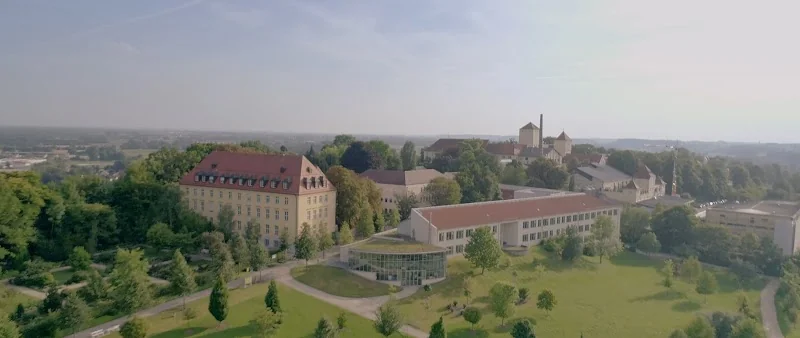
Freising
Am Hofgarten 4, 85354 Freising-Weihenstephan, Deutschland
Weihenstephan-Triesdorf University | Degree Programs & Application
Weihenstephan-Triesdorf University (HSWT) is Germany's green university for applied life and engineering sciences. At two locations – the traditional Weihenstephan campus in Freising and the Triesdorf campus in the Middle Franconian Weidenbach – over 6,100 people study and research solutions for tomorrow. Nature and high-tech come together: modern laboratories, experimental facilities, the Weihenstephan gardens, technology centers, and close-to-partner projects ensure practical learning. Official addresses for your navigation: Weihenstephan Campus, Am Hofgarten 4, 85354 Freising; Triesdorf Campus, Markgrafenstraße 16, 91746 Weidenbach. On the HSWT website, you will find location maps, directions, and a quick overview of degree programs, applications, and services. Rankings and awards – such as the StudyCheck Awards – also underline the high satisfaction of students and alumni. Those seeking a practice-oriented study path with a clear future orientation will find an environment here that meaningfully connects sustainability, technology, and business – rooted in the region, connected internationally.
Degree Programs and Profile of HSWT: Green Engineering Sciences with Practical Relevance
The degree offerings at HSWT are focused on the sustainable use and protection of natural resources. It includes bachelor's and master's programs in areas such as agriculture, horticulture, landscape architecture and planning, forestry and timber management, environmental and bioengineering, food technology, brewing and beverage technology, agricultural engineering, as well as business-oriented profiles along green value chains. The university emphasizes “Applied Sciences for Life” – meaning that content is applied early in laboratories, technology centers, workshops, experimental facilities, and in cooperation with companies, associations, and authorities. Additionally, practical excursions and projects enable the immediate transfer of learned concepts to real-world issues. For international target groups, HSWT also offers English-language programs and exchange formats; one example is the Master's in Digital Farming, which integrates data, sensors, and agricultural processes. Those particularly interested in the beverage industry will find a renowned environment in the Bachelor's program in Brewing and Beverage Technology at the Weihenstephan location, with integration into laboratories, pilot plants, and the region's rich brewing and beverage culture. The spectrum is continuously expanding: Additional degree programs have been announced or introduced for the winter semester 2025/26, specifically complementing the portfolio in Weihenstephan and Triesdorf with future topics – from climate adaptation to sustainable urban planning to modern production and environmental technologies. The close networking in Weihenstephan with institutions such as the Technical University of Munich (e.g., in the context of forestry and timber) and regional authorities enhances the transdisciplinary character. In Triesdorf, the dense educational network of universities, vocational schools, competence centers, and experimental operations shapes the special practical focus. For prospective students, HSWT regularly organizes information days and trial offers. For example, information days took place in March 2026 in Triesdorf (March 20, 2026) and Weihenstephan (March 27, 2026) – featuring program insights, counseling offers, and campus tours. Those wanting to delve deeper can utilize the degree program pages with module information and admission requirements, the campus pages for living, life, and leisure, as well as the pages of the International Office.
Application and Deadlines: How to Apply to HSWT
The application for a study program at HSWT is done digitally through the university's online application portal. The “Application” page guides you step by step through the process – from selecting the degree program to uploading documents to submitting missing documents. Depending on the degree program and type of degree, different pathways are used: For some restricted admission programs, the portal hochschulstart.de may also be relevant; this is explicitly explained on the HSWT page. HSWT also points out deadlines that may differ between the winter and summer semesters. For international applications (full study), there are specific notes on language and formal requirements; exchange students receive their portal access in coordination with their home university. For each degree offering, the access requirements, any suitability assessments, and required language certificates are described. Good to know: HSWT consolidates counseling options so that you can plan time-critical steps in advance – from general study counseling to subject-specific contacts at the faculties to checklists and information sheets. Those considering internships, stays abroad, or dual models in parallel will find additional information on the program pages. Before submitting, it is worthwhile to check the frequently asked questions about applications and the pages for international applicants; there, certified copies, translations, or recognitions are described, among other things. After submission, the portal informs about the processing status; relevant messages are also sent via email. Tip: If you are interested in the summer semester or an English-language program, you should check the sometimes differing time frames. To ensure smooth enrollment, HSWT provides information on enrollment, semester fees (student services), and organizational topics during your studies centrally.
Addresses, Campus Map, and Orientation: Weihenstephan (Freising) and Triesdorf (Weidenbach)
For your own travel planning and “Maps” search, the official addresses are crucial: Weihenstephan Campus, Am Hofgarten 4, 85354 Freising; Triesdorf Campus, Markgrafenstraße 16, 91746 Weidenbach. HSWT provides location maps and orientation information that explain important building clusters and numbering (e.g., A-, C-, F-, H-areas in Weihenstephan) and clarify the paths between lecture halls, laboratories, libraries, and service facilities. Those new to Freising will find a dense university and research landscape in the vicinity of Weihenstephan Hill: In addition to HSWT, there are institutions of the Technical University of Munich, experimental fields, and the Weihenstephan gardens, which connect teaching, research, and the public. For Weidenbach/Triesdorf, the campus is embedded in a historically grown educational landscape; university buildings, vocational schools, experimental facilities, and laboratories are within walking distance. For quick orientation, it is advisable to take a look at the campus pages with location map downloads. Photo and media inquiries, information on visual identity (logo, imagery), and further materials are coordinated by university communication; official logos are available for legitimate uses. For digital maps (e.g., Google Maps), entering the above addresses is usually sufficient; on the HSWT page “Directions,” additional notes for fine orientation (stops, walking paths, building names) are provided. Those needing to switch locations benefit from the good regional integration: Freising is connected via Munich Airport, the S-Bahn, and DB regional trains; Triesdorf is located in the Franconian Lake District with connections via Triesdorf train station and regional bus lines. Both locations offer a wide range of leisure and nature activities in the vicinity – from the Domberg and the Isar meadows in Freising to cycling and hiking trails between Altmühlsee and Brombachsee near Triesdorf.
Directions and Parking: Public Transport, Walking Paths, and Parking Options at a Glance
For the Weihenstephan campus, the HSWT page “Directions” is the central point of contact. From Freising train station, bus lines 638 (usually about every 12 minutes, travel time around 8 minutes) and 639 (about every 30 minutes, travel time around 6 minutes) go to stops like “Am Staudengarten,” “Weihenstephan,” “Weihenstephaner Berg,” or “Forstzentrum” – depending on the target building. If you want to walk, you should plan about 20 minutes for the walk from the station to the core areas of the campus. Bicycle parking spaces, including a repair station, are designated. For traveling to Triesdorf, it is advisable to take the train to Triesdorf station; from there, bus line 736 connects the station with the stop “Triesdorf/Weidenbach Markgrafenstraße” in about 21 minutes. Designated parking spaces are available in Triesdorf for events and daily study life – the HSWT information sheet and location maps document, among other things, the parking lot P2 on Seckendorffstraße. The municipality of Weidenbach additionally provides information on accommodations and infrastructure near the campus. In Freising, parking spaces are organized by the city; those arriving by car should pay attention to municipal notices regarding parking availability and, if possible, opt for public transport or bicycles. For special events – such as information days, campus tours, or conferences – HSWT often publishes additional information on meeting points, entrances, or temporary traffic regulations. Whether in Freising or Triesdorf: The linked directions pages, campus maps, and notices on the buildings help with fine orientation. Those needing barrier-free paths can contact the respective faculty, student secretariat, or study counseling in advance to clarify elevators, ramps, and level access. The digital services of HSWT (MyCampus, Intranet), which consolidate location and room information, are also practical – especially at the beginning of the semester when events are spread across multiple buildings.
Locations in Comparison: Freising-Weihenstephan and Weidenbach/Triesdorf
Weihenstephan in Freising is considered a traditional scientific location where the green university and research landscape in Bavaria is particularly concentrated. The campus is located around Weihenstephan Hill and the Hofgarten; short distances connect university buildings, library, cafeteria, laboratories, experimental facilities, and the Weihenstephan gardens. In teaching and research, HSWT cooperates in various fields, including forestry and timber and other life sciences focuses. The environment offers not only a rich cultural and leisure offer but also quick access to Munich. Triesdorf/Weidenbach, on the other hand, is known as the smallest place in Germany with a university – a campus in the green, where teaching, experimental fields, workshops, and laboratories work particularly closely together. Here, faculties such as agriculture, food and nutrition, and environmental engineering are located; in addition, competence centers, vocational schools, and technical facilities enable practical research and learning. Both locations share a close connection to practice: projects with companies, excursions, laboratory courses, and technical assignments are standard in many degree programs. The urban context is different: Freising offers a more urban environment with immediate proximity to the metropolitan region and airport; Triesdorf represents a rural-historical flair, short distances, and a particularly family-oriented community. For students, this duality means real freedom of choice depending on their personal learning and lifestyle. Housing is organized at both locations through dormitories, shared apartments, and private rentals; the campus pages link to contact points and overviews. Those commuting between the locations can experience events at both places – for example, as part of projects, internships, or elective modules. This creates an overall profile that combines the strengths of both worlds: strong practice, excellent networking, and real proximity to nature, production, technology, and society.
Rankings, Reviews, and Image: StudyCheck Awards, Feedback, and Public Perception
HSWT has been scoring high satisfaction in independent evaluation portals for years. In 2026, it ranks among the top 10 most popular universities in the StudyCheck Awards in the category of 5,000 to 15,000 students; in this category, HSWT ranks 5th out of 42 listed institutions nationwide. The university refers to a score of 9.09/10 points and particularly positive evaluations for study content, instructors, courses, and facilities. Such results reflect the profile: practical, interdisciplinary, applied – with a clear focus on sustainability. Reviews and testimonials on portals like StudyCheck provide prospective students with additional insights into study life, support, and practical components. Through its own press releases, news, and social media channels, HSWT also informs about awards, new degree programs, appointment successes, and partnerships. The university communication is responsible for the visual external representation – including photography, imagery, and logo; media can find contacts and materials there. The HSWT logo is available in common press archives or in media and press communication. As a university, HSWT also actively positions itself with theme days, fairs, trial offers, and information days. Interested parties receive authentic impressions of laboratories, gardens, technology centers, and workshops there. In collaboration with practical partners from agriculture, horticulture, environmental and energy technology, as well as the food and beverage industry, projects arise that reflect the future working world. For study choice, these are valuable indicators: rankings provide orientation, campus visits give a gut feeling – together they create a coherent picture of a research- and practice-oriented green university.
Semester Times and Study Organization: Lecture Times, Exams, and “Semester Breaks”
The organization of lecture times, exam periods, and lecture-free times is regulated by regulations in Bavaria; at HSWT, the currently valid dates are centrally recorded in the study organization. Important to know: “Semester breaks” in the narrower sense are usually not a continuous vacation season at universities but refer to the lecture-free time – during which many exams, block events, internships, or project phases take place. Students should therefore plan early: Module handbooks and chairs communicate exam formats and windows, internship offices and career services advise on practical times. HSWT publishes information on semester fees (student services), re-registration, leave of absence, examination regulations, and service pathways on the corresponding subpages; much is accessible in the intranet, but central overviews are linked. For international students, there are sometimes additional formalities such as residence registration or insurance certificates; the International Office supports this. Those wishing to work in parallel will find information on student jobs and the compatibility of work and study. Especially at a practice-oriented university, it is worthwhile to strategically use the lecture-free time for laboratory projects, field trials, excursions, or short internships – this deepens competencies and establishes contacts in companies early on. For long-term study planning, it is advisable to look at recurring HSWT dates such as information days, kick-off or welcome formats, as well as exam periods, which are similarly structured from semester to semester but can vary in exact dates. The page on study organization is a reliable source for this; adjustments are communicated promptly there.
Jobs, Job Offers, and Career: Career Paths at and with HSWT
Career paths often begin at HSWT during studies: practical projects with companies, student jobs, laboratory activities, and excursions provide early feedback from the working world. Those wishing to work at the university itself – in teaching, research, administration, or technical services – can find current job postings on the HSWT career page and the linked job portal. For students and graduates, the university job exchange offers a variety of opportunities from internships to student jobs to direct entry; additionally, the career service advises on application documents, networking, and employer contacts. In research and transfer, HSWT opens attractive perspectives – from scientific staff to cooperative doctorates with partners to third-party funded projects in areas such as energy, environment, food, bioinformatics, or circular economy. The close networking with regions and industries pays off for graduates: many degree programs have robust employer contacts that facilitate the transition into jobs in agriculture, horticulture, environmental technology, authorities, consulting, planning offices, food and beverage industry, and start-ups. Events such as information days, career fairs, or thematic networking events (e.g., in the beverage and agricultural sector) bring students together with potential employers. In parallel, HSWT promotes entrepreneurship and supports founding questions; alumni remain connected to the university through networks, share career paths, and open doors. Those interested in an academic career can find information on qualification paths, funding lines, and junior staff topics on the career subpages. In short: Whether you aim for teaching and research, companies, or administration – the combination of practical relevance, networking, and regional integration offers many paths to take on responsibility directly after graduation.
Sources:
- Weihenstephan-Triesdorf University – Homepage (EN) with Information Days 2026 and Profile
- HSWT – Overview of Degree Programs
- HSWT – Application: Step by Step
- HSWT – Directions: Weihenstephan & Triesdorf (Bus Lines, Walking Paths)
- HSWT – Campus Life Weihenstephan
- HSWT – Campus Life Triesdorf
- HSWT – Study Organisation: Semester Times & Organisation
- HSWT – Press Release: StudyCheck Awards 2026 (Top 10, 5th Place in Category)
- StudyCheck – Weihenstephan-Triesdorf University: Reviews & Profile
- HSWT – Contact & Locations (Addresses Freising and Weidenbach)
- HSWT – Info PDF: Campus Triesdorf, Address & Parking P2 (Seckendorffstraße)
- HSWT – News: Seven New Degree Programs for WS 2025/26
- University Job Exchange – Career Portal (HSWT linked)
- HSWT – Working at HSWT (Career & Job Offers)
- Wikipedia – Center for Forestry and Timber Weihenstephan (Cooperations at the Location)
Show moreShow less
Weihenstephan-Triesdorf University | Degree Programs & Application
Weihenstephan-Triesdorf University (HSWT) is Germany's green university for applied life and engineering sciences. At two locations – the traditional Weihenstephan campus in Freising and the Triesdorf campus in the Middle Franconian Weidenbach – over 6,100 people study and research solutions for tomorrow. Nature and high-tech come together: modern laboratories, experimental facilities, the Weihenstephan gardens, technology centers, and close-to-partner projects ensure practical learning. Official addresses for your navigation: Weihenstephan Campus, Am Hofgarten 4, 85354 Freising; Triesdorf Campus, Markgrafenstraße 16, 91746 Weidenbach. On the HSWT website, you will find location maps, directions, and a quick overview of degree programs, applications, and services. Rankings and awards – such as the StudyCheck Awards – also underline the high satisfaction of students and alumni. Those seeking a practice-oriented study path with a clear future orientation will find an environment here that meaningfully connects sustainability, technology, and business – rooted in the region, connected internationally.
Degree Programs and Profile of HSWT: Green Engineering Sciences with Practical Relevance
The degree offerings at HSWT are focused on the sustainable use and protection of natural resources. It includes bachelor's and master's programs in areas such as agriculture, horticulture, landscape architecture and planning, forestry and timber management, environmental and bioengineering, food technology, brewing and beverage technology, agricultural engineering, as well as business-oriented profiles along green value chains. The university emphasizes “Applied Sciences for Life” – meaning that content is applied early in laboratories, technology centers, workshops, experimental facilities, and in cooperation with companies, associations, and authorities. Additionally, practical excursions and projects enable the immediate transfer of learned concepts to real-world issues. For international target groups, HSWT also offers English-language programs and exchange formats; one example is the Master's in Digital Farming, which integrates data, sensors, and agricultural processes. Those particularly interested in the beverage industry will find a renowned environment in the Bachelor's program in Brewing and Beverage Technology at the Weihenstephan location, with integration into laboratories, pilot plants, and the region's rich brewing and beverage culture. The spectrum is continuously expanding: Additional degree programs have been announced or introduced for the winter semester 2025/26, specifically complementing the portfolio in Weihenstephan and Triesdorf with future topics – from climate adaptation to sustainable urban planning to modern production and environmental technologies. The close networking in Weihenstephan with institutions such as the Technical University of Munich (e.g., in the context of forestry and timber) and regional authorities enhances the transdisciplinary character. In Triesdorf, the dense educational network of universities, vocational schools, competence centers, and experimental operations shapes the special practical focus. For prospective students, HSWT regularly organizes information days and trial offers. For example, information days took place in March 2026 in Triesdorf (March 20, 2026) and Weihenstephan (March 27, 2026) – featuring program insights, counseling offers, and campus tours. Those wanting to delve deeper can utilize the degree program pages with module information and admission requirements, the campus pages for living, life, and leisure, as well as the pages of the International Office.
Application and Deadlines: How to Apply to HSWT
The application for a study program at HSWT is done digitally through the university's online application portal. The “Application” page guides you step by step through the process – from selecting the degree program to uploading documents to submitting missing documents. Depending on the degree program and type of degree, different pathways are used: For some restricted admission programs, the portal hochschulstart.de may also be relevant; this is explicitly explained on the HSWT page. HSWT also points out deadlines that may differ between the winter and summer semesters. For international applications (full study), there are specific notes on language and formal requirements; exchange students receive their portal access in coordination with their home university. For each degree offering, the access requirements, any suitability assessments, and required language certificates are described. Good to know: HSWT consolidates counseling options so that you can plan time-critical steps in advance – from general study counseling to subject-specific contacts at the faculties to checklists and information sheets. Those considering internships, stays abroad, or dual models in parallel will find additional information on the program pages. Before submitting, it is worthwhile to check the frequently asked questions about applications and the pages for international applicants; there, certified copies, translations, or recognitions are described, among other things. After submission, the portal informs about the processing status; relevant messages are also sent via email. Tip: If you are interested in the summer semester or an English-language program, you should check the sometimes differing time frames. To ensure smooth enrollment, HSWT provides information on enrollment, semester fees (student services), and organizational topics during your studies centrally.
Addresses, Campus Map, and Orientation: Weihenstephan (Freising) and Triesdorf (Weidenbach)
For your own travel planning and “Maps” search, the official addresses are crucial: Weihenstephan Campus, Am Hofgarten 4, 85354 Freising; Triesdorf Campus, Markgrafenstraße 16, 91746 Weidenbach. HSWT provides location maps and orientation information that explain important building clusters and numbering (e.g., A-, C-, F-, H-areas in Weihenstephan) and clarify the paths between lecture halls, laboratories, libraries, and service facilities. Those new to Freising will find a dense university and research landscape in the vicinity of Weihenstephan Hill: In addition to HSWT, there are institutions of the Technical University of Munich, experimental fields, and the Weihenstephan gardens, which connect teaching, research, and the public. For Weidenbach/Triesdorf, the campus is embedded in a historically grown educational landscape; university buildings, vocational schools, experimental facilities, and laboratories are within walking distance. For quick orientation, it is advisable to take a look at the campus pages with location map downloads. Photo and media inquiries, information on visual identity (logo, imagery), and further materials are coordinated by university communication; official logos are available for legitimate uses. For digital maps (e.g., Google Maps), entering the above addresses is usually sufficient; on the HSWT page “Directions,” additional notes for fine orientation (stops, walking paths, building names) are provided. Those needing to switch locations benefit from the good regional integration: Freising is connected via Munich Airport, the S-Bahn, and DB regional trains; Triesdorf is located in the Franconian Lake District with connections via Triesdorf train station and regional bus lines. Both locations offer a wide range of leisure and nature activities in the vicinity – from the Domberg and the Isar meadows in Freising to cycling and hiking trails between Altmühlsee and Brombachsee near Triesdorf.
Directions and Parking: Public Transport, Walking Paths, and Parking Options at a Glance
For the Weihenstephan campus, the HSWT page “Directions” is the central point of contact. From Freising train station, bus lines 638 (usually about every 12 minutes, travel time around 8 minutes) and 639 (about every 30 minutes, travel time around 6 minutes) go to stops like “Am Staudengarten,” “Weihenstephan,” “Weihenstephaner Berg,” or “Forstzentrum” – depending on the target building. If you want to walk, you should plan about 20 minutes for the walk from the station to the core areas of the campus. Bicycle parking spaces, including a repair station, are designated. For traveling to Triesdorf, it is advisable to take the train to Triesdorf station; from there, bus line 736 connects the station with the stop “Triesdorf/Weidenbach Markgrafenstraße” in about 21 minutes. Designated parking spaces are available in Triesdorf for events and daily study life – the HSWT information sheet and location maps document, among other things, the parking lot P2 on Seckendorffstraße. The municipality of Weidenbach additionally provides information on accommodations and infrastructure near the campus. In Freising, parking spaces are organized by the city; those arriving by car should pay attention to municipal notices regarding parking availability and, if possible, opt for public transport or bicycles. For special events – such as information days, campus tours, or conferences – HSWT often publishes additional information on meeting points, entrances, or temporary traffic regulations. Whether in Freising or Triesdorf: The linked directions pages, campus maps, and notices on the buildings help with fine orientation. Those needing barrier-free paths can contact the respective faculty, student secretariat, or study counseling in advance to clarify elevators, ramps, and level access. The digital services of HSWT (MyCampus, Intranet), which consolidate location and room information, are also practical – especially at the beginning of the semester when events are spread across multiple buildings.
Locations in Comparison: Freising-Weihenstephan and Weidenbach/Triesdorf
Weihenstephan in Freising is considered a traditional scientific location where the green university and research landscape in Bavaria is particularly concentrated. The campus is located around Weihenstephan Hill and the Hofgarten; short distances connect university buildings, library, cafeteria, laboratories, experimental facilities, and the Weihenstephan gardens. In teaching and research, HSWT cooperates in various fields, including forestry and timber and other life sciences focuses. The environment offers not only a rich cultural and leisure offer but also quick access to Munich. Triesdorf/Weidenbach, on the other hand, is known as the smallest place in Germany with a university – a campus in the green, where teaching, experimental fields, workshops, and laboratories work particularly closely together. Here, faculties such as agriculture, food and nutrition, and environmental engineering are located; in addition, competence centers, vocational schools, and technical facilities enable practical research and learning. Both locations share a close connection to practice: projects with companies, excursions, laboratory courses, and technical assignments are standard in many degree programs. The urban context is different: Freising offers a more urban environment with immediate proximity to the metropolitan region and airport; Triesdorf represents a rural-historical flair, short distances, and a particularly family-oriented community. For students, this duality means real freedom of choice depending on their personal learning and lifestyle. Housing is organized at both locations through dormitories, shared apartments, and private rentals; the campus pages link to contact points and overviews. Those commuting between the locations can experience events at both places – for example, as part of projects, internships, or elective modules. This creates an overall profile that combines the strengths of both worlds: strong practice, excellent networking, and real proximity to nature, production, technology, and society.
Rankings, Reviews, and Image: StudyCheck Awards, Feedback, and Public Perception
HSWT has been scoring high satisfaction in independent evaluation portals for years. In 2026, it ranks among the top 10 most popular universities in the StudyCheck Awards in the category of 5,000 to 15,000 students; in this category, HSWT ranks 5th out of 42 listed institutions nationwide. The university refers to a score of 9.09/10 points and particularly positive evaluations for study content, instructors, courses, and facilities. Such results reflect the profile: practical, interdisciplinary, applied – with a clear focus on sustainability. Reviews and testimonials on portals like StudyCheck provide prospective students with additional insights into study life, support, and practical components. Through its own press releases, news, and social media channels, HSWT also informs about awards, new degree programs, appointment successes, and partnerships. The university communication is responsible for the visual external representation – including photography, imagery, and logo; media can find contacts and materials there. The HSWT logo is available in common press archives or in media and press communication. As a university, HSWT also actively positions itself with theme days, fairs, trial offers, and information days. Interested parties receive authentic impressions of laboratories, gardens, technology centers, and workshops there. In collaboration with practical partners from agriculture, horticulture, environmental and energy technology, as well as the food and beverage industry, projects arise that reflect the future working world. For study choice, these are valuable indicators: rankings provide orientation, campus visits give a gut feeling – together they create a coherent picture of a research- and practice-oriented green university.
Semester Times and Study Organization: Lecture Times, Exams, and “Semester Breaks”
The organization of lecture times, exam periods, and lecture-free times is regulated by regulations in Bavaria; at HSWT, the currently valid dates are centrally recorded in the study organization. Important to know: “Semester breaks” in the narrower sense are usually not a continuous vacation season at universities but refer to the lecture-free time – during which many exams, block events, internships, or project phases take place. Students should therefore plan early: Module handbooks and chairs communicate exam formats and windows, internship offices and career services advise on practical times. HSWT publishes information on semester fees (student services), re-registration, leave of absence, examination regulations, and service pathways on the corresponding subpages; much is accessible in the intranet, but central overviews are linked. For international students, there are sometimes additional formalities such as residence registration or insurance certificates; the International Office supports this. Those wishing to work in parallel will find information on student jobs and the compatibility of work and study. Especially at a practice-oriented university, it is worthwhile to strategically use the lecture-free time for laboratory projects, field trials, excursions, or short internships – this deepens competencies and establishes contacts in companies early on. For long-term study planning, it is advisable to look at recurring HSWT dates such as information days, kick-off or welcome formats, as well as exam periods, which are similarly structured from semester to semester but can vary in exact dates. The page on study organization is a reliable source for this; adjustments are communicated promptly there.
Jobs, Job Offers, and Career: Career Paths at and with HSWT
Career paths often begin at HSWT during studies: practical projects with companies, student jobs, laboratory activities, and excursions provide early feedback from the working world. Those wishing to work at the university itself – in teaching, research, administration, or technical services – can find current job postings on the HSWT career page and the linked job portal. For students and graduates, the university job exchange offers a variety of opportunities from internships to student jobs to direct entry; additionally, the career service advises on application documents, networking, and employer contacts. In research and transfer, HSWT opens attractive perspectives – from scientific staff to cooperative doctorates with partners to third-party funded projects in areas such as energy, environment, food, bioinformatics, or circular economy. The close networking with regions and industries pays off for graduates: many degree programs have robust employer contacts that facilitate the transition into jobs in agriculture, horticulture, environmental technology, authorities, consulting, planning offices, food and beverage industry, and start-ups. Events such as information days, career fairs, or thematic networking events (e.g., in the beverage and agricultural sector) bring students together with potential employers. In parallel, HSWT promotes entrepreneurship and supports founding questions; alumni remain connected to the university through networks, share career paths, and open doors. Those interested in an academic career can find information on qualification paths, funding lines, and junior staff topics on the career subpages. In short: Whether you aim for teaching and research, companies, or administration – the combination of practical relevance, networking, and regional integration offers many paths to take on responsibility directly after graduation.
Sources:
- Weihenstephan-Triesdorf University – Homepage (EN) with Information Days 2026 and Profile
- HSWT – Overview of Degree Programs
- HSWT – Application: Step by Step
- HSWT – Directions: Weihenstephan & Triesdorf (Bus Lines, Walking Paths)
- HSWT – Campus Life Weihenstephan
- HSWT – Campus Life Triesdorf
- HSWT – Study Organisation: Semester Times & Organisation
- HSWT – Press Release: StudyCheck Awards 2026 (Top 10, 5th Place in Category)
- StudyCheck – Weihenstephan-Triesdorf University: Reviews & Profile
- HSWT – Contact & Locations (Addresses Freising and Weidenbach)
- HSWT – Info PDF: Campus Triesdorf, Address & Parking P2 (Seckendorffstraße)
- HSWT – News: Seven New Degree Programs for WS 2025/26
- University Job Exchange – Career Portal (HSWT linked)
- HSWT – Working at HSWT (Career & Job Offers)
- Wikipedia – Center for Forestry and Timber Weihenstephan (Cooperations at the Location)
Weihenstephan-Triesdorf University | Degree Programs & Application
Weihenstephan-Triesdorf University (HSWT) is Germany's green university for applied life and engineering sciences. At two locations – the traditional Weihenstephan campus in Freising and the Triesdorf campus in the Middle Franconian Weidenbach – over 6,100 people study and research solutions for tomorrow. Nature and high-tech come together: modern laboratories, experimental facilities, the Weihenstephan gardens, technology centers, and close-to-partner projects ensure practical learning. Official addresses for your navigation: Weihenstephan Campus, Am Hofgarten 4, 85354 Freising; Triesdorf Campus, Markgrafenstraße 16, 91746 Weidenbach. On the HSWT website, you will find location maps, directions, and a quick overview of degree programs, applications, and services. Rankings and awards – such as the StudyCheck Awards – also underline the high satisfaction of students and alumni. Those seeking a practice-oriented study path with a clear future orientation will find an environment here that meaningfully connects sustainability, technology, and business – rooted in the region, connected internationally.
Degree Programs and Profile of HSWT: Green Engineering Sciences with Practical Relevance
The degree offerings at HSWT are focused on the sustainable use and protection of natural resources. It includes bachelor's and master's programs in areas such as agriculture, horticulture, landscape architecture and planning, forestry and timber management, environmental and bioengineering, food technology, brewing and beverage technology, agricultural engineering, as well as business-oriented profiles along green value chains. The university emphasizes “Applied Sciences for Life” – meaning that content is applied early in laboratories, technology centers, workshops, experimental facilities, and in cooperation with companies, associations, and authorities. Additionally, practical excursions and projects enable the immediate transfer of learned concepts to real-world issues. For international target groups, HSWT also offers English-language programs and exchange formats; one example is the Master's in Digital Farming, which integrates data, sensors, and agricultural processes. Those particularly interested in the beverage industry will find a renowned environment in the Bachelor's program in Brewing and Beverage Technology at the Weihenstephan location, with integration into laboratories, pilot plants, and the region's rich brewing and beverage culture. The spectrum is continuously expanding: Additional degree programs have been announced or introduced for the winter semester 2025/26, specifically complementing the portfolio in Weihenstephan and Triesdorf with future topics – from climate adaptation to sustainable urban planning to modern production and environmental technologies. The close networking in Weihenstephan with institutions such as the Technical University of Munich (e.g., in the context of forestry and timber) and regional authorities enhances the transdisciplinary character. In Triesdorf, the dense educational network of universities, vocational schools, competence centers, and experimental operations shapes the special practical focus. For prospective students, HSWT regularly organizes information days and trial offers. For example, information days took place in March 2026 in Triesdorf (March 20, 2026) and Weihenstephan (March 27, 2026) – featuring program insights, counseling offers, and campus tours. Those wanting to delve deeper can utilize the degree program pages with module information and admission requirements, the campus pages for living, life, and leisure, as well as the pages of the International Office.
Application and Deadlines: How to Apply to HSWT
The application for a study program at HSWT is done digitally through the university's online application portal. The “Application” page guides you step by step through the process – from selecting the degree program to uploading documents to submitting missing documents. Depending on the degree program and type of degree, different pathways are used: For some restricted admission programs, the portal hochschulstart.de may also be relevant; this is explicitly explained on the HSWT page. HSWT also points out deadlines that may differ between the winter and summer semesters. For international applications (full study), there are specific notes on language and formal requirements; exchange students receive their portal access in coordination with their home university. For each degree offering, the access requirements, any suitability assessments, and required language certificates are described. Good to know: HSWT consolidates counseling options so that you can plan time-critical steps in advance – from general study counseling to subject-specific contacts at the faculties to checklists and information sheets. Those considering internships, stays abroad, or dual models in parallel will find additional information on the program pages. Before submitting, it is worthwhile to check the frequently asked questions about applications and the pages for international applicants; there, certified copies, translations, or recognitions are described, among other things. After submission, the portal informs about the processing status; relevant messages are also sent via email. Tip: If you are interested in the summer semester or an English-language program, you should check the sometimes differing time frames. To ensure smooth enrollment, HSWT provides information on enrollment, semester fees (student services), and organizational topics during your studies centrally.
Addresses, Campus Map, and Orientation: Weihenstephan (Freising) and Triesdorf (Weidenbach)
For your own travel planning and “Maps” search, the official addresses are crucial: Weihenstephan Campus, Am Hofgarten 4, 85354 Freising; Triesdorf Campus, Markgrafenstraße 16, 91746 Weidenbach. HSWT provides location maps and orientation information that explain important building clusters and numbering (e.g., A-, C-, F-, H-areas in Weihenstephan) and clarify the paths between lecture halls, laboratories, libraries, and service facilities. Those new to Freising will find a dense university and research landscape in the vicinity of Weihenstephan Hill: In addition to HSWT, there are institutions of the Technical University of Munich, experimental fields, and the Weihenstephan gardens, which connect teaching, research, and the public. For Weidenbach/Triesdorf, the campus is embedded in a historically grown educational landscape; university buildings, vocational schools, experimental facilities, and laboratories are within walking distance. For quick orientation, it is advisable to take a look at the campus pages with location map downloads. Photo and media inquiries, information on visual identity (logo, imagery), and further materials are coordinated by university communication; official logos are available for legitimate uses. For digital maps (e.g., Google Maps), entering the above addresses is usually sufficient; on the HSWT page “Directions,” additional notes for fine orientation (stops, walking paths, building names) are provided. Those needing to switch locations benefit from the good regional integration: Freising is connected via Munich Airport, the S-Bahn, and DB regional trains; Triesdorf is located in the Franconian Lake District with connections via Triesdorf train station and regional bus lines. Both locations offer a wide range of leisure and nature activities in the vicinity – from the Domberg and the Isar meadows in Freising to cycling and hiking trails between Altmühlsee and Brombachsee near Triesdorf.
Directions and Parking: Public Transport, Walking Paths, and Parking Options at a Glance
For the Weihenstephan campus, the HSWT page “Directions” is the central point of contact. From Freising train station, bus lines 638 (usually about every 12 minutes, travel time around 8 minutes) and 639 (about every 30 minutes, travel time around 6 minutes) go to stops like “Am Staudengarten,” “Weihenstephan,” “Weihenstephaner Berg,” or “Forstzentrum” – depending on the target building. If you want to walk, you should plan about 20 minutes for the walk from the station to the core areas of the campus. Bicycle parking spaces, including a repair station, are designated. For traveling to Triesdorf, it is advisable to take the train to Triesdorf station; from there, bus line 736 connects the station with the stop “Triesdorf/Weidenbach Markgrafenstraße” in about 21 minutes. Designated parking spaces are available in Triesdorf for events and daily study life – the HSWT information sheet and location maps document, among other things, the parking lot P2 on Seckendorffstraße. The municipality of Weidenbach additionally provides information on accommodations and infrastructure near the campus. In Freising, parking spaces are organized by the city; those arriving by car should pay attention to municipal notices regarding parking availability and, if possible, opt for public transport or bicycles. For special events – such as information days, campus tours, or conferences – HSWT often publishes additional information on meeting points, entrances, or temporary traffic regulations. Whether in Freising or Triesdorf: The linked directions pages, campus maps, and notices on the buildings help with fine orientation. Those needing barrier-free paths can contact the respective faculty, student secretariat, or study counseling in advance to clarify elevators, ramps, and level access. The digital services of HSWT (MyCampus, Intranet), which consolidate location and room information, are also practical – especially at the beginning of the semester when events are spread across multiple buildings.
Locations in Comparison: Freising-Weihenstephan and Weidenbach/Triesdorf
Weihenstephan in Freising is considered a traditional scientific location where the green university and research landscape in Bavaria is particularly concentrated. The campus is located around Weihenstephan Hill and the Hofgarten; short distances connect university buildings, library, cafeteria, laboratories, experimental facilities, and the Weihenstephan gardens. In teaching and research, HSWT cooperates in various fields, including forestry and timber and other life sciences focuses. The environment offers not only a rich cultural and leisure offer but also quick access to Munich. Triesdorf/Weidenbach, on the other hand, is known as the smallest place in Germany with a university – a campus in the green, where teaching, experimental fields, workshops, and laboratories work particularly closely together. Here, faculties such as agriculture, food and nutrition, and environmental engineering are located; in addition, competence centers, vocational schools, and technical facilities enable practical research and learning. Both locations share a close connection to practice: projects with companies, excursions, laboratory courses, and technical assignments are standard in many degree programs. The urban context is different: Freising offers a more urban environment with immediate proximity to the metropolitan region and airport; Triesdorf represents a rural-historical flair, short distances, and a particularly family-oriented community. For students, this duality means real freedom of choice depending on their personal learning and lifestyle. Housing is organized at both locations through dormitories, shared apartments, and private rentals; the campus pages link to contact points and overviews. Those commuting between the locations can experience events at both places – for example, as part of projects, internships, or elective modules. This creates an overall profile that combines the strengths of both worlds: strong practice, excellent networking, and real proximity to nature, production, technology, and society.
Rankings, Reviews, and Image: StudyCheck Awards, Feedback, and Public Perception
HSWT has been scoring high satisfaction in independent evaluation portals for years. In 2026, it ranks among the top 10 most popular universities in the StudyCheck Awards in the category of 5,000 to 15,000 students; in this category, HSWT ranks 5th out of 42 listed institutions nationwide. The university refers to a score of 9.09/10 points and particularly positive evaluations for study content, instructors, courses, and facilities. Such results reflect the profile: practical, interdisciplinary, applied – with a clear focus on sustainability. Reviews and testimonials on portals like StudyCheck provide prospective students with additional insights into study life, support, and practical components. Through its own press releases, news, and social media channels, HSWT also informs about awards, new degree programs, appointment successes, and partnerships. The university communication is responsible for the visual external representation – including photography, imagery, and logo; media can find contacts and materials there. The HSWT logo is available in common press archives or in media and press communication. As a university, HSWT also actively positions itself with theme days, fairs, trial offers, and information days. Interested parties receive authentic impressions of laboratories, gardens, technology centers, and workshops there. In collaboration with practical partners from agriculture, horticulture, environmental and energy technology, as well as the food and beverage industry, projects arise that reflect the future working world. For study choice, these are valuable indicators: rankings provide orientation, campus visits give a gut feeling – together they create a coherent picture of a research- and practice-oriented green university.
Semester Times and Study Organization: Lecture Times, Exams, and “Semester Breaks”
The organization of lecture times, exam periods, and lecture-free times is regulated by regulations in Bavaria; at HSWT, the currently valid dates are centrally recorded in the study organization. Important to know: “Semester breaks” in the narrower sense are usually not a continuous vacation season at universities but refer to the lecture-free time – during which many exams, block events, internships, or project phases take place. Students should therefore plan early: Module handbooks and chairs communicate exam formats and windows, internship offices and career services advise on practical times. HSWT publishes information on semester fees (student services), re-registration, leave of absence, examination regulations, and service pathways on the corresponding subpages; much is accessible in the intranet, but central overviews are linked. For international students, there are sometimes additional formalities such as residence registration or insurance certificates; the International Office supports this. Those wishing to work in parallel will find information on student jobs and the compatibility of work and study. Especially at a practice-oriented university, it is worthwhile to strategically use the lecture-free time for laboratory projects, field trials, excursions, or short internships – this deepens competencies and establishes contacts in companies early on. For long-term study planning, it is advisable to look at recurring HSWT dates such as information days, kick-off or welcome formats, as well as exam periods, which are similarly structured from semester to semester but can vary in exact dates. The page on study organization is a reliable source for this; adjustments are communicated promptly there.
Jobs, Job Offers, and Career: Career Paths at and with HSWT
Career paths often begin at HSWT during studies: practical projects with companies, student jobs, laboratory activities, and excursions provide early feedback from the working world. Those wishing to work at the university itself – in teaching, research, administration, or technical services – can find current job postings on the HSWT career page and the linked job portal. For students and graduates, the university job exchange offers a variety of opportunities from internships to student jobs to direct entry; additionally, the career service advises on application documents, networking, and employer contacts. In research and transfer, HSWT opens attractive perspectives – from scientific staff to cooperative doctorates with partners to third-party funded projects in areas such as energy, environment, food, bioinformatics, or circular economy. The close networking with regions and industries pays off for graduates: many degree programs have robust employer contacts that facilitate the transition into jobs in agriculture, horticulture, environmental technology, authorities, consulting, planning offices, food and beverage industry, and start-ups. Events such as information days, career fairs, or thematic networking events (e.g., in the beverage and agricultural sector) bring students together with potential employers. In parallel, HSWT promotes entrepreneurship and supports founding questions; alumni remain connected to the university through networks, share career paths, and open doors. Those interested in an academic career can find information on qualification paths, funding lines, and junior staff topics on the career subpages. In short: Whether you aim for teaching and research, companies, or administration – the combination of practical relevance, networking, and regional integration offers many paths to take on responsibility directly after graduation.
Sources:
- Weihenstephan-Triesdorf University – Homepage (EN) with Information Days 2026 and Profile
- HSWT – Overview of Degree Programs
- HSWT – Application: Step by Step
- HSWT – Directions: Weihenstephan & Triesdorf (Bus Lines, Walking Paths)
- HSWT – Campus Life Weihenstephan
- HSWT – Campus Life Triesdorf
- HSWT – Study Organisation: Semester Times & Organisation
- HSWT – Press Release: StudyCheck Awards 2026 (Top 10, 5th Place in Category)
- StudyCheck – Weihenstephan-Triesdorf University: Reviews & Profile
- HSWT – Contact & Locations (Addresses Freising and Weidenbach)
- HSWT – Info PDF: Campus Triesdorf, Address & Parking P2 (Seckendorffstraße)
- HSWT – News: Seven New Degree Programs for WS 2025/26
- University Job Exchange – Career Portal (HSWT linked)
- HSWT – Working at HSWT (Career & Job Offers)
- Wikipedia – Center for Forestry and Timber Weihenstephan (Cooperations at the Location)
Upcoming Events

Cinema at the Square 2026
Pure summer cinema in Freising: Cinema at the Square 2026 brings nine free open-air evenings to the Weihenstephan campus. Screen, summer, community! #OpenAirCinema
Summer Grafting of Fruit Trees
A theoretical part takes place in the auditorium, followed by practical training in the grafting technique on apple rootstocks. The goal is for each person to...
Weihenstephaner Day for Leisure Gardening
Garden knowledge with foresight in Freising: The Weihenstephaner Day for Leisure Gardening combines practice, lectures, and climate change topics. 25 euros, registration required. #Freising #Horticulture
Frequently Asked Questions
Reviews
JAGAN M
5. February 2026
One of the good public universities with reputed professors focusing on sustainable programs for a better sustainable future. Friendly and supportive environment for international students with good care.
Christoph Limbo
16. January 2025
Horrible school. They deny people education! Profs even ignore questions. Embarrassing to call it a "school".
Amos Cheruiyot
2. October 2024
A place to be academically!
DA BÄHDA
28. March 2017
Top!
Otabek Imamov
8. April 2022
Fine