
Kranzberg
Unnamed Road, 85402 Kranzberg, Deutschland
P1 Oberberghausen | Access & Parking
P1 Oberberghausen is more than just a parking lot on the edge of the forest. When you arrive here, you stand at the practical access point to the World Forest Freising, a large arboretum in the Kranzberg Forest that connects nature, orientation, and history at a short distance. The location is situated on St 2084 between Freising and Allershausen and is designed so that visitors can directly enter the forest area. Especially for walks, family tours, or a quiet start to the day, P1 Oberberghausen is a clear point of orientation. The official description explicitly names the parking lot as P1, near the Freising-Allershausen road, and points out that the World Forest is open year-round. This makes the place suitable not only for quick access but also as a base for longer stays in the area. In the immediate vicinity, paths, info spots, and themed trails lead further into the area. ([weltwald.de](https://www.weltwald.de/service/kontakt-anfahrt.html))
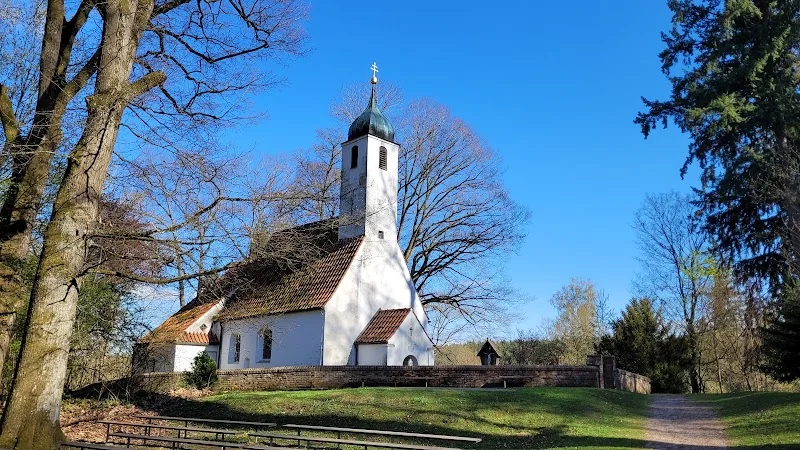
Particularly interesting is the location in the tension field of nature, culture, and orientation. On one side, the parking lot is at a modern visitor entrance to the World Forest, while just a few steps away, a historically shaped space opens up with the St. Clemens forest church and memories of the former Oberberghausen. This very mix makes P1 Oberberghausen highly relevant for those seeking access, parking, and excursion information. Those arriving with specific questions about parking, route guidance, themed trails, or visitor tips find a clear starting point for their further tour here. ([weltwald.de](https://www.weltwald.de/weltwald-entdecken/geschichte-des-weltwaldes.html))
Access and Parking at P1 Oberberghausen
The access to P1 Oberberghausen is officially described quite clearly. From Freising, you drive on St 2084 towards Allershausen. After about 2.7 to 3.0 kilometers, you turn left into the Kranzberg Forest. Right after this turn, the parking lots P1 Oberberghausen and P2 Eisweiher are located, which are the two main entrances to the World Forest on this side of the area. Close to the parking spaces are the info pavilions Tulip Tree and Sugar Maple, so visitors receive good spatial orientation right at the beginning of their tour. The path guidance is therefore not only practical but also logically structured: park the car, recognize the entrance, gather information, and then switch to the marked paths. For the SEO search around access and parking, this combination is central because it immediately shows users how to navigate the area and where to continue after parking. ([weltwald.de](https://www.weltwald.de/service/kontakt-anfahrt.html))
Those traveling by bicycle also find a suitable solution. According to the official contact and access page, the World Forest is easily reachable via the developed bike path Freising-Allershausen parallel to St 2084. This is important for visitors who do not wish to arrive by car but seek a nature-friendly, quiet connection. For visitors arriving by bus, the MVV bus line 619 is relevant: it is best to get off at Ampertshausen and walk about 200 meters to parking P2 Eisweiher or to the info pavilion French Maple. P1 Oberberghausen is thus part of a tiered access system that considers different modes of arrival while still making orientation easy. For many users, this flexibility is a decisive advantage because it does not reduce the location to a single access point. ([weltwald.de](https://www.weltwald.de/service/kontakt-anfahrt.html))
For visitors coming from different directions, the parking concept is also sensible. The official site additionally names P3 Kleiner Spessart as an option if you use the somewhat rough gravel road through the Kranzberg Forest from Freising to Kranzberg. From there, it is about 400 meters on foot to the info pavilion French Maple. This results in a clear logic: P1 Oberberghausen is the direct entrance via St 2084, P2 offers a similarly convenient alternative right by the forest, and P3 is especially interesting for those who choose the route through the forest itself. Especially for excursions in the World Forest, this division is helpful as it simplifies the paths depending on the mode of transport and personal route. Therefore, those specifically searching for parking, access, or parking world will find not just a single parking space but a whole system of visitor entrances. ([weltwald.de](https://www.weltwald.de/service/kontakt-anfahrt.html))
World Forest Freising in Kranzberg Forest
The great added value of P1 Oberberghausen only truly reveals itself in connection with the World Forest Freising. The official presentation describes the area as a collection of trees from around the world, covering about 100 hectares, located at the gates of Freising in the Kranzberg Forest. Since the first plantings in 1987, over 300 tree and shrub species are now represented, and the project is explicitly envisioned to include more than double that number of species in the future. Thus, the World Forest is not just a piece of forest but a living state arboretum with educational and landscape aspirations. For many users, P1 Oberberghausen is not just a parking lot but the starting point for an extraordinary nature experience. The combination of size, biodiversity, and clear path guidance makes the place particularly attractive as an excursion destination. ([weltwald.de](https://www.weltwald.de/))
The structure of the World Forest follows a clear botanical and geographical order. According to the official overview, the area is divided into four geographical large regions: North America, Europe and Western Asia, as well as Central and Eastern Asia. Within these large regions, a total of 18 geographical planting quarters are distinguished, which are oriented towards the natural home regions of the trees. This is particularly appealing to visitors because the walk does not feel random but is planned like a small journey through vegetation zones and origin areas. For example, those in the North America area discover typical species such as Sugar Maple, Two-colored Oak, or Yellow Birch. In other quarters, tree species from Europe, Western Asia, or the Far East are found. The World Forest thus conveys a vivid picture of how forest types are regionally shaped and how diverse tree landscapes can look on Earth. ([weltwald.de](https://www.weltwald.de/weltwald-verstehen/aufbau-und-uebersicht.html))
The visitor experience also includes that the area is not only collected but also staged. At the center of the World Forest is a central pavilion, near which the exhibition Forest-Forest can be seen, contrasting forestry in Germany and the USA. Additionally, there are gardens of the continents that provide cultural insights into the home countries of the World Forest trees. This mix of botany, education, and quality of stay makes the World Forest a place where walks serve not only for crossing but also for discovering. Families particularly benefit from the fact that paths, pavilions, display boards, and rest areas connect with each other. P1 Oberberghausen is thus the practical entry point into a space that offers far more than a simple forest path. ([weltwald.de](https://www.weltwald.de/weltwald-entdecken/der-weltwald.html))
History of Oberberghausen and St. Clemens
The history of the place is closely linked to the establishment of the World Forest. According to official history, the World Forest Freising is a relatively young project, whose founding in 1977 is associated with the establishment of the Weihenstephan science and research campus. The decision on the location was not difficult, as there was already a forest department in the nearby Kranzberg Forest with a striking number of tree species from distant countries. For P1 Oberberghausen, this means: the current parking lot is located in an area that has been developed not only as a natural space but also as a scientifically forested landscape. The current visitor structure with parking lots, info points, and themed paths is therefore the result of a long planning history that begins long before the current excursion tours. ([weltwald.de](https://www.weltwald.de/weltwald-entdecken/geschichte-des-weltwaldes.html))
The area itself was formerly the local land of the hamlet of Oberberghausen. The official historical overview describes that Oberberghausen consisted of four farms, namely the Mair, Ochsenhans, Kellhamer, and Mesner farms. Towards the end of the 19th century, the royal Bavarian forestry authority acquired the peasant property and shortly thereafter reforested the area. Various exotic wood species were also used, which today are part of the collection as valuable old trees. The church of St. Clemens has remained as the last witness of the former village culture, surrounded by a small cemetery. Particularly noteworthy is that the village church, according to official representation, dates back to the tenth century and was originally a gift from the Bishop of Freising, Abraham, to the canonry of Weihenstephan. This gives the place a historical depth that is immediately palpable during a visit. ([weltwald.de](https://www.weltwald.de/weltwald-entdecken/geschichte-des-weltwaldes.html))
The further development of the area is also well documented. Initially, a demonstration and experimental garden, called the Salicetum, was created with the involvement of LMU Munich. On a large area, willow cultures were planted to supply the basket weaving in the Freising area with raw materials. Later, most areas were gradually reforested with spruce, while smaller meadow valleys were left out, giving the arboretum its park-like character to this day. The church was restored with great effort, and the forest warden's house was newly built in 1905 from the structural remains of the Kellhamerhof. Today, the surroundings of St. Clemens feel like a connection of landscape, memory, and quiet excursion atmosphere. Therefore, starting from P1 Oberberghausen, one moves not only in a parking area but in a space of historical layers. ([weltwald.de](https://www.weltwald.de/weltwald-entdecken/geschichte-des-weltwaldes.html))
Themed Trails, App, and Orientation on Site
The World Forest is structured so that visitors can explore the facility on multiple levels. Officially, several options are mentioned: You can stay on the extensive network of developed forest roads and hiking trails, orient yourself with the flyer and overview map, or follow the themed trails marked with colored symbols. These themed trails are particularly interesting because they occasionally lead over beaten paths into the inner stock. To avoid confusion, wooden planks help with orientation at the junctions and in between. All themed trails meet at the central pavilion, making the area comprehensible for first-time visitors. P1 Oberberghausen is therefore not just a parking lot but a first hub in a clearly readable path network. ([weltwald.de](https://www.weltwald.de/weltwald-entdecken/themenpfade.html?utm_source=openai))
Additionally, the World Forest app is available, which makes the visit even more targeted. According to the official description, it contains a map view with offline available geodata, various feature layers, and a search function for German and Latin tree species names. The GPS positioning supports orientation on site, and the search results are automatically selected and positioned with auto-zoom on the map. By tapping on information points about the planting parcels, detailed information can be retrieved. This is particularly helpful for people who do not just want to take a walk but specifically want to find certain tree species or thematic areas. For an SEO page around P1 Oberberghausen, this point is important because seekers often need not only a parking space but also an idea of how to navigate the area. ([weltwald.de](https://www.weltwald.de/service/anmeldung/weltwald-app.html?utm_source=openai))
The thematic diversity of the World Forest is great. In the North America West area, for example, you can find Douglas Fir, Yellow Pine, or Giant Sequoia, complemented by the America Garden. In the Europe-themed trail, visitors encounter native tree species as well as hardy representatives from the Mediterranean region to the southern coast of the Caspian Sea, along with the Botanicum and the Europe Garden. In the eastern part of the area, particularly exotic-looking species such as Dawn Redwood, Silver Fir, or Hiba Arborvitae impress in the Central and Eastern Asia area; there lies the Asia Garden with a red pagoda, moon gate, and arched bridge. This very mix of plants, landscape, and small architectural motifs makes the path from parking P1 Oberberghausen so varied. Those who enter the area with open eyes experience not only a forest but a narrated world landscape. ([weltwald.de](https://www.weltwald.de/weltwald-entdecken/themenpfade.html?utm_source=openai))
Events, Meeting Points, and Practical Visitor Tips
The official events page shows that the World Forest is not only a place for quiet walks but is also regularly used for guided tours, thematic walks, and cultural formats. Several dates explicitly name the World Forest parking P1 as the meeting point, near the Freising-Allershausen road at the height of St 2084. This makes it clear that P1 Oberberghausen also plays an important organizational role. The program includes guided walks, offerings with literary texts, movement formats such as Taiso in the Asia Garden, or musical events in the forest theater. Some dates require registration, which is important for users who want to connect their visit not spontaneously but with a specific event. P1 is thus not only a point of arrival but also a meeting point for events in the natural space. ([weltwald.de](https://www.weltwald.de/service/aktuelles-und-veranstaltungen.html))
In practice, it is advisable to plan the visit consciously depending on the mode of arrival. Those arriving by car and wanting to enter the World Forest directly use P1 Oberberghausen as the first access. Those traveling by bus orient themselves at Ampertshausen and reach the site at P2 Eisweiher and the info pavilion French Maple via the short walk. Those coming from Kranzberg via the gravel road can choose P3 Kleiner Spessart as an alternative and walk further from there. Since the World Forest is open year-round, a visit is worthwhile in every season; at the same time, sturdy footwear should be planned depending on the weather, especially if following the themed trails and path variants. The combination of tranquility, signage, nature experience, and cultural-historical background makes the place particularly attractive for families, nature lovers, and walkers. ([weltwald.de](https://www.weltwald.de/service/kontakt-anfahrt.html))
In the end, it becomes clear: P1 Oberberghausen is not just any parking lot but a well-defined entry point into an extraordinary landscape and learning space. The official website refers to the proximity to the St. Clemens forest church, the central info pavilions, the central pavilion, and the various thematic areas of the World Forest. Therefore, those looking for access, parking, opening hours, themed trails, or events will find a place where everything converges. This is exactly what makes P1 Oberberghausen so useful for visitors: a simple starting point from which nature, history, and orientation combine into a compact excursion experience. ([weltwald.de](https://www.weltwald.de/service/kontakt-anfahrt.html))
Sources:
Show moreShow less
P1 Oberberghausen | Access & Parking
P1 Oberberghausen is more than just a parking lot on the edge of the forest. When you arrive here, you stand at the practical access point to the World Forest Freising, a large arboretum in the Kranzberg Forest that connects nature, orientation, and history at a short distance. The location is situated on St 2084 between Freising and Allershausen and is designed so that visitors can directly enter the forest area. Especially for walks, family tours, or a quiet start to the day, P1 Oberberghausen is a clear point of orientation. The official description explicitly names the parking lot as P1, near the Freising-Allershausen road, and points out that the World Forest is open year-round. This makes the place suitable not only for quick access but also as a base for longer stays in the area. In the immediate vicinity, paths, info spots, and themed trails lead further into the area. ([weltwald.de](https://www.weltwald.de/service/kontakt-anfahrt.html))
Particularly interesting is the location in the tension field of nature, culture, and orientation. On one side, the parking lot is at a modern visitor entrance to the World Forest, while just a few steps away, a historically shaped space opens up with the St. Clemens forest church and memories of the former Oberberghausen. This very mix makes P1 Oberberghausen highly relevant for those seeking access, parking, and excursion information. Those arriving with specific questions about parking, route guidance, themed trails, or visitor tips find a clear starting point for their further tour here. ([weltwald.de](https://www.weltwald.de/weltwald-entdecken/geschichte-des-weltwaldes.html))
Access and Parking at P1 Oberberghausen
The access to P1 Oberberghausen is officially described quite clearly. From Freising, you drive on St 2084 towards Allershausen. After about 2.7 to 3.0 kilometers, you turn left into the Kranzberg Forest. Right after this turn, the parking lots P1 Oberberghausen and P2 Eisweiher are located, which are the two main entrances to the World Forest on this side of the area. Close to the parking spaces are the info pavilions Tulip Tree and Sugar Maple, so visitors receive good spatial orientation right at the beginning of their tour. The path guidance is therefore not only practical but also logically structured: park the car, recognize the entrance, gather information, and then switch to the marked paths. For the SEO search around access and parking, this combination is central because it immediately shows users how to navigate the area and where to continue after parking. ([weltwald.de](https://www.weltwald.de/service/kontakt-anfahrt.html))
Those traveling by bicycle also find a suitable solution. According to the official contact and access page, the World Forest is easily reachable via the developed bike path Freising-Allershausen parallel to St 2084. This is important for visitors who do not wish to arrive by car but seek a nature-friendly, quiet connection. For visitors arriving by bus, the MVV bus line 619 is relevant: it is best to get off at Ampertshausen and walk about 200 meters to parking P2 Eisweiher or to the info pavilion French Maple. P1 Oberberghausen is thus part of a tiered access system that considers different modes of arrival while still making orientation easy. For many users, this flexibility is a decisive advantage because it does not reduce the location to a single access point. ([weltwald.de](https://www.weltwald.de/service/kontakt-anfahrt.html))
For visitors coming from different directions, the parking concept is also sensible. The official site additionally names P3 Kleiner Spessart as an option if you use the somewhat rough gravel road through the Kranzberg Forest from Freising to Kranzberg. From there, it is about 400 meters on foot to the info pavilion French Maple. This results in a clear logic: P1 Oberberghausen is the direct entrance via St 2084, P2 offers a similarly convenient alternative right by the forest, and P3 is especially interesting for those who choose the route through the forest itself. Especially for excursions in the World Forest, this division is helpful as it simplifies the paths depending on the mode of transport and personal route. Therefore, those specifically searching for parking, access, or parking world will find not just a single parking space but a whole system of visitor entrances. ([weltwald.de](https://www.weltwald.de/service/kontakt-anfahrt.html))
World Forest Freising in Kranzberg Forest
The great added value of P1 Oberberghausen only truly reveals itself in connection with the World Forest Freising. The official presentation describes the area as a collection of trees from around the world, covering about 100 hectares, located at the gates of Freising in the Kranzberg Forest. Since the first plantings in 1987, over 300 tree and shrub species are now represented, and the project is explicitly envisioned to include more than double that number of species in the future. Thus, the World Forest is not just a piece of forest but a living state arboretum with educational and landscape aspirations. For many users, P1 Oberberghausen is not just a parking lot but the starting point for an extraordinary nature experience. The combination of size, biodiversity, and clear path guidance makes the place particularly attractive as an excursion destination. ([weltwald.de](https://www.weltwald.de/))
The structure of the World Forest follows a clear botanical and geographical order. According to the official overview, the area is divided into four geographical large regions: North America, Europe and Western Asia, as well as Central and Eastern Asia. Within these large regions, a total of 18 geographical planting quarters are distinguished, which are oriented towards the natural home regions of the trees. This is particularly appealing to visitors because the walk does not feel random but is planned like a small journey through vegetation zones and origin areas. For example, those in the North America area discover typical species such as Sugar Maple, Two-colored Oak, or Yellow Birch. In other quarters, tree species from Europe, Western Asia, or the Far East are found. The World Forest thus conveys a vivid picture of how forest types are regionally shaped and how diverse tree landscapes can look on Earth. ([weltwald.de](https://www.weltwald.de/weltwald-verstehen/aufbau-und-uebersicht.html))
The visitor experience also includes that the area is not only collected but also staged. At the center of the World Forest is a central pavilion, near which the exhibition Forest-Forest can be seen, contrasting forestry in Germany and the USA. Additionally, there are gardens of the continents that provide cultural insights into the home countries of the World Forest trees. This mix of botany, education, and quality of stay makes the World Forest a place where walks serve not only for crossing but also for discovering. Families particularly benefit from the fact that paths, pavilions, display boards, and rest areas connect with each other. P1 Oberberghausen is thus the practical entry point into a space that offers far more than a simple forest path. ([weltwald.de](https://www.weltwald.de/weltwald-entdecken/der-weltwald.html))
History of Oberberghausen and St. Clemens
The history of the place is closely linked to the establishment of the World Forest. According to official history, the World Forest Freising is a relatively young project, whose founding in 1977 is associated with the establishment of the Weihenstephan science and research campus. The decision on the location was not difficult, as there was already a forest department in the nearby Kranzberg Forest with a striking number of tree species from distant countries. For P1 Oberberghausen, this means: the current parking lot is located in an area that has been developed not only as a natural space but also as a scientifically forested landscape. The current visitor structure with parking lots, info points, and themed paths is therefore the result of a long planning history that begins long before the current excursion tours. ([weltwald.de](https://www.weltwald.de/weltwald-entdecken/geschichte-des-weltwaldes.html))
The area itself was formerly the local land of the hamlet of Oberberghausen. The official historical overview describes that Oberberghausen consisted of four farms, namely the Mair, Ochsenhans, Kellhamer, and Mesner farms. Towards the end of the 19th century, the royal Bavarian forestry authority acquired the peasant property and shortly thereafter reforested the area. Various exotic wood species were also used, which today are part of the collection as valuable old trees. The church of St. Clemens has remained as the last witness of the former village culture, surrounded by a small cemetery. Particularly noteworthy is that the village church, according to official representation, dates back to the tenth century and was originally a gift from the Bishop of Freising, Abraham, to the canonry of Weihenstephan. This gives the place a historical depth that is immediately palpable during a visit. ([weltwald.de](https://www.weltwald.de/weltwald-entdecken/geschichte-des-weltwaldes.html))
The further development of the area is also well documented. Initially, a demonstration and experimental garden, called the Salicetum, was created with the involvement of LMU Munich. On a large area, willow cultures were planted to supply the basket weaving in the Freising area with raw materials. Later, most areas were gradually reforested with spruce, while smaller meadow valleys were left out, giving the arboretum its park-like character to this day. The church was restored with great effort, and the forest warden's house was newly built in 1905 from the structural remains of the Kellhamerhof. Today, the surroundings of St. Clemens feel like a connection of landscape, memory, and quiet excursion atmosphere. Therefore, starting from P1 Oberberghausen, one moves not only in a parking area but in a space of historical layers. ([weltwald.de](https://www.weltwald.de/weltwald-entdecken/geschichte-des-weltwaldes.html))
Themed Trails, App, and Orientation on Site
The World Forest is structured so that visitors can explore the facility on multiple levels. Officially, several options are mentioned: You can stay on the extensive network of developed forest roads and hiking trails, orient yourself with the flyer and overview map, or follow the themed trails marked with colored symbols. These themed trails are particularly interesting because they occasionally lead over beaten paths into the inner stock. To avoid confusion, wooden planks help with orientation at the junctions and in between. All themed trails meet at the central pavilion, making the area comprehensible for first-time visitors. P1 Oberberghausen is therefore not just a parking lot but a first hub in a clearly readable path network. ([weltwald.de](https://www.weltwald.de/weltwald-entdecken/themenpfade.html?utm_source=openai))
Additionally, the World Forest app is available, which makes the visit even more targeted. According to the official description, it contains a map view with offline available geodata, various feature layers, and a search function for German and Latin tree species names. The GPS positioning supports orientation on site, and the search results are automatically selected and positioned with auto-zoom on the map. By tapping on information points about the planting parcels, detailed information can be retrieved. This is particularly helpful for people who do not just want to take a walk but specifically want to find certain tree species or thematic areas. For an SEO page around P1 Oberberghausen, this point is important because seekers often need not only a parking space but also an idea of how to navigate the area. ([weltwald.de](https://www.weltwald.de/service/anmeldung/weltwald-app.html?utm_source=openai))
The thematic diversity of the World Forest is great. In the North America West area, for example, you can find Douglas Fir, Yellow Pine, or Giant Sequoia, complemented by the America Garden. In the Europe-themed trail, visitors encounter native tree species as well as hardy representatives from the Mediterranean region to the southern coast of the Caspian Sea, along with the Botanicum and the Europe Garden. In the eastern part of the area, particularly exotic-looking species such as Dawn Redwood, Silver Fir, or Hiba Arborvitae impress in the Central and Eastern Asia area; there lies the Asia Garden with a red pagoda, moon gate, and arched bridge. This very mix of plants, landscape, and small architectural motifs makes the path from parking P1 Oberberghausen so varied. Those who enter the area with open eyes experience not only a forest but a narrated world landscape. ([weltwald.de](https://www.weltwald.de/weltwald-entdecken/themenpfade.html?utm_source=openai))
Events, Meeting Points, and Practical Visitor Tips
The official events page shows that the World Forest is not only a place for quiet walks but is also regularly used for guided tours, thematic walks, and cultural formats. Several dates explicitly name the World Forest parking P1 as the meeting point, near the Freising-Allershausen road at the height of St 2084. This makes it clear that P1 Oberberghausen also plays an important organizational role. The program includes guided walks, offerings with literary texts, movement formats such as Taiso in the Asia Garden, or musical events in the forest theater. Some dates require registration, which is important for users who want to connect their visit not spontaneously but with a specific event. P1 is thus not only a point of arrival but also a meeting point for events in the natural space. ([weltwald.de](https://www.weltwald.de/service/aktuelles-und-veranstaltungen.html))
In practice, it is advisable to plan the visit consciously depending on the mode of arrival. Those arriving by car and wanting to enter the World Forest directly use P1 Oberberghausen as the first access. Those traveling by bus orient themselves at Ampertshausen and reach the site at P2 Eisweiher and the info pavilion French Maple via the short walk. Those coming from Kranzberg via the gravel road can choose P3 Kleiner Spessart as an alternative and walk further from there. Since the World Forest is open year-round, a visit is worthwhile in every season; at the same time, sturdy footwear should be planned depending on the weather, especially if following the themed trails and path variants. The combination of tranquility, signage, nature experience, and cultural-historical background makes the place particularly attractive for families, nature lovers, and walkers. ([weltwald.de](https://www.weltwald.de/service/kontakt-anfahrt.html))
In the end, it becomes clear: P1 Oberberghausen is not just any parking lot but a well-defined entry point into an extraordinary landscape and learning space. The official website refers to the proximity to the St. Clemens forest church, the central info pavilions, the central pavilion, and the various thematic areas of the World Forest. Therefore, those looking for access, parking, opening hours, themed trails, or events will find a place where everything converges. This is exactly what makes P1 Oberberghausen so useful for visitors: a simple starting point from which nature, history, and orientation combine into a compact excursion experience. ([weltwald.de](https://www.weltwald.de/service/kontakt-anfahrt.html))
Sources:
P1 Oberberghausen | Access & Parking
P1 Oberberghausen is more than just a parking lot on the edge of the forest. When you arrive here, you stand at the practical access point to the World Forest Freising, a large arboretum in the Kranzberg Forest that connects nature, orientation, and history at a short distance. The location is situated on St 2084 between Freising and Allershausen and is designed so that visitors can directly enter the forest area. Especially for walks, family tours, or a quiet start to the day, P1 Oberberghausen is a clear point of orientation. The official description explicitly names the parking lot as P1, near the Freising-Allershausen road, and points out that the World Forest is open year-round. This makes the place suitable not only for quick access but also as a base for longer stays in the area. In the immediate vicinity, paths, info spots, and themed trails lead further into the area. ([weltwald.de](https://www.weltwald.de/service/kontakt-anfahrt.html))
Particularly interesting is the location in the tension field of nature, culture, and orientation. On one side, the parking lot is at a modern visitor entrance to the World Forest, while just a few steps away, a historically shaped space opens up with the St. Clemens forest church and memories of the former Oberberghausen. This very mix makes P1 Oberberghausen highly relevant for those seeking access, parking, and excursion information. Those arriving with specific questions about parking, route guidance, themed trails, or visitor tips find a clear starting point for their further tour here. ([weltwald.de](https://www.weltwald.de/weltwald-entdecken/geschichte-des-weltwaldes.html))
Access and Parking at P1 Oberberghausen
The access to P1 Oberberghausen is officially described quite clearly. From Freising, you drive on St 2084 towards Allershausen. After about 2.7 to 3.0 kilometers, you turn left into the Kranzberg Forest. Right after this turn, the parking lots P1 Oberberghausen and P2 Eisweiher are located, which are the two main entrances to the World Forest on this side of the area. Close to the parking spaces are the info pavilions Tulip Tree and Sugar Maple, so visitors receive good spatial orientation right at the beginning of their tour. The path guidance is therefore not only practical but also logically structured: park the car, recognize the entrance, gather information, and then switch to the marked paths. For the SEO search around access and parking, this combination is central because it immediately shows users how to navigate the area and where to continue after parking. ([weltwald.de](https://www.weltwald.de/service/kontakt-anfahrt.html))
Those traveling by bicycle also find a suitable solution. According to the official contact and access page, the World Forest is easily reachable via the developed bike path Freising-Allershausen parallel to St 2084. This is important for visitors who do not wish to arrive by car but seek a nature-friendly, quiet connection. For visitors arriving by bus, the MVV bus line 619 is relevant: it is best to get off at Ampertshausen and walk about 200 meters to parking P2 Eisweiher or to the info pavilion French Maple. P1 Oberberghausen is thus part of a tiered access system that considers different modes of arrival while still making orientation easy. For many users, this flexibility is a decisive advantage because it does not reduce the location to a single access point. ([weltwald.de](https://www.weltwald.de/service/kontakt-anfahrt.html))
For visitors coming from different directions, the parking concept is also sensible. The official site additionally names P3 Kleiner Spessart as an option if you use the somewhat rough gravel road through the Kranzberg Forest from Freising to Kranzberg. From there, it is about 400 meters on foot to the info pavilion French Maple. This results in a clear logic: P1 Oberberghausen is the direct entrance via St 2084, P2 offers a similarly convenient alternative right by the forest, and P3 is especially interesting for those who choose the route through the forest itself. Especially for excursions in the World Forest, this division is helpful as it simplifies the paths depending on the mode of transport and personal route. Therefore, those specifically searching for parking, access, or parking world will find not just a single parking space but a whole system of visitor entrances. ([weltwald.de](https://www.weltwald.de/service/kontakt-anfahrt.html))
World Forest Freising in Kranzberg Forest
The great added value of P1 Oberberghausen only truly reveals itself in connection with the World Forest Freising. The official presentation describes the area as a collection of trees from around the world, covering about 100 hectares, located at the gates of Freising in the Kranzberg Forest. Since the first plantings in 1987, over 300 tree and shrub species are now represented, and the project is explicitly envisioned to include more than double that number of species in the future. Thus, the World Forest is not just a piece of forest but a living state arboretum with educational and landscape aspirations. For many users, P1 Oberberghausen is not just a parking lot but the starting point for an extraordinary nature experience. The combination of size, biodiversity, and clear path guidance makes the place particularly attractive as an excursion destination. ([weltwald.de](https://www.weltwald.de/))
The structure of the World Forest follows a clear botanical and geographical order. According to the official overview, the area is divided into four geographical large regions: North America, Europe and Western Asia, as well as Central and Eastern Asia. Within these large regions, a total of 18 geographical planting quarters are distinguished, which are oriented towards the natural home regions of the trees. This is particularly appealing to visitors because the walk does not feel random but is planned like a small journey through vegetation zones and origin areas. For example, those in the North America area discover typical species such as Sugar Maple, Two-colored Oak, or Yellow Birch. In other quarters, tree species from Europe, Western Asia, or the Far East are found. The World Forest thus conveys a vivid picture of how forest types are regionally shaped and how diverse tree landscapes can look on Earth. ([weltwald.de](https://www.weltwald.de/weltwald-verstehen/aufbau-und-uebersicht.html))
The visitor experience also includes that the area is not only collected but also staged. At the center of the World Forest is a central pavilion, near which the exhibition Forest-Forest can be seen, contrasting forestry in Germany and the USA. Additionally, there are gardens of the continents that provide cultural insights into the home countries of the World Forest trees. This mix of botany, education, and quality of stay makes the World Forest a place where walks serve not only for crossing but also for discovering. Families particularly benefit from the fact that paths, pavilions, display boards, and rest areas connect with each other. P1 Oberberghausen is thus the practical entry point into a space that offers far more than a simple forest path. ([weltwald.de](https://www.weltwald.de/weltwald-entdecken/der-weltwald.html))
History of Oberberghausen and St. Clemens
The history of the place is closely linked to the establishment of the World Forest. According to official history, the World Forest Freising is a relatively young project, whose founding in 1977 is associated with the establishment of the Weihenstephan science and research campus. The decision on the location was not difficult, as there was already a forest department in the nearby Kranzberg Forest with a striking number of tree species from distant countries. For P1 Oberberghausen, this means: the current parking lot is located in an area that has been developed not only as a natural space but also as a scientifically forested landscape. The current visitor structure with parking lots, info points, and themed paths is therefore the result of a long planning history that begins long before the current excursion tours. ([weltwald.de](https://www.weltwald.de/weltwald-entdecken/geschichte-des-weltwaldes.html))
The area itself was formerly the local land of the hamlet of Oberberghausen. The official historical overview describes that Oberberghausen consisted of four farms, namely the Mair, Ochsenhans, Kellhamer, and Mesner farms. Towards the end of the 19th century, the royal Bavarian forestry authority acquired the peasant property and shortly thereafter reforested the area. Various exotic wood species were also used, which today are part of the collection as valuable old trees. The church of St. Clemens has remained as the last witness of the former village culture, surrounded by a small cemetery. Particularly noteworthy is that the village church, according to official representation, dates back to the tenth century and was originally a gift from the Bishop of Freising, Abraham, to the canonry of Weihenstephan. This gives the place a historical depth that is immediately palpable during a visit. ([weltwald.de](https://www.weltwald.de/weltwald-entdecken/geschichte-des-weltwaldes.html))
The further development of the area is also well documented. Initially, a demonstration and experimental garden, called the Salicetum, was created with the involvement of LMU Munich. On a large area, willow cultures were planted to supply the basket weaving in the Freising area with raw materials. Later, most areas were gradually reforested with spruce, while smaller meadow valleys were left out, giving the arboretum its park-like character to this day. The church was restored with great effort, and the forest warden's house was newly built in 1905 from the structural remains of the Kellhamerhof. Today, the surroundings of St. Clemens feel like a connection of landscape, memory, and quiet excursion atmosphere. Therefore, starting from P1 Oberberghausen, one moves not only in a parking area but in a space of historical layers. ([weltwald.de](https://www.weltwald.de/weltwald-entdecken/geschichte-des-weltwaldes.html))
Themed Trails, App, and Orientation on Site
The World Forest is structured so that visitors can explore the facility on multiple levels. Officially, several options are mentioned: You can stay on the extensive network of developed forest roads and hiking trails, orient yourself with the flyer and overview map, or follow the themed trails marked with colored symbols. These themed trails are particularly interesting because they occasionally lead over beaten paths into the inner stock. To avoid confusion, wooden planks help with orientation at the junctions and in between. All themed trails meet at the central pavilion, making the area comprehensible for first-time visitors. P1 Oberberghausen is therefore not just a parking lot but a first hub in a clearly readable path network. ([weltwald.de](https://www.weltwald.de/weltwald-entdecken/themenpfade.html?utm_source=openai))
Additionally, the World Forest app is available, which makes the visit even more targeted. According to the official description, it contains a map view with offline available geodata, various feature layers, and a search function for German and Latin tree species names. The GPS positioning supports orientation on site, and the search results are automatically selected and positioned with auto-zoom on the map. By tapping on information points about the planting parcels, detailed information can be retrieved. This is particularly helpful for people who do not just want to take a walk but specifically want to find certain tree species or thematic areas. For an SEO page around P1 Oberberghausen, this point is important because seekers often need not only a parking space but also an idea of how to navigate the area. ([weltwald.de](https://www.weltwald.de/service/anmeldung/weltwald-app.html?utm_source=openai))
The thematic diversity of the World Forest is great. In the North America West area, for example, you can find Douglas Fir, Yellow Pine, or Giant Sequoia, complemented by the America Garden. In the Europe-themed trail, visitors encounter native tree species as well as hardy representatives from the Mediterranean region to the southern coast of the Caspian Sea, along with the Botanicum and the Europe Garden. In the eastern part of the area, particularly exotic-looking species such as Dawn Redwood, Silver Fir, or Hiba Arborvitae impress in the Central and Eastern Asia area; there lies the Asia Garden with a red pagoda, moon gate, and arched bridge. This very mix of plants, landscape, and small architectural motifs makes the path from parking P1 Oberberghausen so varied. Those who enter the area with open eyes experience not only a forest but a narrated world landscape. ([weltwald.de](https://www.weltwald.de/weltwald-entdecken/themenpfade.html?utm_source=openai))
Events, Meeting Points, and Practical Visitor Tips
The official events page shows that the World Forest is not only a place for quiet walks but is also regularly used for guided tours, thematic walks, and cultural formats. Several dates explicitly name the World Forest parking P1 as the meeting point, near the Freising-Allershausen road at the height of St 2084. This makes it clear that P1 Oberberghausen also plays an important organizational role. The program includes guided walks, offerings with literary texts, movement formats such as Taiso in the Asia Garden, or musical events in the forest theater. Some dates require registration, which is important for users who want to connect their visit not spontaneously but with a specific event. P1 is thus not only a point of arrival but also a meeting point for events in the natural space. ([weltwald.de](https://www.weltwald.de/service/aktuelles-und-veranstaltungen.html))
In practice, it is advisable to plan the visit consciously depending on the mode of arrival. Those arriving by car and wanting to enter the World Forest directly use P1 Oberberghausen as the first access. Those traveling by bus orient themselves at Ampertshausen and reach the site at P2 Eisweiher and the info pavilion French Maple via the short walk. Those coming from Kranzberg via the gravel road can choose P3 Kleiner Spessart as an alternative and walk further from there. Since the World Forest is open year-round, a visit is worthwhile in every season; at the same time, sturdy footwear should be planned depending on the weather, especially if following the themed trails and path variants. The combination of tranquility, signage, nature experience, and cultural-historical background makes the place particularly attractive for families, nature lovers, and walkers. ([weltwald.de](https://www.weltwald.de/service/kontakt-anfahrt.html))
In the end, it becomes clear: P1 Oberberghausen is not just any parking lot but a well-defined entry point into an extraordinary landscape and learning space. The official website refers to the proximity to the St. Clemens forest church, the central info pavilions, the central pavilion, and the various thematic areas of the World Forest. Therefore, those looking for access, parking, opening hours, themed trails, or events will find a place where everything converges. This is exactly what makes P1 Oberberghausen so useful for visitors: a simple starting point from which nature, history, and orientation combine into a compact excursion experience. ([weltwald.de](https://www.weltwald.de/service/kontakt-anfahrt.html))
Sources:
Upcoming Events
Taiso in the Asian Garden
Taiso is a traditional Japanese movement form for strengthening body and spirit. Through its holistic approach, Taiso promotes overall...

Excursion into the World of Trees
Discover the World Forest Freising on a special tour with exotic tree species, quiet paths, and exciting forest stories. 12.07.2026, free admission. Sign up now. #Freising
Frequently Asked Questions
Reviews
Mateja Spoljaric
8. May 2021
Not a place for a walk with kids. Has great bike tracks and lots to see.
Hans Field
26. January 2023
Good place for a long and instructive walk.
Panteleimon Fountoulidis
12. July 2022
Scheeeee!
Andy Keller
4. February 2023
Perfect place to relax, walk, recharge, and unwind. There are always new paths and trails to discover. Beautiful surroundings and nature in winter and summer. Several directions start right from the parking lot.
Christian Hell
19. April 2022
A great area and completely free of charge. There are no shops or restaurants, but a very beautiful landscape. In the well-signposted park, the different landscapes of the temperate climate zone are presented. Also suitable for children and strollers.