
Bahnhofstraße, Freising
Bahnhofstraße, 85354 Freising, Germany
Roider-Jackl-Fountain | Freising & Viktualienmarkt
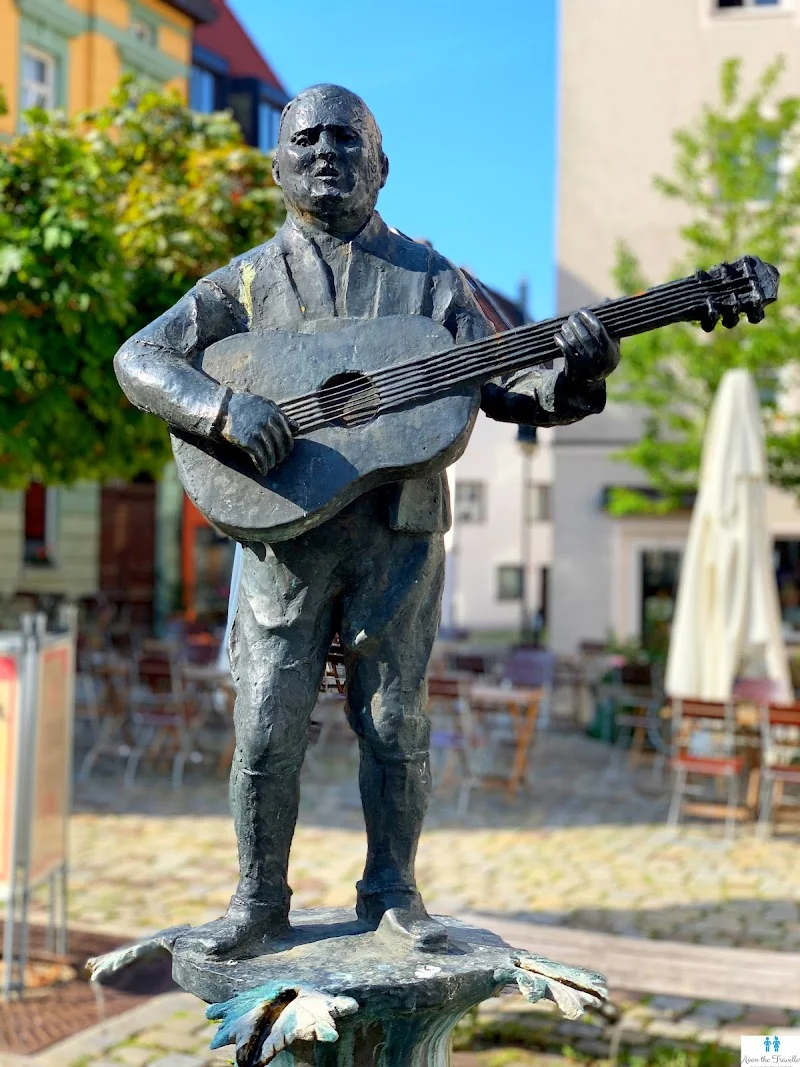
The Roider-Jackl-Fountain is a prominent landmark in the old town of Freising. It is located at Wörth, where Bahnhofstraße and Obere Hauptstraße meet and the ascent to Oberen Domberggasse begins. The bronze figure commemorates Jakob Roider, better known as Roider Jackl, one of the defining Bavarian folk singers of the 20th century. Those strolling through the old town quickly come across the small square with the fountain, which often serves as a meeting point for city tours. Due to its central location between Marienplatz and Domberg, it is an excellent starting point for walks, photo stops, and short breaks. Not to be confused: There is a second fountain of the same name in Munich at Viktualienmarkt. Both honor the same artist but differ in design, location, and use. For visitors in Freising, the fountain is easily accessible, with parking options as well as restaurants and shops just around the corner. Thus, a small monument becomes a vibrant place where city history, culture, and everyday life come together.
Roider-Jackl-Fountain Freising: Location, Access, and Parking
The Freising Roider-Jackl-Fountain is located in a prime city center location: at Wörth, right at the intersection of Bahnhofstraße/Obere Hauptstraße and at the foot of Oberen Domberggasse. This position makes it equally visible to those arriving from the train station as well as to strollers making their way from Marienplatz towards Domberg. Those traveling by train can reach the fountain on foot in just a few minutes: From Freising train station, Bahnhofstraße leads directly into the old town, the path is flat, well signposted, and lined with shops. The location is mentioned in program notes and tourist announcements from the city as an official meeting point, which further enlivens the square and makes it easier to find.
For visitors arriving by car, the parking garage Am Wörth/Domberg is ideal. The access is located at Bahnhofstraße 16. From there, there is a barrier-free route: It is about 200 meters towards Obere Hauptstraße, making it easy to access with strollers or luggage. The parking garage offers numerous spaces and is listed in the city information as a central offering for city center visitors. Alternatively, the Untere Altstadt parking garage and other designated city center parking spaces provide additional capacity. The city center itself is designed for short distances; from the parking garage, restaurants, cafés, and shops can be reached just as quickly as Marienplatz or the ascent to Domberg. Those who prefer bus and train benefit from the dense city bus network that serves the area between Bahnhofstraße and the old town at frequent intervals. This makes the fountain well connected for day visitors and locals – whether for a quick stop on the way to the market, as a starting point for a city tour, or as a quiet photo spot at the edge of the shopping streets.
The city has been working for several years to enhance the old town areas around the fountain. The goal is to increase the quality of stay, slow down traffic, and make pathways safer. Measures such as tree plantings, new paving, and the creation of a more defined square space at Wörth contribute to making the fountain more visible while also providing shade and seating in the vicinity. This creates an urban living room that gives the monument a worthy setting while also relieving everyday life at the edges of the main paths.
Difference: Roider-Jackl-Fountain Freising vs. Viktualienmarkt Munich
Google searches often lead to two locations: the Roider-Jackl-Fountain in Freising and the similarly named fountain at Viktualienmarkt in Munich. Both honor the folk singer Roider Jackl but are created by different artists and stand in very different urban spaces. In Munich, the fountain bears the signature of sculptor Hans Osel; it was erected in 1977 and is classified as a drinking fountain. Its location at Viktualienmarkt makes it part of a whole series of fountains that honor Munich originals and artists. Surrounded by market stalls and old town houses, it is embedded in a lively, tourist-heavy area and is almost continuously accessible. The Munich city information explicitly lists it as a fountain at Viktualienmarkt; in city tours, it is often mentioned together with the other market fountains.
In contrast, the Freising Roider-Jackl-Fountain is a local tribute in a more intimate square. The bronze sculpture comes from Freising artist Karl Huber, who designed the figure as a remembrance of the folk singer who passed away in Freising. The location at Wörth, near the intersection of Bahnhofstraße/Obere Hauptstraße and at the foot of Oberen Domberggasse, connects the axis from the train station into the old town with the ascent to Domberg. While in Munich the market character shapes the experience, in Freising it is the juxtaposition of shopping street, historical urban space, and short distances to sights like Domberg, Marienplatz, and Moosach. Both fountains are independent: they differ in scale, artistic signature, and urban context. Therefore, those searching for images will encounter different settings: In Munich, market stalls and the old town houses around Viktualienmarkt dominate, while in Freising, it is the street intersection at the edge of the old town, the view towards Domberg, and the facades of the main street. This dual aspect explains why autocomplete suggestions often contain both “Freising” and “Viktualienmarkt.”
Images of the Roider-Jackl-Fountain: Munich and Freising in Comparison
The image search provides two thematic worlds. For Freising, public image archives and city portals show the bronze figure in the context of the small square at Wörth, often with sightlines towards Obere Hauptstraße or the ascent to Domberg. Common perspectives include close-ups of the figure and detail views of the fountain base with the engraved Gstanzl. For atmospheric photos, the morning or evening hours are recommended when the soft light emphasizes facades and paving. Those wishing to capture Domberg as a background can easily use slightly offset viewpoints along Bahnhofstraße or Oberen Domberggasse. During the pre-Christmas season or at city festivals, additional life is created through decorations and people in the image; on quieter days, a longer exposure time emphasizes the gentle play of water at the edge of the basin.
For Munich, images that convey the market character dominate: fruit and flower stalls, people in motion, the dense old town backdrop. The bronze figure at Viktualienmarkt is seen in series with other market fountains dedicated to other Munich originals. Typically, it is shown with surrounding elements such as signs, market stalls, and paved areas. Those wishing to photograph both locations in comparison can highlight the characteristic contrasts: In Freising, the quiet old town corner at Wörth, in Munich, the bustling market heart. When researching images, it is important to check the captions and location information, as both fountains share the same name. Helpful keywords include Freising, Wörth, Bahnhofstraße, Obere Hauptstraße, Domberggasse for Freising, as well as Viktualienmarkt and Altstadt-Lehel for Munich. This way, results can be quickly assigned, and misunderstandings are avoided.
Editorial uses also apply: The Freising motifs are excellent for contributions to urban culture, walks between Marienplatz and Domberg, or for references to city tours that start at the fountain. Munich motifs fit reports around Viktualienmarkt, about urban fountains, and cultural walks in the old town. Those wishing to license images should pay attention to the respective source citations and releases from the archives. Many photos are available under free licenses, some come from municipal media sites or city portals. A careful review of image rights remains essential regardless of the location.
Roider-Jackl-Weg in Freising: Reference to the Fountain
The name Roider Jackl is present in Freising not only through the fountain but also through the street name Roider-Jackl-Weg. This naming underscores that the city gives the folk singer permanent visibility beyond the fountain. Addresses in this street show how strongly the reference is anchored in everyday city life. For visitors looking for further traces from the fountain, a round through the old town with detours into side streets and alleys, where historical and modern names meet, is recommended. City tours regularly pick up such naming stories and make their origins tangible: from traditional designations to professional and family names to honors for personalities like Roider Jackl.
The path from the fountain to Roider-Jackl-Weg is symbolic: while the fountain serves as a fixed place of remembrance, the street naming shows how cultural history enters the everyday orientation of a city. For newcomers to the city’s history, the official guided tours offered by the city provide a good opportunity to understand these connections. At the fountain, first anecdotes are often told before moving on to places, squares, and buildings that have shaped Freising. Those exploring individually can orient themselves using the city maps and signposts that open up the city center and mark the most important stations. In total, a dense network of memorial sites emerges: the fountain as an artistic sign, the street name as a practical everyday reminder, and additional stations like Marienplatz, Domberg, or the opened Moosach arms as scenic and historical backdrops. Thus, the name Roider Jackl harmoniously integrates into the Freising experience at several points.
The city’s activities to enhance the old town – such as planting climate-resilient trees and creating a square-like framing of the area at Wörth – contribute to ensuring that the fountain does not stand isolated but is an anchor in an attractive, well-utilized urban space. Events such as concerts at the fountain during the folk festival, markets, or cultural weekends reinforce this effect because they re-stage the square and provide visitors with different access to the city’s history.
Background: Who was Roider Jackl? Fountain and Artist
Roider Jackl, born Jakob Roider on June 17, 1906, in Lower Bavaria's Weihmichl, died on May 8, 1975, in Freising. He is considered a defining figure of the Bavarian folk singer tradition of the post-war period. He became famous for his Gstanzln – pointed, often politically-satirical verses in dialect. His close connection to Freising is still evident today: his final resting place is at the St. Georg cemetery, and the cityscape remembers him with the fountain and the street name. Those wishing to discover his work will find numerous points of connection in the local memory culture, from city tours to thematic events.
The Freising Roider-Jackl-Fountain is a work by artist Karl Huber (1928–2009). Huber, rooted in Freising, created the bronze figure as a monument to the folk singer. A special detail is the Gstanzl about Roider Jackl himself attached to the fountain; it thematically connects to the representations and makes the link between sculpture and life’s work tangible. The location at the foot of Oberen Domberggasse emphasizes the proximity between the old town space and Domberg. Overall, the fountain is intentionally kept compact: it integrates into the street space, marks a square, and remains approachable – a place where passersby can pause, take a photo, or meet.
To better understand the frequent online search queries, it is worth looking at Munich: The Roider-Jackl-Fountain there was erected in 1977 at Viktualienmarkt and is by Hans Osel. It belongs to the series of market fountains that honor Munich originals and artistic personalities and is designated as a drinking fountain. Thus, the name Roider-Jackl-Fountain has two significant fixed points in Bavaria. For research, it is always advisable to specify the sought location – Freising or Munich. This way, information, photos, and access tips can be quickly and correctly assigned.
The bronze figure in Freising stands as a symbol of how local memory culture becomes visible in urban space. It connects art, history, and everyday life without appearing museum-like. Especially because the fountain stands in a busy spot in the old town, it is part of daily life – and perhaps the most authentic way to commemorate a folk singer: not on a closed pedestal but right among the people who shape the city.
Tips for Visiting: Tours, Markets, and Photo Spots at the Fountain
Those visiting the Roider-Jackl-Fountain can easily combine their stay with further experiences in the old town. Several city tours start or end at the fountain – it is designated as a meeting point in the official event announcements. Thematic tours, for example, focus on the stories behind Freising street names, the fountain landscape of the old town, or the traces of the folk singer himself. Even during city festivals, cultural weekends, and market dates, the area around the fountain is activated: around Wörth, there are sales stalls, and as part of the folk festival, there have already been Saturday concerts at the fountain. The square is thus not only a place of remembrance but also a stage for encounters.
Photo enthusiasts should best utilize the sightlines along Bahnhofstraße and Oberen Domberggasse. Due to the slight elevation, attractive backgrounds can be combined with the facades of the main street or hints of Domberg. A tip for quiet motifs: those who come early in the morning often find the square empty and benefit from the angled light on the paving and bronze. In the late afternoon, the sun bathes the area in warm light; depending on the season, reflections on the water and lively shadow images of the trees planted by the city as part of the old town enhancement emerge.
For planning, it is worth looking at accessibility. The paths between the train station, parking garages, and old town are short. Those using the fountain as a starting point can reach Marienplatz, the opened Moosach, and the ascent to Domberg in just a few minutes. Those who prefer to relax will find cafés and bakeries in immediate proximity. Conveniently, the parking garage Am Wörth is so close that a short stop is also possible. Families with children or travelers with luggage benefit from the barrier-free route that the city describes for the connection from the parking garage to the old town. Thus, the small fountain becomes the great conductor of a city walk that connects culture, culinary delights, and views.
Sources:
- Wikipedia – Roider Jackl (Biography, Locations of the Fountains)
- State Capital Munich – Roider-Jackl-Fountain at Viktualienmarkt
- MUX Munich – Roider Jackl Fountain, Viktualienmarkt (Information on Hans Osel, 1977)
- Tourism Freising – Arrival & Parking (Parking Garage Am Wörth, Untere Altstadt)
- City of Freising – Parking Garage Am Wörth/Domberg, barrier-free route
- City of Freising – Parking Offer (Parking Garages and Spaces)
- Tourism Freising – Group Tours, Fountain and City Themes
- Tourism Freising – City Tour, Meeting Point Roider-Jackl-Fountain
- Wikimedia Commons – Category Roider-Jackl-Fountain (Freising)
- Komoot – Roider-Jackl-Fountain (Location Description Old Town, Bahnhofstraße/Obere Hauptstraße)
- Wikipedia – Karl Huber (Note on Freising Monument Fountain)
- City of Freising – Walking Trees Upper Old Town (Area at Wörth/Fountain)
- City of Freising – On the Way to the Moosach Opening (Square Design at the Fountain)
- City of Freising – Minutes (Old Town Festival, Area up to the Roider-Jackl-Fountain)
- Tourism Freising – Folk Festival: Saturday Concert at Roider-Jackl-Fountain
Show moreShow less
Roider-Jackl-Fountain | Freising & Viktualienmarkt
The Roider-Jackl-Fountain is a prominent landmark in the old town of Freising. It is located at Wörth, where Bahnhofstraße and Obere Hauptstraße meet and the ascent to Oberen Domberggasse begins. The bronze figure commemorates Jakob Roider, better known as Roider Jackl, one of the defining Bavarian folk singers of the 20th century. Those strolling through the old town quickly come across the small square with the fountain, which often serves as a meeting point for city tours. Due to its central location between Marienplatz and Domberg, it is an excellent starting point for walks, photo stops, and short breaks. Not to be confused: There is a second fountain of the same name in Munich at Viktualienmarkt. Both honor the same artist but differ in design, location, and use. For visitors in Freising, the fountain is easily accessible, with parking options as well as restaurants and shops just around the corner. Thus, a small monument becomes a vibrant place where city history, culture, and everyday life come together.
Roider-Jackl-Fountain Freising: Location, Access, and Parking
The Freising Roider-Jackl-Fountain is located in a prime city center location: at Wörth, right at the intersection of Bahnhofstraße/Obere Hauptstraße and at the foot of Oberen Domberggasse. This position makes it equally visible to those arriving from the train station as well as to strollers making their way from Marienplatz towards Domberg. Those traveling by train can reach the fountain on foot in just a few minutes: From Freising train station, Bahnhofstraße leads directly into the old town, the path is flat, well signposted, and lined with shops. The location is mentioned in program notes and tourist announcements from the city as an official meeting point, which further enlivens the square and makes it easier to find.
For visitors arriving by car, the parking garage Am Wörth/Domberg is ideal. The access is located at Bahnhofstraße 16. From there, there is a barrier-free route: It is about 200 meters towards Obere Hauptstraße, making it easy to access with strollers or luggage. The parking garage offers numerous spaces and is listed in the city information as a central offering for city center visitors. Alternatively, the Untere Altstadt parking garage and other designated city center parking spaces provide additional capacity. The city center itself is designed for short distances; from the parking garage, restaurants, cafés, and shops can be reached just as quickly as Marienplatz or the ascent to Domberg. Those who prefer bus and train benefit from the dense city bus network that serves the area between Bahnhofstraße and the old town at frequent intervals. This makes the fountain well connected for day visitors and locals – whether for a quick stop on the way to the market, as a starting point for a city tour, or as a quiet photo spot at the edge of the shopping streets.
The city has been working for several years to enhance the old town areas around the fountain. The goal is to increase the quality of stay, slow down traffic, and make pathways safer. Measures such as tree plantings, new paving, and the creation of a more defined square space at Wörth contribute to making the fountain more visible while also providing shade and seating in the vicinity. This creates an urban living room that gives the monument a worthy setting while also relieving everyday life at the edges of the main paths.
Difference: Roider-Jackl-Fountain Freising vs. Viktualienmarkt Munich
Google searches often lead to two locations: the Roider-Jackl-Fountain in Freising and the similarly named fountain at Viktualienmarkt in Munich. Both honor the folk singer Roider Jackl but are created by different artists and stand in very different urban spaces. In Munich, the fountain bears the signature of sculptor Hans Osel; it was erected in 1977 and is classified as a drinking fountain. Its location at Viktualienmarkt makes it part of a whole series of fountains that honor Munich originals and artists. Surrounded by market stalls and old town houses, it is embedded in a lively, tourist-heavy area and is almost continuously accessible. The Munich city information explicitly lists it as a fountain at Viktualienmarkt; in city tours, it is often mentioned together with the other market fountains.
In contrast, the Freising Roider-Jackl-Fountain is a local tribute in a more intimate square. The bronze sculpture comes from Freising artist Karl Huber, who designed the figure as a remembrance of the folk singer who passed away in Freising. The location at Wörth, near the intersection of Bahnhofstraße/Obere Hauptstraße and at the foot of Oberen Domberggasse, connects the axis from the train station into the old town with the ascent to Domberg. While in Munich the market character shapes the experience, in Freising it is the juxtaposition of shopping street, historical urban space, and short distances to sights like Domberg, Marienplatz, and Moosach. Both fountains are independent: they differ in scale, artistic signature, and urban context. Therefore, those searching for images will encounter different settings: In Munich, market stalls and the old town houses around Viktualienmarkt dominate, while in Freising, it is the street intersection at the edge of the old town, the view towards Domberg, and the facades of the main street. This dual aspect explains why autocomplete suggestions often contain both “Freising” and “Viktualienmarkt.”
Images of the Roider-Jackl-Fountain: Munich and Freising in Comparison
The image search provides two thematic worlds. For Freising, public image archives and city portals show the bronze figure in the context of the small square at Wörth, often with sightlines towards Obere Hauptstraße or the ascent to Domberg. Common perspectives include close-ups of the figure and detail views of the fountain base with the engraved Gstanzl. For atmospheric photos, the morning or evening hours are recommended when the soft light emphasizes facades and paving. Those wishing to capture Domberg as a background can easily use slightly offset viewpoints along Bahnhofstraße or Oberen Domberggasse. During the pre-Christmas season or at city festivals, additional life is created through decorations and people in the image; on quieter days, a longer exposure time emphasizes the gentle play of water at the edge of the basin.
For Munich, images that convey the market character dominate: fruit and flower stalls, people in motion, the dense old town backdrop. The bronze figure at Viktualienmarkt is seen in series with other market fountains dedicated to other Munich originals. Typically, it is shown with surrounding elements such as signs, market stalls, and paved areas. Those wishing to photograph both locations in comparison can highlight the characteristic contrasts: In Freising, the quiet old town corner at Wörth, in Munich, the bustling market heart. When researching images, it is important to check the captions and location information, as both fountains share the same name. Helpful keywords include Freising, Wörth, Bahnhofstraße, Obere Hauptstraße, Domberggasse for Freising, as well as Viktualienmarkt and Altstadt-Lehel for Munich. This way, results can be quickly assigned, and misunderstandings are avoided.
Editorial uses also apply: The Freising motifs are excellent for contributions to urban culture, walks between Marienplatz and Domberg, or for references to city tours that start at the fountain. Munich motifs fit reports around Viktualienmarkt, about urban fountains, and cultural walks in the old town. Those wishing to license images should pay attention to the respective source citations and releases from the archives. Many photos are available under free licenses, some come from municipal media sites or city portals. A careful review of image rights remains essential regardless of the location.
Roider-Jackl-Weg in Freising: Reference to the Fountain
The name Roider Jackl is present in Freising not only through the fountain but also through the street name Roider-Jackl-Weg. This naming underscores that the city gives the folk singer permanent visibility beyond the fountain. Addresses in this street show how strongly the reference is anchored in everyday city life. For visitors looking for further traces from the fountain, a round through the old town with detours into side streets and alleys, where historical and modern names meet, is recommended. City tours regularly pick up such naming stories and make their origins tangible: from traditional designations to professional and family names to honors for personalities like Roider Jackl.
The path from the fountain to Roider-Jackl-Weg is symbolic: while the fountain serves as a fixed place of remembrance, the street naming shows how cultural history enters the everyday orientation of a city. For newcomers to the city’s history, the official guided tours offered by the city provide a good opportunity to understand these connections. At the fountain, first anecdotes are often told before moving on to places, squares, and buildings that have shaped Freising. Those exploring individually can orient themselves using the city maps and signposts that open up the city center and mark the most important stations. In total, a dense network of memorial sites emerges: the fountain as an artistic sign, the street name as a practical everyday reminder, and additional stations like Marienplatz, Domberg, or the opened Moosach arms as scenic and historical backdrops. Thus, the name Roider Jackl harmoniously integrates into the Freising experience at several points.
The city’s activities to enhance the old town – such as planting climate-resilient trees and creating a square-like framing of the area at Wörth – contribute to ensuring that the fountain does not stand isolated but is an anchor in an attractive, well-utilized urban space. Events such as concerts at the fountain during the folk festival, markets, or cultural weekends reinforce this effect because they re-stage the square and provide visitors with different access to the city’s history.
Background: Who was Roider Jackl? Fountain and Artist
Roider Jackl, born Jakob Roider on June 17, 1906, in Lower Bavaria's Weihmichl, died on May 8, 1975, in Freising. He is considered a defining figure of the Bavarian folk singer tradition of the post-war period. He became famous for his Gstanzln – pointed, often politically-satirical verses in dialect. His close connection to Freising is still evident today: his final resting place is at the St. Georg cemetery, and the cityscape remembers him with the fountain and the street name. Those wishing to discover his work will find numerous points of connection in the local memory culture, from city tours to thematic events.
The Freising Roider-Jackl-Fountain is a work by artist Karl Huber (1928–2009). Huber, rooted in Freising, created the bronze figure as a monument to the folk singer. A special detail is the Gstanzl about Roider Jackl himself attached to the fountain; it thematically connects to the representations and makes the link between sculpture and life’s work tangible. The location at the foot of Oberen Domberggasse emphasizes the proximity between the old town space and Domberg. Overall, the fountain is intentionally kept compact: it integrates into the street space, marks a square, and remains approachable – a place where passersby can pause, take a photo, or meet.
To better understand the frequent online search queries, it is worth looking at Munich: The Roider-Jackl-Fountain there was erected in 1977 at Viktualienmarkt and is by Hans Osel. It belongs to the series of market fountains that honor Munich originals and artistic personalities and is designated as a drinking fountain. Thus, the name Roider-Jackl-Fountain has two significant fixed points in Bavaria. For research, it is always advisable to specify the sought location – Freising or Munich. This way, information, photos, and access tips can be quickly and correctly assigned.
The bronze figure in Freising stands as a symbol of how local memory culture becomes visible in urban space. It connects art, history, and everyday life without appearing museum-like. Especially because the fountain stands in a busy spot in the old town, it is part of daily life – and perhaps the most authentic way to commemorate a folk singer: not on a closed pedestal but right among the people who shape the city.
Tips for Visiting: Tours, Markets, and Photo Spots at the Fountain
Those visiting the Roider-Jackl-Fountain can easily combine their stay with further experiences in the old town. Several city tours start or end at the fountain – it is designated as a meeting point in the official event announcements. Thematic tours, for example, focus on the stories behind Freising street names, the fountain landscape of the old town, or the traces of the folk singer himself. Even during city festivals, cultural weekends, and market dates, the area around the fountain is activated: around Wörth, there are sales stalls, and as part of the folk festival, there have already been Saturday concerts at the fountain. The square is thus not only a place of remembrance but also a stage for encounters.
Photo enthusiasts should best utilize the sightlines along Bahnhofstraße and Oberen Domberggasse. Due to the slight elevation, attractive backgrounds can be combined with the facades of the main street or hints of Domberg. A tip for quiet motifs: those who come early in the morning often find the square empty and benefit from the angled light on the paving and bronze. In the late afternoon, the sun bathes the area in warm light; depending on the season, reflections on the water and lively shadow images of the trees planted by the city as part of the old town enhancement emerge.
For planning, it is worth looking at accessibility. The paths between the train station, parking garages, and old town are short. Those using the fountain as a starting point can reach Marienplatz, the opened Moosach, and the ascent to Domberg in just a few minutes. Those who prefer to relax will find cafés and bakeries in immediate proximity. Conveniently, the parking garage Am Wörth is so close that a short stop is also possible. Families with children or travelers with luggage benefit from the barrier-free route that the city describes for the connection from the parking garage to the old town. Thus, the small fountain becomes the great conductor of a city walk that connects culture, culinary delights, and views.
Sources:
- Wikipedia – Roider Jackl (Biography, Locations of the Fountains)
- State Capital Munich – Roider-Jackl-Fountain at Viktualienmarkt
- MUX Munich – Roider Jackl Fountain, Viktualienmarkt (Information on Hans Osel, 1977)
- Tourism Freising – Arrival & Parking (Parking Garage Am Wörth, Untere Altstadt)
- City of Freising – Parking Garage Am Wörth/Domberg, barrier-free route
- City of Freising – Parking Offer (Parking Garages and Spaces)
- Tourism Freising – Group Tours, Fountain and City Themes
- Tourism Freising – City Tour, Meeting Point Roider-Jackl-Fountain
- Wikimedia Commons – Category Roider-Jackl-Fountain (Freising)
- Komoot – Roider-Jackl-Fountain (Location Description Old Town, Bahnhofstraße/Obere Hauptstraße)
- Wikipedia – Karl Huber (Note on Freising Monument Fountain)
- City of Freising – Walking Trees Upper Old Town (Area at Wörth/Fountain)
- City of Freising – On the Way to the Moosach Opening (Square Design at the Fountain)
- City of Freising – Minutes (Old Town Festival, Area up to the Roider-Jackl-Fountain)
- Tourism Freising – Folk Festival: Saturday Concert at Roider-Jackl-Fountain
Roider-Jackl-Fountain | Freising & Viktualienmarkt
The Roider-Jackl-Fountain is a prominent landmark in the old town of Freising. It is located at Wörth, where Bahnhofstraße and Obere Hauptstraße meet and the ascent to Oberen Domberggasse begins. The bronze figure commemorates Jakob Roider, better known as Roider Jackl, one of the defining Bavarian folk singers of the 20th century. Those strolling through the old town quickly come across the small square with the fountain, which often serves as a meeting point for city tours. Due to its central location between Marienplatz and Domberg, it is an excellent starting point for walks, photo stops, and short breaks. Not to be confused: There is a second fountain of the same name in Munich at Viktualienmarkt. Both honor the same artist but differ in design, location, and use. For visitors in Freising, the fountain is easily accessible, with parking options as well as restaurants and shops just around the corner. Thus, a small monument becomes a vibrant place where city history, culture, and everyday life come together.
Roider-Jackl-Fountain Freising: Location, Access, and Parking
The Freising Roider-Jackl-Fountain is located in a prime city center location: at Wörth, right at the intersection of Bahnhofstraße/Obere Hauptstraße and at the foot of Oberen Domberggasse. This position makes it equally visible to those arriving from the train station as well as to strollers making their way from Marienplatz towards Domberg. Those traveling by train can reach the fountain on foot in just a few minutes: From Freising train station, Bahnhofstraße leads directly into the old town, the path is flat, well signposted, and lined with shops. The location is mentioned in program notes and tourist announcements from the city as an official meeting point, which further enlivens the square and makes it easier to find.
For visitors arriving by car, the parking garage Am Wörth/Domberg is ideal. The access is located at Bahnhofstraße 16. From there, there is a barrier-free route: It is about 200 meters towards Obere Hauptstraße, making it easy to access with strollers or luggage. The parking garage offers numerous spaces and is listed in the city information as a central offering for city center visitors. Alternatively, the Untere Altstadt parking garage and other designated city center parking spaces provide additional capacity. The city center itself is designed for short distances; from the parking garage, restaurants, cafés, and shops can be reached just as quickly as Marienplatz or the ascent to Domberg. Those who prefer bus and train benefit from the dense city bus network that serves the area between Bahnhofstraße and the old town at frequent intervals. This makes the fountain well connected for day visitors and locals – whether for a quick stop on the way to the market, as a starting point for a city tour, or as a quiet photo spot at the edge of the shopping streets.
The city has been working for several years to enhance the old town areas around the fountain. The goal is to increase the quality of stay, slow down traffic, and make pathways safer. Measures such as tree plantings, new paving, and the creation of a more defined square space at Wörth contribute to making the fountain more visible while also providing shade and seating in the vicinity. This creates an urban living room that gives the monument a worthy setting while also relieving everyday life at the edges of the main paths.
Difference: Roider-Jackl-Fountain Freising vs. Viktualienmarkt Munich
Google searches often lead to two locations: the Roider-Jackl-Fountain in Freising and the similarly named fountain at Viktualienmarkt in Munich. Both honor the folk singer Roider Jackl but are created by different artists and stand in very different urban spaces. In Munich, the fountain bears the signature of sculptor Hans Osel; it was erected in 1977 and is classified as a drinking fountain. Its location at Viktualienmarkt makes it part of a whole series of fountains that honor Munich originals and artists. Surrounded by market stalls and old town houses, it is embedded in a lively, tourist-heavy area and is almost continuously accessible. The Munich city information explicitly lists it as a fountain at Viktualienmarkt; in city tours, it is often mentioned together with the other market fountains.
In contrast, the Freising Roider-Jackl-Fountain is a local tribute in a more intimate square. The bronze sculpture comes from Freising artist Karl Huber, who designed the figure as a remembrance of the folk singer who passed away in Freising. The location at Wörth, near the intersection of Bahnhofstraße/Obere Hauptstraße and at the foot of Oberen Domberggasse, connects the axis from the train station into the old town with the ascent to Domberg. While in Munich the market character shapes the experience, in Freising it is the juxtaposition of shopping street, historical urban space, and short distances to sights like Domberg, Marienplatz, and Moosach. Both fountains are independent: they differ in scale, artistic signature, and urban context. Therefore, those searching for images will encounter different settings: In Munich, market stalls and the old town houses around Viktualienmarkt dominate, while in Freising, it is the street intersection at the edge of the old town, the view towards Domberg, and the facades of the main street. This dual aspect explains why autocomplete suggestions often contain both “Freising” and “Viktualienmarkt.”
Images of the Roider-Jackl-Fountain: Munich and Freising in Comparison
The image search provides two thematic worlds. For Freising, public image archives and city portals show the bronze figure in the context of the small square at Wörth, often with sightlines towards Obere Hauptstraße or the ascent to Domberg. Common perspectives include close-ups of the figure and detail views of the fountain base with the engraved Gstanzl. For atmospheric photos, the morning or evening hours are recommended when the soft light emphasizes facades and paving. Those wishing to capture Domberg as a background can easily use slightly offset viewpoints along Bahnhofstraße or Oberen Domberggasse. During the pre-Christmas season or at city festivals, additional life is created through decorations and people in the image; on quieter days, a longer exposure time emphasizes the gentle play of water at the edge of the basin.
For Munich, images that convey the market character dominate: fruit and flower stalls, people in motion, the dense old town backdrop. The bronze figure at Viktualienmarkt is seen in series with other market fountains dedicated to other Munich originals. Typically, it is shown with surrounding elements such as signs, market stalls, and paved areas. Those wishing to photograph both locations in comparison can highlight the characteristic contrasts: In Freising, the quiet old town corner at Wörth, in Munich, the bustling market heart. When researching images, it is important to check the captions and location information, as both fountains share the same name. Helpful keywords include Freising, Wörth, Bahnhofstraße, Obere Hauptstraße, Domberggasse for Freising, as well as Viktualienmarkt and Altstadt-Lehel for Munich. This way, results can be quickly assigned, and misunderstandings are avoided.
Editorial uses also apply: The Freising motifs are excellent for contributions to urban culture, walks between Marienplatz and Domberg, or for references to city tours that start at the fountain. Munich motifs fit reports around Viktualienmarkt, about urban fountains, and cultural walks in the old town. Those wishing to license images should pay attention to the respective source citations and releases from the archives. Many photos are available under free licenses, some come from municipal media sites or city portals. A careful review of image rights remains essential regardless of the location.
Roider-Jackl-Weg in Freising: Reference to the Fountain
The name Roider Jackl is present in Freising not only through the fountain but also through the street name Roider-Jackl-Weg. This naming underscores that the city gives the folk singer permanent visibility beyond the fountain. Addresses in this street show how strongly the reference is anchored in everyday city life. For visitors looking for further traces from the fountain, a round through the old town with detours into side streets and alleys, where historical and modern names meet, is recommended. City tours regularly pick up such naming stories and make their origins tangible: from traditional designations to professional and family names to honors for personalities like Roider Jackl.
The path from the fountain to Roider-Jackl-Weg is symbolic: while the fountain serves as a fixed place of remembrance, the street naming shows how cultural history enters the everyday orientation of a city. For newcomers to the city’s history, the official guided tours offered by the city provide a good opportunity to understand these connections. At the fountain, first anecdotes are often told before moving on to places, squares, and buildings that have shaped Freising. Those exploring individually can orient themselves using the city maps and signposts that open up the city center and mark the most important stations. In total, a dense network of memorial sites emerges: the fountain as an artistic sign, the street name as a practical everyday reminder, and additional stations like Marienplatz, Domberg, or the opened Moosach arms as scenic and historical backdrops. Thus, the name Roider Jackl harmoniously integrates into the Freising experience at several points.
The city’s activities to enhance the old town – such as planting climate-resilient trees and creating a square-like framing of the area at Wörth – contribute to ensuring that the fountain does not stand isolated but is an anchor in an attractive, well-utilized urban space. Events such as concerts at the fountain during the folk festival, markets, or cultural weekends reinforce this effect because they re-stage the square and provide visitors with different access to the city’s history.
Background: Who was Roider Jackl? Fountain and Artist
Roider Jackl, born Jakob Roider on June 17, 1906, in Lower Bavaria's Weihmichl, died on May 8, 1975, in Freising. He is considered a defining figure of the Bavarian folk singer tradition of the post-war period. He became famous for his Gstanzln – pointed, often politically-satirical verses in dialect. His close connection to Freising is still evident today: his final resting place is at the St. Georg cemetery, and the cityscape remembers him with the fountain and the street name. Those wishing to discover his work will find numerous points of connection in the local memory culture, from city tours to thematic events.
The Freising Roider-Jackl-Fountain is a work by artist Karl Huber (1928–2009). Huber, rooted in Freising, created the bronze figure as a monument to the folk singer. A special detail is the Gstanzl about Roider Jackl himself attached to the fountain; it thematically connects to the representations and makes the link between sculpture and life’s work tangible. The location at the foot of Oberen Domberggasse emphasizes the proximity between the old town space and Domberg. Overall, the fountain is intentionally kept compact: it integrates into the street space, marks a square, and remains approachable – a place where passersby can pause, take a photo, or meet.
To better understand the frequent online search queries, it is worth looking at Munich: The Roider-Jackl-Fountain there was erected in 1977 at Viktualienmarkt and is by Hans Osel. It belongs to the series of market fountains that honor Munich originals and artistic personalities and is designated as a drinking fountain. Thus, the name Roider-Jackl-Fountain has two significant fixed points in Bavaria. For research, it is always advisable to specify the sought location – Freising or Munich. This way, information, photos, and access tips can be quickly and correctly assigned.
The bronze figure in Freising stands as a symbol of how local memory culture becomes visible in urban space. It connects art, history, and everyday life without appearing museum-like. Especially because the fountain stands in a busy spot in the old town, it is part of daily life – and perhaps the most authentic way to commemorate a folk singer: not on a closed pedestal but right among the people who shape the city.
Tips for Visiting: Tours, Markets, and Photo Spots at the Fountain
Those visiting the Roider-Jackl-Fountain can easily combine their stay with further experiences in the old town. Several city tours start or end at the fountain – it is designated as a meeting point in the official event announcements. Thematic tours, for example, focus on the stories behind Freising street names, the fountain landscape of the old town, or the traces of the folk singer himself. Even during city festivals, cultural weekends, and market dates, the area around the fountain is activated: around Wörth, there are sales stalls, and as part of the folk festival, there have already been Saturday concerts at the fountain. The square is thus not only a place of remembrance but also a stage for encounters.
Photo enthusiasts should best utilize the sightlines along Bahnhofstraße and Oberen Domberggasse. Due to the slight elevation, attractive backgrounds can be combined with the facades of the main street or hints of Domberg. A tip for quiet motifs: those who come early in the morning often find the square empty and benefit from the angled light on the paving and bronze. In the late afternoon, the sun bathes the area in warm light; depending on the season, reflections on the water and lively shadow images of the trees planted by the city as part of the old town enhancement emerge.
For planning, it is worth looking at accessibility. The paths between the train station, parking garages, and old town are short. Those using the fountain as a starting point can reach Marienplatz, the opened Moosach, and the ascent to Domberg in just a few minutes. Those who prefer to relax will find cafés and bakeries in immediate proximity. Conveniently, the parking garage Am Wörth is so close that a short stop is also possible. Families with children or travelers with luggage benefit from the barrier-free route that the city describes for the connection from the parking garage to the old town. Thus, the small fountain becomes the great conductor of a city walk that connects culture, culinary delights, and views.
Sources:
- Wikipedia – Roider Jackl (Biography, Locations of the Fountains)
- State Capital Munich – Roider-Jackl-Fountain at Viktualienmarkt
- MUX Munich – Roider Jackl Fountain, Viktualienmarkt (Information on Hans Osel, 1977)
- Tourism Freising – Arrival & Parking (Parking Garage Am Wörth, Untere Altstadt)
- City of Freising – Parking Garage Am Wörth/Domberg, barrier-free route
- City of Freising – Parking Offer (Parking Garages and Spaces)
- Tourism Freising – Group Tours, Fountain and City Themes
- Tourism Freising – City Tour, Meeting Point Roider-Jackl-Fountain
- Wikimedia Commons – Category Roider-Jackl-Fountain (Freising)
- Komoot – Roider-Jackl-Fountain (Location Description Old Town, Bahnhofstraße/Obere Hauptstraße)
- Wikipedia – Karl Huber (Note on Freising Monument Fountain)
- City of Freising – Walking Trees Upper Old Town (Area at Wörth/Fountain)
- City of Freising – On the Way to the Moosach Opening (Square Design at the Fountain)
- City of Freising – Minutes (Old Town Festival, Area up to the Roider-Jackl-Fountain)
- Tourism Freising – Folk Festival: Saturday Concert at Roider-Jackl-Fountain
Upcoming Events
No events found
Frequently Asked Questions
Reviews
BradinHK
22. June 2018
Roider-Jackl-Brunnen is a simple sculpture fountain located at the small square at the Bahnhogstrasse and Obere Hauptstrasse intersection in the city centre. This is a small bronze of Roider Jackl strumming his guitar. Small trickles of water pour over leaf pattern spouts into a small well. There is German engraving on the front of the well about Roider Jackl. This is a cute fountain, similar to those seen in Viktualienmarkt in Munich. Have a quick look and continue onward with intended sightseeing in Freising.
Aoon Mujtaba (Aoon The Traveller)
11. August 2020
Highly recommended to explore this area while you are in Freising, Germany.
Me, I_love_life
11. February 2026
Roider Jackl (real name Jakob Roider, 1906–1975) was the "political dwarf" among Bavarian folk singers. While the other fountain heroes shone more through acting and humor, he was the undisputed king of the Gstanzl (satirical verse). Here are the facts and legends that make him so special: The quick-witted forester: He wasn't a trained actor, but a forestry official by profession. His employer was the Free State of Bavaria. This didn't stop him from mercilessly mocking the Bavarian state government and even the Federal Chancellor in his verses. The "public enemy" with civil servant status: His performance at the Nockherberg is legendary. He was the first to elevate political satire to a high art form. It is said that the ministers trembled before his verses, but had to put on a brave face because the people loved him. Legend surrounding Adenauer: It is said that during a visit to Bavaria, he greeted Chancellor Konrad Adenauer with such sharp wit in the form of a traditional Bavarian folk song that Adenauer only realized how insulted he had just been belatedly—and then couldn't help but laugh heartily. The "Viktualienmarkt Fountain Clash": His fountain (erected in 1977) depicts him with his beloved zither. It is the only fountain that portrays a person with a musical instrument—a symbol of the power of words, which, through music, become a weapon. Official information about the Roider Jackl Fountain. Almost forgotten: Roider Jackl was a master of improvisation. He could spontaneously respond to shouts from the audience. Many of these brilliant moments are lost today, as they were never recorded and only live on in the memories of those who witnessed them. The Bavarian conscience: In the post-war era, he was one of the few who dared to openly address corruption and cronyism – always disguised in the innocuous-sounding three-beat rhythm of a Gstanzl (a traditional Bavarian folk song). Here's the truly remarkable part, often forgotten: The "civil servant rebel": He was a forestry secretary his entire life, and thus a civil servant. His scathing mockery of his own superior – the Bavarian state government – at the Nockherberg festival was a legal tightrope walk. He should have been prosecuted for "insulting state authorities," but he was so popular that he was allowed to get away with it. The slap in the face for the Chancellor: Legend has it that he sang a Gstanzl to Konrad Adenauer at a reception, one so subtly wicked that the Chancellor asked him if he could translate it into German. Jackl replied dryly: "Mr. Chancellor, the truth is hard enough to bear in Bavarian." The inventor of the "live diss": Long before rap battles, he mastered the art of the impromptu Bavarian folk song. He would have the audience shout out words and, within seconds, craft a punchline. This art of "ad-hoc mockery" is now considered almost extinct. The zither as a shield: He used his instrument almost like a weapon. If a rhyme was particularly "harsh," he would follow it with a particularly sweet chord on the zither to mask its sharpness. Critics called this his "acoustic cloak of invisibility." The forgotten film star: He acted in Heimatfilme (German regional films) like "Der Ehestreik" (The Marriage Strike), but strictly refused to wear makeup or learn lines. He said, "I look the way I look, and I talk the way I speak." This drove directors to despair, but made him the most authentic face on screen. The Fountain Mystery: His fountain at the Viktualienmarkt is the only one that depicts an artist with his tools. But look at his gaze: He's not looking at the crowd, but slightly to the side – as if he's eyeing the next minister strolling through the market. Did you know that he often wrote his Gstanzl (traditional Bavarian folk songs) on beer coasters, which are now preserved as cultural heritage in the Bavarian State Archives? His grave is not in Munich, but in his adopted home of Freising, in the St. Georg Cemetery.
Warkop Jogokariyan
12. September 2022
This is quite a beautiful place with very distinctive buildings. I love the city of Freising, even though it's thousands of kilometers from where I live. I passed this place on my way from the train station to my hotel. The fountain isn't very large, but it offers something different.
Thomas Schmiedgen
25. April 2024
Beautiful little fountain in the city center of Freising.