
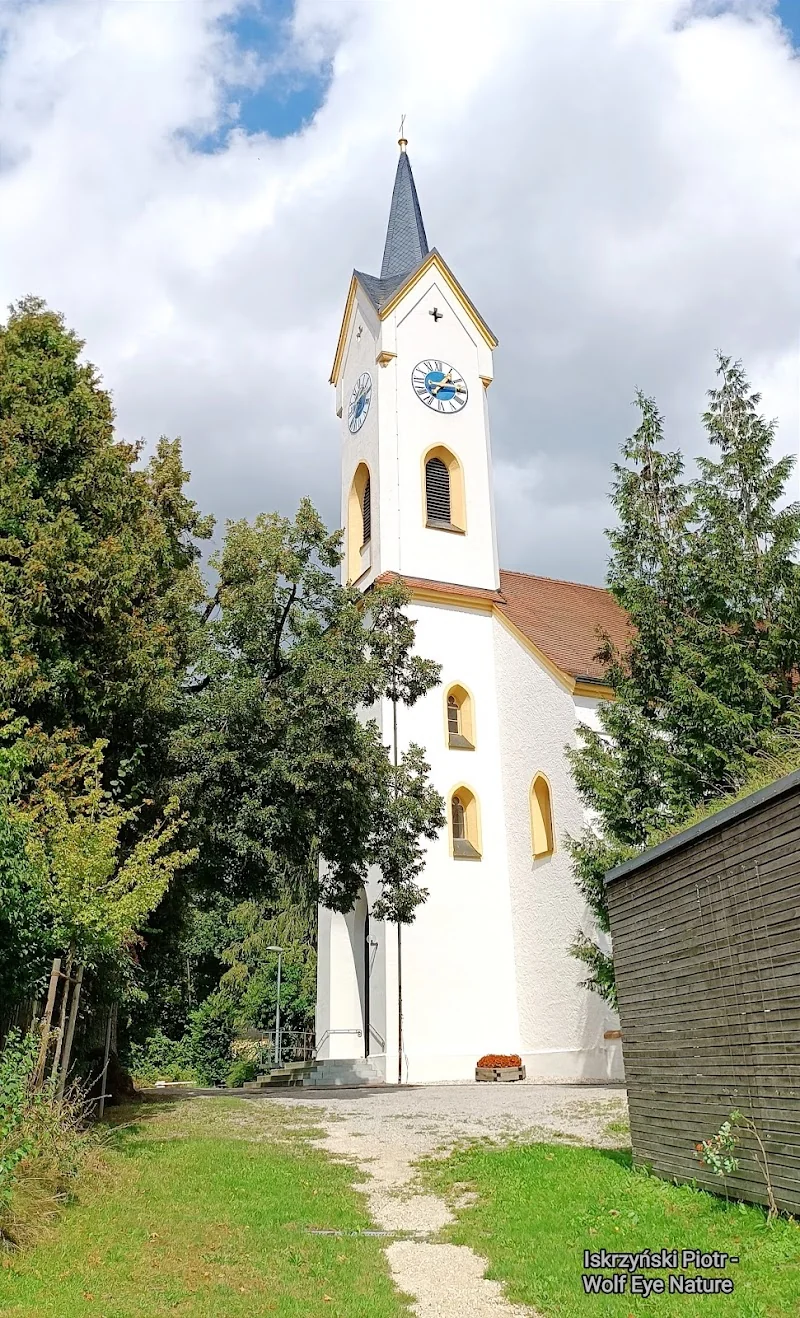
Hohenbachernstraße 37, Freising-Vötting
Hohenbachernstraße 37, 85354 Freising, Germany
St. Jakob - Freising | Church & Way of St. James
St. Jakob in Freising-Vötting is much more than a church building on the outskirts of the Freising city center. The parish church stands on a hill in the west of the city, near the Weihenstephan university campus, and has shaped the district of Vötting since the 19th century as a visible sign of history, faith, and local identity. Those searching for St. Jakob Freising, Church of St. Jakob Freising, or Parish of St. Jakob Freising Vötting will find here a place where the long Weihenstephan tradition, the community life of the city church of Freising, and the Way of St. James connection come together in a coherent whole. The church is built in neo-Gothic forms, was consecrated in 1857, and is located in an environment that has been shaped by the old spiritual center of Freising for centuries. Today, in addition to the house of worship, the parish office and the parish center at Hohenbachernstraße 37 are part of the daily presence of the parish in the district. Thus, St. Jakob is not only a historical church building but also a vibrant place for services, pastoral care, family offerings, and local community. ([stadtkirche-freising.de](https://www.stadtkirche-freising.de/geschichte-der-pfarrei))
History of the Parish of St. Jakob in Vötting
The history of St. Jakob in Freising is closely linked to the earlier development of the Weihenstephan hill. According to the city church of Freising, the first signs of a parish organization can be traced back to around the year 830, when a small spiritual community emerged in the vicinity of what would later become the Weihenstephan monastery. In 1021, this developed into a Benedictine abbey, and the monastery parish of Weihenstephan included the places Vötting, Hohenbachern, Kleinbachern, Dürnast, Oberberghausen, and Wippenhausen. In 1158, the parish community received its own church immediately in front of the west entrance of the monastery, which was consecrated by Bishop Otto I of Freising and dedicated to Saint James the Elder. This early tradition of St. James is still part of the identity of the place today. With the secularization of 1803, this old church was demolished; by 1810/1811, the former monastery church also disappeared, leaving the parish without an actual parish church for a long time. The filial church in Hohenbachern and a provisional chapel were not sufficient in the long term, which is why citizens of Vötting and parish vicars campaigned for a new building for decades. ([stadtkirche-freising.de](https://www.stadtkirche-freising.de/geschichte-der-pfarrei))
It was not until 1851 that King Maximilian II Joseph ordered a reorganization of the parish and promised the construction of a new church along with a parish house; the construction costs were borne by the state. In 1854, work began north of the town center of Vötting. The official presentation of the city church of Freising emphasizes that the new parish church was equipped with Gothic architectural and furnishing elements and could be consecrated in 1857 after its completion. This restored an orderly church structure in the old parish. At the same time, the name of the parish changed to Weihenstephan-Vötting. A further turning point came in 1937 with the incorporation of Vötting into Freising: the Weihenstephan parish became the city parish of St. Jakob Freising, which is still valid today. The current structure still includes Vötting, Hohenbachern, Kleinbachern, Dürnast, and Gartelshausen, as well as facilities of the Weihenstephan science center. For the search terms St. Jakob Freising history or Parish of St. Jakob Freising Vötting, this historical path is crucial because it explains why the church is relatively young compared to medieval buildings, while the parish tradition is significantly older. ([stadtkirche-freising.de](https://www.stadtkirche-freising.de/geschichte-der-pfarrei))
Neo-Gothic Architecture, Furnishings, and Organ
The current parish church of St. Jakob was built between 1854 and 1857 in historically neo-Gothic forms. Outdooractive describes the building as generously dimensioned, as it was intended not only to serve the parish community but also the teachers and students in Weihenstephan. The architects mentioned are Franz Xaver Beyschlag and Carl Klumpp, both associated with Friedrich von Gärtner. This classification is important because it shows that St. Jakob was not planned as a small village church but as a representative sacred building with a supra-local function. The official parish history also confirms that the church was built north of the town center and equipped with Gothic architectural and furnishing elements. The result is a building that sets a clear accent in the Freising church landscape: neo-Gothic, restrained in form language, but clearly oriented towards dignity, order, and liturgical clarity. Especially for people searching for Church of St. Jakob Freising or St. Jakob Freising opening hours, it is helpful to know that they are facing a functional parish building from the 19th century that still tells a strong story of the medieval St. James tradition. ([outdooractive.com](https://www.outdooractive.com/de/poi/region-muenchen-ingolstadt/pfarrkirche-st.-jakob-in-voetting/63857489/))
Regarding the interior furnishings, the Archdiocese of Munich and Freising provides a specific hint about the organ of the parish church: it is an instrument by an unknown organ builder from around 1950, which was restored in 2003 by organ builder Maximilian Offner. The organ has 20 registers on two manuals and pedal and operates with a pneumatic cone chest. Thus, it is an essential part of the musical life in the area of St. Jakob Freising organ. For a parish church, this is more than just technical equipment: such an organ supports services, festive days, and church music and significantly shapes the acoustic impact of the interior. The official documentation also mentions the acceptance on 17.09.2003 by the organ expert KMD Wolfgang Kiechle. Even though the church is primarily perceived today as a parish church, the organ shows that in St. Jakob, not only liturgical practice but also musical care plays a role. This is a strong added value for visitors who are interested in architecture, sound, and church culture. ([erzbistum-muenchen.de](https://www.erzbistum-muenchen.de/ordinariat/ressort-4-seelsorge-und-kirchliches-leben/Kirchenmusik/orgeln/cont/75310))
Parish Office, Kindergarten, and Parish Center at Hohenbachernstraße 37
Those searching for St. Jakob Freising parish office or St. Jakob Freising kindergarten will inevitably end up at Hohenbachernstraße 37. According to the official city church of Freising, the parish office St. Jakob is located there; the opening hours are Thursdays from 3:00 PM to 5:00 PM. The same address also appears in the history of the parish as the location of the parish center Vötting, which was built in 1965 under city pastor Matthias Gammel. Particularly interesting is the dual use: the parish center houses an integrated kindergarten, and according to the city church, the building was the first parish center in the Freising deanery. In 1992, it was expanded after a land exchange to create additional rooms for youth and parish groups. These facts are very valuable for practical orientation, as they show that St. Jakob is not just a church in the narrower sense but a whole church site with administrative, educational, and meeting functions. This also explains why many people associate the parish with the search term St. Jakob Freising kindergarten: here is indeed a church place where worship, administration, and family work are closely interconnected. ([stadtkirche-freising.de](https://www.stadtkirche-freising.de/geschichte-der-pfarrei))
The parish center is not only significant internally but also serves as an expression of local roots externally. According to parish history, parish members can rent rooms for special occasions there. Thus, the building functions as a meeting place for groups, conversations, celebrations, and events, acting as a social anchor in the Vötting district. Especially for a location like St. Jakob in Freising, this dual function is crucial: the place does not only live from its history but also from its everyday use. For families with children, for volunteers, for groups, and for people interested in church infrastructure, the address Hohenbachernstraße 37 is therefore a central reference point. It bundles the search intentions for opening hours, contact, kindergarten, and parish office into a single, clearly defined location. ([stadtkirche-freising.de](https://www.stadtkirche-freising.de/geschichte-der-pfarrei))
Services and Church Life Today
Current church life is a particularly important SEO and information aspect for St. Jakob Freising because many users specifically search for programs, services, or opening hours. The city church of Freising has adjusted its weekend schedule as of October 1, 2024; for St. Jakob Vötting, a service is now regularly scheduled on Sundays at 10:30 AM. This information is practically relevant as it provides orientation for visits and places the location within the ongoing parish operations. The new schedule was decided after a lengthy discussion process with the stakeholders and committees to better align the service schedule with the wishes of the faithful. St. Jakob is thus not a static memorial but part of an active city church with several locations. Those searching for St. Jakob Freising opening hours or service St. Jakob Vötting will therefore find a lively place of celebration that is clearly integrated into the structure of the city church of Freising. ([stadtkirche-freising.de](https://www.stadtkirche-freising.de/archiv/i/82829997/neue-gottesdienstzeiten-ab-oktober))
Especially this integration into the city church is important for the perception of the place. The official parish history describes St. Jakob as the city parish of Freising with a district that includes not only Vötting and Hohenbachern but also Kleinbachern, Dürnast, and Gartelshausen. Additionally, there are facilities of the Weihenstephan science center. This means: it is not just about a single village church, but about a church center with regional relevance. Due to its proximity to the campus, the use of the parish center, and the ongoing services, St. Jakob remains visible in the present. For visitors, this is particularly pleasant because history and present do not contradict each other but complement. One does not only enter a historical building but a place that continues to carry organized parish operations, pastoral care, and church practice. This combination makes St. Jakob so interesting for search queries like Church St. Jakob Freising or St. Jakob Freising history. ([stadtkirche-freising.de](https://www.stadtkirche-freising.de/geschichte-der-pfarrei))
St. Jakob and the Way of St. James in Freising
A particularly strong theme surrounding St. Jakob Freising is the connection to the Way of St. James. Outdooractive explicitly describes the parish church St. Jakob in Vötting as a station on the Munich Way of St. James. This is a central indication for pilgrims and those interested in cultural history, as the Way of St. James gives the place a supra-regional orientation and connects it with a European network of traditions. The St. James tradition is deeply rooted in Freising: even the historical parish church of the 12th century was dedicated to Saint James the Elder. This continuity makes the current church location in Vötting more than just a local parish; it also symbolically represents the journey, departure, arrival, and spiritual search. Those searching for Freising Way of St. James will therefore quickly discover that St. Jakob is a suitable stopping point where the historical significance of the Apostle James and the regional religious history intersect. ([outdooractive.com](https://www.outdooractive.com/de/poi/region-muenchen-ingolstadt/pfarrkirche-st.-jakob-in-voetting/63857489/))
For practical purposes, the location of the church is particularly easy to understand. The city church of Freising describes St. Jakob as a church on a hill in the middle of the original village of Vötting, directly adjacent to the Weihenstephan university campus. Outdooractive complements this perspective with the note that the building in the vicinity of the old spiritual center and the Weihenstephan hill is ideally suited for its role within the Way of St. James. From an SEO perspective, this is important because search queries like Freising Way of St. James, St. Jakob Freising, or Church St. Jakob Freising do not only target a building but a story of being on the way. Those arriving here find a place where tradition does not seem museum-like but continues to live in the city's topography. The St. James tradition is not merely a name in St. Jakob but content. ([stadtkirche-freising.de](https://www.stadtkirche-freising.de/geschichte-der-pfarrei))
Directions, Location, and Orientation on Site
The official address Hohenbachernstraße 37, 85354 Freising provides the most important practical orientation for getting there. The parish office is located exactly there, and the parish center with kindergarten is also situated at this address. Those searching for St. Jakob Freising address or St. Jakob Freising parish office thus have a clear point of contact. The church itself is located in the district of Vötting on a hill and can be easily placed in relation to the town center. Outdooractive also provides a map and travel function and geographically locates the church as a point in the Munich-Ingolstadt region. This is helpful for visitors planning to arrive by car, on foot, or by bicycle. Although the sources do not provide a detailed parking description, the official address is sufficiently clear for navigation and route planning. Thus, practical orientation remains uncomplicated: one drives or walks to Vötting, uses Hohenbachernstraße as a guiding axis, and orients oneself at the parish office or the parish center location. ([stadtkirche-freising.de](https://www.stadtkirche-freising.de/pfarrburos/i/77412095/st-jakob-votting))
Those visiting the church should keep in mind the local context with Weihenstephan. The city church of Freising describes St. Jakob as a building on a hill west of the university campus, and the history of the city of Freising indicates that the layout of the place has been more focused on its own village center since the 19th century. This makes St. Jakob today easily recognizable as a local focal point of Vötting. For people searching for a quiet church place with history, this is a clear advantage. The church is not located in a hectic city center but in an environment where residential areas, parishes, and scientific campuses come together. This makes the location pleasant and clearly identifiable for visitors. Therefore, when searching for St. Jakob Freising opening hours or directions, the combination of official address, parish office contact, and map function is the best way to orient oneself. ([stadtkirche-freising.de](https://www.stadtkirche-freising.de/geschichte-der-pfarrei))
Sources:
- City Church Freising - History of the Parish of St. Jakob
- City Church Freising - Parish Office St. Jakob Vötting
- City Church Freising - New Service Times from October 2024
- Outdooractive - Parish Church St. Jakob in Vötting
- Archdiocese of Munich and Freising - Parish Church St. Jakob in Freising-Vötting
- City of Freising - Archive Pieces 2021
Show moreShow less
St. Jakob - Freising | Church & Way of St. James
St. Jakob in Freising-Vötting is much more than a church building on the outskirts of the Freising city center. The parish church stands on a hill in the west of the city, near the Weihenstephan university campus, and has shaped the district of Vötting since the 19th century as a visible sign of history, faith, and local identity. Those searching for St. Jakob Freising, Church of St. Jakob Freising, or Parish of St. Jakob Freising Vötting will find here a place where the long Weihenstephan tradition, the community life of the city church of Freising, and the Way of St. James connection come together in a coherent whole. The church is built in neo-Gothic forms, was consecrated in 1857, and is located in an environment that has been shaped by the old spiritual center of Freising for centuries. Today, in addition to the house of worship, the parish office and the parish center at Hohenbachernstraße 37 are part of the daily presence of the parish in the district. Thus, St. Jakob is not only a historical church building but also a vibrant place for services, pastoral care, family offerings, and local community. ([stadtkirche-freising.de](https://www.stadtkirche-freising.de/geschichte-der-pfarrei))
History of the Parish of St. Jakob in Vötting
The history of St. Jakob in Freising is closely linked to the earlier development of the Weihenstephan hill. According to the city church of Freising, the first signs of a parish organization can be traced back to around the year 830, when a small spiritual community emerged in the vicinity of what would later become the Weihenstephan monastery. In 1021, this developed into a Benedictine abbey, and the monastery parish of Weihenstephan included the places Vötting, Hohenbachern, Kleinbachern, Dürnast, Oberberghausen, and Wippenhausen. In 1158, the parish community received its own church immediately in front of the west entrance of the monastery, which was consecrated by Bishop Otto I of Freising and dedicated to Saint James the Elder. This early tradition of St. James is still part of the identity of the place today. With the secularization of 1803, this old church was demolished; by 1810/1811, the former monastery church also disappeared, leaving the parish without an actual parish church for a long time. The filial church in Hohenbachern and a provisional chapel were not sufficient in the long term, which is why citizens of Vötting and parish vicars campaigned for a new building for decades. ([stadtkirche-freising.de](https://www.stadtkirche-freising.de/geschichte-der-pfarrei))
It was not until 1851 that King Maximilian II Joseph ordered a reorganization of the parish and promised the construction of a new church along with a parish house; the construction costs were borne by the state. In 1854, work began north of the town center of Vötting. The official presentation of the city church of Freising emphasizes that the new parish church was equipped with Gothic architectural and furnishing elements and could be consecrated in 1857 after its completion. This restored an orderly church structure in the old parish. At the same time, the name of the parish changed to Weihenstephan-Vötting. A further turning point came in 1937 with the incorporation of Vötting into Freising: the Weihenstephan parish became the city parish of St. Jakob Freising, which is still valid today. The current structure still includes Vötting, Hohenbachern, Kleinbachern, Dürnast, and Gartelshausen, as well as facilities of the Weihenstephan science center. For the search terms St. Jakob Freising history or Parish of St. Jakob Freising Vötting, this historical path is crucial because it explains why the church is relatively young compared to medieval buildings, while the parish tradition is significantly older. ([stadtkirche-freising.de](https://www.stadtkirche-freising.de/geschichte-der-pfarrei))
Neo-Gothic Architecture, Furnishings, and Organ
The current parish church of St. Jakob was built between 1854 and 1857 in historically neo-Gothic forms. Outdooractive describes the building as generously dimensioned, as it was intended not only to serve the parish community but also the teachers and students in Weihenstephan. The architects mentioned are Franz Xaver Beyschlag and Carl Klumpp, both associated with Friedrich von Gärtner. This classification is important because it shows that St. Jakob was not planned as a small village church but as a representative sacred building with a supra-local function. The official parish history also confirms that the church was built north of the town center and equipped with Gothic architectural and furnishing elements. The result is a building that sets a clear accent in the Freising church landscape: neo-Gothic, restrained in form language, but clearly oriented towards dignity, order, and liturgical clarity. Especially for people searching for Church of St. Jakob Freising or St. Jakob Freising opening hours, it is helpful to know that they are facing a functional parish building from the 19th century that still tells a strong story of the medieval St. James tradition. ([outdooractive.com](https://www.outdooractive.com/de/poi/region-muenchen-ingolstadt/pfarrkirche-st.-jakob-in-voetting/63857489/))
Regarding the interior furnishings, the Archdiocese of Munich and Freising provides a specific hint about the organ of the parish church: it is an instrument by an unknown organ builder from around 1950, which was restored in 2003 by organ builder Maximilian Offner. The organ has 20 registers on two manuals and pedal and operates with a pneumatic cone chest. Thus, it is an essential part of the musical life in the area of St. Jakob Freising organ. For a parish church, this is more than just technical equipment: such an organ supports services, festive days, and church music and significantly shapes the acoustic impact of the interior. The official documentation also mentions the acceptance on 17.09.2003 by the organ expert KMD Wolfgang Kiechle. Even though the church is primarily perceived today as a parish church, the organ shows that in St. Jakob, not only liturgical practice but also musical care plays a role. This is a strong added value for visitors who are interested in architecture, sound, and church culture. ([erzbistum-muenchen.de](https://www.erzbistum-muenchen.de/ordinariat/ressort-4-seelsorge-und-kirchliches-leben/Kirchenmusik/orgeln/cont/75310))
Parish Office, Kindergarten, and Parish Center at Hohenbachernstraße 37
Those searching for St. Jakob Freising parish office or St. Jakob Freising kindergarten will inevitably end up at Hohenbachernstraße 37. According to the official city church of Freising, the parish office St. Jakob is located there; the opening hours are Thursdays from 3:00 PM to 5:00 PM. The same address also appears in the history of the parish as the location of the parish center Vötting, which was built in 1965 under city pastor Matthias Gammel. Particularly interesting is the dual use: the parish center houses an integrated kindergarten, and according to the city church, the building was the first parish center in the Freising deanery. In 1992, it was expanded after a land exchange to create additional rooms for youth and parish groups. These facts are very valuable for practical orientation, as they show that St. Jakob is not just a church in the narrower sense but a whole church site with administrative, educational, and meeting functions. This also explains why many people associate the parish with the search term St. Jakob Freising kindergarten: here is indeed a church place where worship, administration, and family work are closely interconnected. ([stadtkirche-freising.de](https://www.stadtkirche-freising.de/geschichte-der-pfarrei))
The parish center is not only significant internally but also serves as an expression of local roots externally. According to parish history, parish members can rent rooms for special occasions there. Thus, the building functions as a meeting place for groups, conversations, celebrations, and events, acting as a social anchor in the Vötting district. Especially for a location like St. Jakob in Freising, this dual function is crucial: the place does not only live from its history but also from its everyday use. For families with children, for volunteers, for groups, and for people interested in church infrastructure, the address Hohenbachernstraße 37 is therefore a central reference point. It bundles the search intentions for opening hours, contact, kindergarten, and parish office into a single, clearly defined location. ([stadtkirche-freising.de](https://www.stadtkirche-freising.de/geschichte-der-pfarrei))
Services and Church Life Today
Current church life is a particularly important SEO and information aspect for St. Jakob Freising because many users specifically search for programs, services, or opening hours. The city church of Freising has adjusted its weekend schedule as of October 1, 2024; for St. Jakob Vötting, a service is now regularly scheduled on Sundays at 10:30 AM. This information is practically relevant as it provides orientation for visits and places the location within the ongoing parish operations. The new schedule was decided after a lengthy discussion process with the stakeholders and committees to better align the service schedule with the wishes of the faithful. St. Jakob is thus not a static memorial but part of an active city church with several locations. Those searching for St. Jakob Freising opening hours or service St. Jakob Vötting will therefore find a lively place of celebration that is clearly integrated into the structure of the city church of Freising. ([stadtkirche-freising.de](https://www.stadtkirche-freising.de/archiv/i/82829997/neue-gottesdienstzeiten-ab-oktober))
Especially this integration into the city church is important for the perception of the place. The official parish history describes St. Jakob as the city parish of Freising with a district that includes not only Vötting and Hohenbachern but also Kleinbachern, Dürnast, and Gartelshausen. Additionally, there are facilities of the Weihenstephan science center. This means: it is not just about a single village church, but about a church center with regional relevance. Due to its proximity to the campus, the use of the parish center, and the ongoing services, St. Jakob remains visible in the present. For visitors, this is particularly pleasant because history and present do not contradict each other but complement. One does not only enter a historical building but a place that continues to carry organized parish operations, pastoral care, and church practice. This combination makes St. Jakob so interesting for search queries like Church St. Jakob Freising or St. Jakob Freising history. ([stadtkirche-freising.de](https://www.stadtkirche-freising.de/geschichte-der-pfarrei))
St. Jakob and the Way of St. James in Freising
A particularly strong theme surrounding St. Jakob Freising is the connection to the Way of St. James. Outdooractive explicitly describes the parish church St. Jakob in Vötting as a station on the Munich Way of St. James. This is a central indication for pilgrims and those interested in cultural history, as the Way of St. James gives the place a supra-regional orientation and connects it with a European network of traditions. The St. James tradition is deeply rooted in Freising: even the historical parish church of the 12th century was dedicated to Saint James the Elder. This continuity makes the current church location in Vötting more than just a local parish; it also symbolically represents the journey, departure, arrival, and spiritual search. Those searching for Freising Way of St. James will therefore quickly discover that St. Jakob is a suitable stopping point where the historical significance of the Apostle James and the regional religious history intersect. ([outdooractive.com](https://www.outdooractive.com/de/poi/region-muenchen-ingolstadt/pfarrkirche-st.-jakob-in-voetting/63857489/))
For practical purposes, the location of the church is particularly easy to understand. The city church of Freising describes St. Jakob as a church on a hill in the middle of the original village of Vötting, directly adjacent to the Weihenstephan university campus. Outdooractive complements this perspective with the note that the building in the vicinity of the old spiritual center and the Weihenstephan hill is ideally suited for its role within the Way of St. James. From an SEO perspective, this is important because search queries like Freising Way of St. James, St. Jakob Freising, or Church St. Jakob Freising do not only target a building but a story of being on the way. Those arriving here find a place where tradition does not seem museum-like but continues to live in the city's topography. The St. James tradition is not merely a name in St. Jakob but content. ([stadtkirche-freising.de](https://www.stadtkirche-freising.de/geschichte-der-pfarrei))
Directions, Location, and Orientation on Site
The official address Hohenbachernstraße 37, 85354 Freising provides the most important practical orientation for getting there. The parish office is located exactly there, and the parish center with kindergarten is also situated at this address. Those searching for St. Jakob Freising address or St. Jakob Freising parish office thus have a clear point of contact. The church itself is located in the district of Vötting on a hill and can be easily placed in relation to the town center. Outdooractive also provides a map and travel function and geographically locates the church as a point in the Munich-Ingolstadt region. This is helpful for visitors planning to arrive by car, on foot, or by bicycle. Although the sources do not provide a detailed parking description, the official address is sufficiently clear for navigation and route planning. Thus, practical orientation remains uncomplicated: one drives or walks to Vötting, uses Hohenbachernstraße as a guiding axis, and orients oneself at the parish office or the parish center location. ([stadtkirche-freising.de](https://www.stadtkirche-freising.de/pfarrburos/i/77412095/st-jakob-votting))
Those visiting the church should keep in mind the local context with Weihenstephan. The city church of Freising describes St. Jakob as a building on a hill west of the university campus, and the history of the city of Freising indicates that the layout of the place has been more focused on its own village center since the 19th century. This makes St. Jakob today easily recognizable as a local focal point of Vötting. For people searching for a quiet church place with history, this is a clear advantage. The church is not located in a hectic city center but in an environment where residential areas, parishes, and scientific campuses come together. This makes the location pleasant and clearly identifiable for visitors. Therefore, when searching for St. Jakob Freising opening hours or directions, the combination of official address, parish office contact, and map function is the best way to orient oneself. ([stadtkirche-freising.de](https://www.stadtkirche-freising.de/geschichte-der-pfarrei))
Sources:
- City Church Freising - History of the Parish of St. Jakob
- City Church Freising - Parish Office St. Jakob Vötting
- City Church Freising - New Service Times from October 2024
- Outdooractive - Parish Church St. Jakob in Vötting
- Archdiocese of Munich and Freising - Parish Church St. Jakob in Freising-Vötting
- City of Freising - Archive Pieces 2021
St. Jakob - Freising | Church & Way of St. James
St. Jakob in Freising-Vötting is much more than a church building on the outskirts of the Freising city center. The parish church stands on a hill in the west of the city, near the Weihenstephan university campus, and has shaped the district of Vötting since the 19th century as a visible sign of history, faith, and local identity. Those searching for St. Jakob Freising, Church of St. Jakob Freising, or Parish of St. Jakob Freising Vötting will find here a place where the long Weihenstephan tradition, the community life of the city church of Freising, and the Way of St. James connection come together in a coherent whole. The church is built in neo-Gothic forms, was consecrated in 1857, and is located in an environment that has been shaped by the old spiritual center of Freising for centuries. Today, in addition to the house of worship, the parish office and the parish center at Hohenbachernstraße 37 are part of the daily presence of the parish in the district. Thus, St. Jakob is not only a historical church building but also a vibrant place for services, pastoral care, family offerings, and local community. ([stadtkirche-freising.de](https://www.stadtkirche-freising.de/geschichte-der-pfarrei))
History of the Parish of St. Jakob in Vötting
The history of St. Jakob in Freising is closely linked to the earlier development of the Weihenstephan hill. According to the city church of Freising, the first signs of a parish organization can be traced back to around the year 830, when a small spiritual community emerged in the vicinity of what would later become the Weihenstephan monastery. In 1021, this developed into a Benedictine abbey, and the monastery parish of Weihenstephan included the places Vötting, Hohenbachern, Kleinbachern, Dürnast, Oberberghausen, and Wippenhausen. In 1158, the parish community received its own church immediately in front of the west entrance of the monastery, which was consecrated by Bishop Otto I of Freising and dedicated to Saint James the Elder. This early tradition of St. James is still part of the identity of the place today. With the secularization of 1803, this old church was demolished; by 1810/1811, the former monastery church also disappeared, leaving the parish without an actual parish church for a long time. The filial church in Hohenbachern and a provisional chapel were not sufficient in the long term, which is why citizens of Vötting and parish vicars campaigned for a new building for decades. ([stadtkirche-freising.de](https://www.stadtkirche-freising.de/geschichte-der-pfarrei))
It was not until 1851 that King Maximilian II Joseph ordered a reorganization of the parish and promised the construction of a new church along with a parish house; the construction costs were borne by the state. In 1854, work began north of the town center of Vötting. The official presentation of the city church of Freising emphasizes that the new parish church was equipped with Gothic architectural and furnishing elements and could be consecrated in 1857 after its completion. This restored an orderly church structure in the old parish. At the same time, the name of the parish changed to Weihenstephan-Vötting. A further turning point came in 1937 with the incorporation of Vötting into Freising: the Weihenstephan parish became the city parish of St. Jakob Freising, which is still valid today. The current structure still includes Vötting, Hohenbachern, Kleinbachern, Dürnast, and Gartelshausen, as well as facilities of the Weihenstephan science center. For the search terms St. Jakob Freising history or Parish of St. Jakob Freising Vötting, this historical path is crucial because it explains why the church is relatively young compared to medieval buildings, while the parish tradition is significantly older. ([stadtkirche-freising.de](https://www.stadtkirche-freising.de/geschichte-der-pfarrei))
Neo-Gothic Architecture, Furnishings, and Organ
The current parish church of St. Jakob was built between 1854 and 1857 in historically neo-Gothic forms. Outdooractive describes the building as generously dimensioned, as it was intended not only to serve the parish community but also the teachers and students in Weihenstephan. The architects mentioned are Franz Xaver Beyschlag and Carl Klumpp, both associated with Friedrich von Gärtner. This classification is important because it shows that St. Jakob was not planned as a small village church but as a representative sacred building with a supra-local function. The official parish history also confirms that the church was built north of the town center and equipped with Gothic architectural and furnishing elements. The result is a building that sets a clear accent in the Freising church landscape: neo-Gothic, restrained in form language, but clearly oriented towards dignity, order, and liturgical clarity. Especially for people searching for Church of St. Jakob Freising or St. Jakob Freising opening hours, it is helpful to know that they are facing a functional parish building from the 19th century that still tells a strong story of the medieval St. James tradition. ([outdooractive.com](https://www.outdooractive.com/de/poi/region-muenchen-ingolstadt/pfarrkirche-st.-jakob-in-voetting/63857489/))
Regarding the interior furnishings, the Archdiocese of Munich and Freising provides a specific hint about the organ of the parish church: it is an instrument by an unknown organ builder from around 1950, which was restored in 2003 by organ builder Maximilian Offner. The organ has 20 registers on two manuals and pedal and operates with a pneumatic cone chest. Thus, it is an essential part of the musical life in the area of St. Jakob Freising organ. For a parish church, this is more than just technical equipment: such an organ supports services, festive days, and church music and significantly shapes the acoustic impact of the interior. The official documentation also mentions the acceptance on 17.09.2003 by the organ expert KMD Wolfgang Kiechle. Even though the church is primarily perceived today as a parish church, the organ shows that in St. Jakob, not only liturgical practice but also musical care plays a role. This is a strong added value for visitors who are interested in architecture, sound, and church culture. ([erzbistum-muenchen.de](https://www.erzbistum-muenchen.de/ordinariat/ressort-4-seelsorge-und-kirchliches-leben/Kirchenmusik/orgeln/cont/75310))
Parish Office, Kindergarten, and Parish Center at Hohenbachernstraße 37
Those searching for St. Jakob Freising parish office or St. Jakob Freising kindergarten will inevitably end up at Hohenbachernstraße 37. According to the official city church of Freising, the parish office St. Jakob is located there; the opening hours are Thursdays from 3:00 PM to 5:00 PM. The same address also appears in the history of the parish as the location of the parish center Vötting, which was built in 1965 under city pastor Matthias Gammel. Particularly interesting is the dual use: the parish center houses an integrated kindergarten, and according to the city church, the building was the first parish center in the Freising deanery. In 1992, it was expanded after a land exchange to create additional rooms for youth and parish groups. These facts are very valuable for practical orientation, as they show that St. Jakob is not just a church in the narrower sense but a whole church site with administrative, educational, and meeting functions. This also explains why many people associate the parish with the search term St. Jakob Freising kindergarten: here is indeed a church place where worship, administration, and family work are closely interconnected. ([stadtkirche-freising.de](https://www.stadtkirche-freising.de/geschichte-der-pfarrei))
The parish center is not only significant internally but also serves as an expression of local roots externally. According to parish history, parish members can rent rooms for special occasions there. Thus, the building functions as a meeting place for groups, conversations, celebrations, and events, acting as a social anchor in the Vötting district. Especially for a location like St. Jakob in Freising, this dual function is crucial: the place does not only live from its history but also from its everyday use. For families with children, for volunteers, for groups, and for people interested in church infrastructure, the address Hohenbachernstraße 37 is therefore a central reference point. It bundles the search intentions for opening hours, contact, kindergarten, and parish office into a single, clearly defined location. ([stadtkirche-freising.de](https://www.stadtkirche-freising.de/geschichte-der-pfarrei))
Services and Church Life Today
Current church life is a particularly important SEO and information aspect for St. Jakob Freising because many users specifically search for programs, services, or opening hours. The city church of Freising has adjusted its weekend schedule as of October 1, 2024; for St. Jakob Vötting, a service is now regularly scheduled on Sundays at 10:30 AM. This information is practically relevant as it provides orientation for visits and places the location within the ongoing parish operations. The new schedule was decided after a lengthy discussion process with the stakeholders and committees to better align the service schedule with the wishes of the faithful. St. Jakob is thus not a static memorial but part of an active city church with several locations. Those searching for St. Jakob Freising opening hours or service St. Jakob Vötting will therefore find a lively place of celebration that is clearly integrated into the structure of the city church of Freising. ([stadtkirche-freising.de](https://www.stadtkirche-freising.de/archiv/i/82829997/neue-gottesdienstzeiten-ab-oktober))
Especially this integration into the city church is important for the perception of the place. The official parish history describes St. Jakob as the city parish of Freising with a district that includes not only Vötting and Hohenbachern but also Kleinbachern, Dürnast, and Gartelshausen. Additionally, there are facilities of the Weihenstephan science center. This means: it is not just about a single village church, but about a church center with regional relevance. Due to its proximity to the campus, the use of the parish center, and the ongoing services, St. Jakob remains visible in the present. For visitors, this is particularly pleasant because history and present do not contradict each other but complement. One does not only enter a historical building but a place that continues to carry organized parish operations, pastoral care, and church practice. This combination makes St. Jakob so interesting for search queries like Church St. Jakob Freising or St. Jakob Freising history. ([stadtkirche-freising.de](https://www.stadtkirche-freising.de/geschichte-der-pfarrei))
St. Jakob and the Way of St. James in Freising
A particularly strong theme surrounding St. Jakob Freising is the connection to the Way of St. James. Outdooractive explicitly describes the parish church St. Jakob in Vötting as a station on the Munich Way of St. James. This is a central indication for pilgrims and those interested in cultural history, as the Way of St. James gives the place a supra-regional orientation and connects it with a European network of traditions. The St. James tradition is deeply rooted in Freising: even the historical parish church of the 12th century was dedicated to Saint James the Elder. This continuity makes the current church location in Vötting more than just a local parish; it also symbolically represents the journey, departure, arrival, and spiritual search. Those searching for Freising Way of St. James will therefore quickly discover that St. Jakob is a suitable stopping point where the historical significance of the Apostle James and the regional religious history intersect. ([outdooractive.com](https://www.outdooractive.com/de/poi/region-muenchen-ingolstadt/pfarrkirche-st.-jakob-in-voetting/63857489/))
For practical purposes, the location of the church is particularly easy to understand. The city church of Freising describes St. Jakob as a church on a hill in the middle of the original village of Vötting, directly adjacent to the Weihenstephan university campus. Outdooractive complements this perspective with the note that the building in the vicinity of the old spiritual center and the Weihenstephan hill is ideally suited for its role within the Way of St. James. From an SEO perspective, this is important because search queries like Freising Way of St. James, St. Jakob Freising, or Church St. Jakob Freising do not only target a building but a story of being on the way. Those arriving here find a place where tradition does not seem museum-like but continues to live in the city's topography. The St. James tradition is not merely a name in St. Jakob but content. ([stadtkirche-freising.de](https://www.stadtkirche-freising.de/geschichte-der-pfarrei))
Directions, Location, and Orientation on Site
The official address Hohenbachernstraße 37, 85354 Freising provides the most important practical orientation for getting there. The parish office is located exactly there, and the parish center with kindergarten is also situated at this address. Those searching for St. Jakob Freising address or St. Jakob Freising parish office thus have a clear point of contact. The church itself is located in the district of Vötting on a hill and can be easily placed in relation to the town center. Outdooractive also provides a map and travel function and geographically locates the church as a point in the Munich-Ingolstadt region. This is helpful for visitors planning to arrive by car, on foot, or by bicycle. Although the sources do not provide a detailed parking description, the official address is sufficiently clear for navigation and route planning. Thus, practical orientation remains uncomplicated: one drives or walks to Vötting, uses Hohenbachernstraße as a guiding axis, and orients oneself at the parish office or the parish center location. ([stadtkirche-freising.de](https://www.stadtkirche-freising.de/pfarrburos/i/77412095/st-jakob-votting))
Those visiting the church should keep in mind the local context with Weihenstephan. The city church of Freising describes St. Jakob as a building on a hill west of the university campus, and the history of the city of Freising indicates that the layout of the place has been more focused on its own village center since the 19th century. This makes St. Jakob today easily recognizable as a local focal point of Vötting. For people searching for a quiet church place with history, this is a clear advantage. The church is not located in a hectic city center but in an environment where residential areas, parishes, and scientific campuses come together. This makes the location pleasant and clearly identifiable for visitors. Therefore, when searching for St. Jakob Freising opening hours or directions, the combination of official address, parish office contact, and map function is the best way to orient oneself. ([stadtkirche-freising.de](https://www.stadtkirche-freising.de/geschichte-der-pfarrei))
Sources:
- City Church Freising - History of the Parish of St. Jakob
- City Church Freising - Parish Office St. Jakob Vötting
- City Church Freising - New Service Times from October 2024
- Outdooractive - Parish Church St. Jakob in Vötting
- Archdiocese of Munich and Freising - Parish Church St. Jakob in Freising-Vötting
- City of Freising - Archive Pieces 2021
Upcoming Events
No events found
Frequently Asked Questions
Reviews
Horst Jellen
28. August 2025
Super
Michael Scarn
10. June 2024
A classic neo-Gothic church, still (almost) in its original condition. Truly worth a visit. Holy Mass is held on Wednesday evenings and Sunday mornings.
Andrea S.
29. April 2022
In times of coronavirus, I prefer a larger church to a smaller one. And here, you can pray with some distance. Furthermore, the church is lovingly decorated for every occasion.
Roland Reiss
23. September 2021
Beautiful church within a small, well-kept cemetery. Close to Weihenberg.
Elisabeth Lauer-Seele
9. June 2019
We were there for communion, beautiful little village church.