
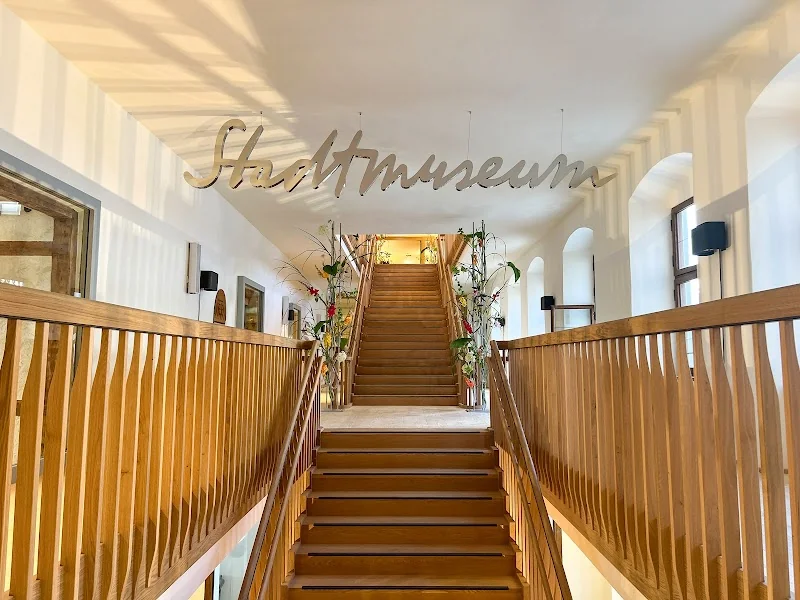
Asamgebäude, 1. Stock, Marienpl. 7, Freising
1. Stock, Asamgebäude, Marienpl. 7, 85354 Freising, Germany
City Museum Freising | Opening Hours & Admission Prices
The City Museum Freising invites you to a lively journey through time in the heart of the cathedral city, located on the first floor of the baroque Asam building at Marienplatz. In freshly renovated rooms, following the festive reopening on July 20, 2024, the city's history unfolds from prehistoric finds to craftsmanship and guilds, as well as documents from more recent times. Visitors discover archaeological originals, rare images, everyday objects, and graphics, experience Freising on paper in the graphic cabinet, and gain insights into the construction and usage history of the Asam building itself in a dedicated room. Convenient for planning: it is open on Tuesdays from 3 PM to 9 PM with free admission, and on other days from Wednesday to Sunday from 11 AM to 5 PM; the access is barrier-free, and a short walk of about seven minutes from the train station leads directly to the museum. Workshops and guided tours – available in several languages upon request – as well as a user-friendly museum app with an audio guide make the visit particularly informative and family-friendly.
Overview of Opening Hours and Admission Prices
Visitors to the City Museum Freising benefit from clear and visitor-friendly conditions. Regular operations run from Wednesday to Sunday from 11 AM to 5 PM. On Tuesdays, the museum opens at 3 PM and remains accessible until 9 PM – an ideal opportunity for an after-work visit in the old town. Particularly attractive: admission is free for everyone on Tuesdays. On regular days, the visit costs 4 euros, reduced 2 euros. Discounts apply, among others, to students, seniors, and groups of ten or more. Children and young people up to and including 18 years pay nothing, making the museum a suitable destination for families, school classes, and youth groups. An annual pass at a fair price of 10 euros is worthwhile for those who wish to visit multiple times a year – for example, to see new special exhibitions or thematic tours. Additionally, guided tours and workshops can be booked: for public tours, an additional fee of 4 euros is charged on top of the admission, while workshops cost 6 euros plus admission. For booked formats, flat-rate conditions and recommended group sizes apply; school offers are specifically tailored in duration. Important for daily planning is that the last admission takes place 30 minutes before closing time. On public holidays, opening hours may change, which is why the city of Freising publishes corresponding notices in a timely manner; for example, it remains closed on Good Friday, while regular opening hours apply on Easter holidays. Generally, the museum app assists with targeted orientation on-site and complements the signage – helpful for optimizing time slots and specifically targeting favorite objects. Those visiting with family can choose Tuesday afternoon as a free introductory visit and later return comfortably with an annual pass.
Current Exhibitions, Programs, and Highlights
The thematic profile of the museum combines a dense permanent exhibition with a varied program of events and special exhibitions. Among the recent favorites of the audience was the winter exhibition Schnee von gestern – Winter in Freising, which made Freising's winter worlds tangible in 2025 and 2026 with atmospheric images, everyday stories, and historical objects. The curatorial line emphasizes illustrative approaches: How was heating done in the past, what pleasures characterized the cold season, and how did artists capture the snowy landscapes? Regularly, the museum offers a structured overview with the classic tour on the first Sunday of each month at 3 PM: in about 60 minutes, the tour leads to selected exhibits and spans a bridge from the Stone Age to the present. Additionally, changing thematic tours take place on the first Tuesday of each month at 7 PM – an evening appointment that allows for cultural planning after work. Special themes open surprising perspectives on Freising's history, from monastic heritage to women's stories and city views on paper. Family offerings such as the traditional waiting for the Christ Child during Advent or child-friendly search games specifically target young visitors. For the young audience and school classes, there is the series Museum in the Treasure Chest: after a compact tour, objects on topics such as city fortifications, crafts, and guilds or the Stone Age and Roman times are explored together. Two workshop formats complement the spectrum: An old card game rediscovered focuses on historical printing techniques and enables playful experiences with a recreated card set; Written or painted invites participants to learn about historical writing styles and create their own name tag with modern hand lettering pens. The museum continuously publishes dates, additional tours, and openings in the city’s event calendar. Those who want to tailor their visit to a specific theme should check the current announcements in advance. Thanks to the good timing and the Tuesday evening opening, exhibition visits, guided tours, and a stroll through the old town at Marienplatz can be easily combined. Throughout the year, special exhibitions, studio formats, and collaborations provide variety – ensuring that even return visitors remain curious.
Management, Team, and History Since 1890
The City Museum is supported by a historically grown and community-oriented structure. Its roots go back to 1890, when citizens of Freising founded the Historical Association and established a city history museum. The collection remained the property of the association, but today the city of Freising operates the museum under municipal sponsorship. After stations in St. George's School, the collection moved in 1965 to the Asam building at Marienplatz, the former prince-bishop's college, and was newly set up there in initially around 250 square meters. A fundamental redesign led to a highly regarded new presentation in the west wing of the building in 2007. From March 2017, the museum was closed to the public due to the general renovation of the Asam building; during this time, the team maintained contact with the local community through a Flying Museum and mobile offerings like the Rolling Suitcase. Finally, on July 20, 2024, the museum celebrated its reopening in expanded, freshly renovated spaces. Eva Willberg is responsible for the content and organizational development as the museum director. The program work is team-oriented: mediation, collection care, and exhibition management are interlinked, supported by cooperation with the Historical Association. The collections span from archaeological finds from prehistory and early history to sacred and profane artworks, guild signs, and craft objects, as well as documents of more recent city history. A graphic cabinet gathers city views and print graphics, while a dedicated room reveals the construction and usage history of the Asam building. In the exhibition architecture, materiality and clear pathways are designed for accessible reception. For visitors, this means: one can jump thematically or be guided along a red thread. The fact that the museum is a member of the German Museums Association and that the redesign was supported by the State Office for Non-State Museums in Bavaria underscores its professional anchoring. The team communicates transparently about tour times, workshop conditions, and discounts, and uses the Tuesday evenings to set a low-threshold signal: culture for all, right in the city.
Accessibility, Location, and Arrival: Here’s How to Arrive Relaxed
The City Museum is located centrally: Marienplatz 7, 85354 Freising, on the first floor of the Asam building. Those arriving by train or S-Bahn can reach the museum on foot in about seven minutes from the station – a short walk through the historic old town that can be nicely combined with a coffee or a look at the town hall's carillon. The access to the museum is barrier-free, the pathways in the building are clear, seating areas, and the service at the cash desk support a relaxed visit. For driving, the city recommends the Freising parking guidance system; it leads to the nearest parking garages around the old town. Bicycle parking facilities can be found in the vicinity, and those traveling with groups should clarify access and drop-off points in advance with the cultural and tourism office. A practical component is the museum app, which can be found in the respective app store under the keyword City Museum Freising. It bundles practical visitor information such as opening hours, directions, admission prices, and offers an audio guide to selected exhibits. Through before-and-after views, one can also trace the work of the restorers who have meticulously prepared numerous objects for the reopening. Inside the museum, there is a museum shop with books and souvenirs; gastronomy in the building ensures that one can comfortably combine exhibition visits with a culinary break. Those visiting with family or a mixed group can use the Tuesday opening as a free option and can also stroll through the collection in peace after work thanks to the late closing time. Guided tours are available in several languages for international guests. Tip for groups: for ten people or more, reduced admission prices per person apply, and tours can be booked flexibly in terms of time. Those who want to orient themselves in advance can find an event calendar and information on holiday openings and special regulations on the city’s pages.
Workshops, Tours, and Educational Offers for Young and Old
Mediation is a central concern at the City Museum Freising. For individual visitors, families, associations, and school classes, different formats are available. The classic tour on the first Sunday of the month at 3 PM leads compactly and pointedly through the most important thematic rooms. Every first Tuesday of the month at 7 PM, thematic tours open the view to special aspects of the city’s history – from monasteries and orders to women’s biographies and city views on paper. In addition to public dates, group tours can be booked by prior arrangement; for 7 to 25 people, the museum calculates a flat rate, and the tour usually lasts about 60 minutes. Workshops complement this offer with active, hands-on elements: An old card game rediscovered introduces historical printing techniques and allows playful experiences with a special object, the so-called bird game from the 18th century, which can be tried out in a reproduced version. Written or painted uses historical writings and painted shooting discs as inspiration to create one’s own name tag with modern hand lettering pens. For the young audience, Museum in the Treasure Chest bundles thematic boxes on the Stone Age and Roman times, city fortifications, and crafts and guilds. Here, participants are allowed not only to look at objects but also to touch selected pieces and explore them together – a low-threshold approach that connects learning with experience. The workshops are designed for groups of usually up to 15 people, last about 75 minutes, and are charged in addition to the admission with a moderate fee. Schools can book shorter units of about 45 minutes; a small fee per student is planned. The languages offered for tours – in addition to German, also English, French, Italian, and Spanish – expand the circle of participants as well as the barrier-free accessibility. For all formats, it is best for interested parties to coordinate dates and conditions directly with the museum team. This way, thematic focuses can also be set, for example, in connection with ongoing special exhibitions or with regard to the curriculum of local schools. The fact that Tuesdays are free of charge facilitates budget planning and lowers barriers – especially for families or associations wishing to discover cultural offerings together.
Reviews, Impressions, and Photos: What Visitors Appreciate
Feedback from guests paints a picture of an inviting, informative house with friendly service. The helpful reception, clearly structured thematic rooms, and the successful interplay of text, object, and image are positively highlighted. Those interested in prehistory find a strong entry point in the archaeological finds; lovers of city history appreciate the proximity to everyday objects and craft testimonies of the old bishop's city. The glass beads and bronze small finds from prehistory and early history, as well as guild signs and historical views of Freising, are among the pieces that remain memorable during visits. Photos published by the city provide good impressions of the spatial experience: the entrance with reception and shop, the room of parents and grandparents, the airy staircase of the Asam building, and the carpet with a large aerial view of the city. Those who like to plan ahead can view these visual impressions in advance and target stations on-site – supported by the museum app, which explains selected exhibits via audio guide. It is important for international guests to know that tours are offered in several languages upon request; explanatory texts in the exhibition are primarily in German, which is particularly important to note during independent tours. Overall, an atmospheric, accessible tour through Freising's past emerges, benefiting from the location advantage in the middle of the old town: before or after the museum, one can stop by at Marienplatz or take the short walk to the train station. The combination of free Tuesdays, fair prices, annual passes, and easily accessible location lowers the barrier for first visits and encourages return visits. Photos and reviews on city portals and map applications show that the concept is perceived as tidy, lovingly curated, and service-oriented. This impression is further reinforced by the visible opening of the house to the local community – with public tours, studio formats, and seasonal highlights such as the nativity presentation during Advent, which connects tradition and urban space.
Compact Service: Contact, Program, Jobs, and Practical Tips
The museum is open on Tuesdays from 3 PM to 9 PM and from Wednesday to Sunday from 11 AM to 5 PM; the last admission is 30 minutes before closing. Address and contact: City Museum Freising, Marienplatz 7, 85354 Freising, Phone 08161 54 44 555, Email stadtmuseum at freising.de. The most important visitor information – directions, accessibility, admission, holiday regulations – is bundled on the city’s website. For program information, the city’s event calendar is recommended, where public tours, thematic evenings, openings, and holiday activities are continuously updated. The museum is a member of the German Museums Association, and the redesign was supported by the State Office for Non-State Museums in Bavaria. For visits with children, Tuesday evenings are ideal, allowing free admission; the museum app adds depth to the tour and makes selected exhibits audible. The shop offers publications and souvenirs, and there is catering in the building, making it easy to combine exhibition visits with a culinary break. Those who visit the museum more frequently or are inspired by changing special exhibitions will find the annual pass for 10 euros to be a good choice. Tour costs and workshop fees are transparent and moderate, and groups receive discounts. For those interested professionally: job offers from the museum and the city’s cultural institutions appear on the city of Freising’s career portal; applications are processed centrally through it. For arrivals by car, the parking guidance system points the way to available parking spaces around the old town; by train and S-Bahn, the journey from the station to Marienplatz takes just a few minutes. Tip for cultural evenings: first, thematic tour on Tuesday at 7 PM, then still time for a drink in the old town before the museum closes at 9 PM. Thanks to the proximity of many attractions in Freising – from the cathedral hill to other cultural sites – the visit can be flexibly combined with a city tour. Those interested in architectural details should not miss the room about the building history in the museum: there, it becomes visible how the Asam building transformed from a university location to a cultural-historical anchor in the city center.
Sources:
Show moreShow less
City Museum Freising | Opening Hours & Admission Prices
The City Museum Freising invites you to a lively journey through time in the heart of the cathedral city, located on the first floor of the baroque Asam building at Marienplatz. In freshly renovated rooms, following the festive reopening on July 20, 2024, the city's history unfolds from prehistoric finds to craftsmanship and guilds, as well as documents from more recent times. Visitors discover archaeological originals, rare images, everyday objects, and graphics, experience Freising on paper in the graphic cabinet, and gain insights into the construction and usage history of the Asam building itself in a dedicated room. Convenient for planning: it is open on Tuesdays from 3 PM to 9 PM with free admission, and on other days from Wednesday to Sunday from 11 AM to 5 PM; the access is barrier-free, and a short walk of about seven minutes from the train station leads directly to the museum. Workshops and guided tours – available in several languages upon request – as well as a user-friendly museum app with an audio guide make the visit particularly informative and family-friendly.
Overview of Opening Hours and Admission Prices
Visitors to the City Museum Freising benefit from clear and visitor-friendly conditions. Regular operations run from Wednesday to Sunday from 11 AM to 5 PM. On Tuesdays, the museum opens at 3 PM and remains accessible until 9 PM – an ideal opportunity for an after-work visit in the old town. Particularly attractive: admission is free for everyone on Tuesdays. On regular days, the visit costs 4 euros, reduced 2 euros. Discounts apply, among others, to students, seniors, and groups of ten or more. Children and young people up to and including 18 years pay nothing, making the museum a suitable destination for families, school classes, and youth groups. An annual pass at a fair price of 10 euros is worthwhile for those who wish to visit multiple times a year – for example, to see new special exhibitions or thematic tours. Additionally, guided tours and workshops can be booked: for public tours, an additional fee of 4 euros is charged on top of the admission, while workshops cost 6 euros plus admission. For booked formats, flat-rate conditions and recommended group sizes apply; school offers are specifically tailored in duration. Important for daily planning is that the last admission takes place 30 minutes before closing time. On public holidays, opening hours may change, which is why the city of Freising publishes corresponding notices in a timely manner; for example, it remains closed on Good Friday, while regular opening hours apply on Easter holidays. Generally, the museum app assists with targeted orientation on-site and complements the signage – helpful for optimizing time slots and specifically targeting favorite objects. Those visiting with family can choose Tuesday afternoon as a free introductory visit and later return comfortably with an annual pass.
Current Exhibitions, Programs, and Highlights
The thematic profile of the museum combines a dense permanent exhibition with a varied program of events and special exhibitions. Among the recent favorites of the audience was the winter exhibition Schnee von gestern – Winter in Freising, which made Freising's winter worlds tangible in 2025 and 2026 with atmospheric images, everyday stories, and historical objects. The curatorial line emphasizes illustrative approaches: How was heating done in the past, what pleasures characterized the cold season, and how did artists capture the snowy landscapes? Regularly, the museum offers a structured overview with the classic tour on the first Sunday of each month at 3 PM: in about 60 minutes, the tour leads to selected exhibits and spans a bridge from the Stone Age to the present. Additionally, changing thematic tours take place on the first Tuesday of each month at 7 PM – an evening appointment that allows for cultural planning after work. Special themes open surprising perspectives on Freising's history, from monastic heritage to women's stories and city views on paper. Family offerings such as the traditional waiting for the Christ Child during Advent or child-friendly search games specifically target young visitors. For the young audience and school classes, there is the series Museum in the Treasure Chest: after a compact tour, objects on topics such as city fortifications, crafts, and guilds or the Stone Age and Roman times are explored together. Two workshop formats complement the spectrum: An old card game rediscovered focuses on historical printing techniques and enables playful experiences with a recreated card set; Written or painted invites participants to learn about historical writing styles and create their own name tag with modern hand lettering pens. The museum continuously publishes dates, additional tours, and openings in the city’s event calendar. Those who want to tailor their visit to a specific theme should check the current announcements in advance. Thanks to the good timing and the Tuesday evening opening, exhibition visits, guided tours, and a stroll through the old town at Marienplatz can be easily combined. Throughout the year, special exhibitions, studio formats, and collaborations provide variety – ensuring that even return visitors remain curious.
Management, Team, and History Since 1890
The City Museum is supported by a historically grown and community-oriented structure. Its roots go back to 1890, when citizens of Freising founded the Historical Association and established a city history museum. The collection remained the property of the association, but today the city of Freising operates the museum under municipal sponsorship. After stations in St. George's School, the collection moved in 1965 to the Asam building at Marienplatz, the former prince-bishop's college, and was newly set up there in initially around 250 square meters. A fundamental redesign led to a highly regarded new presentation in the west wing of the building in 2007. From March 2017, the museum was closed to the public due to the general renovation of the Asam building; during this time, the team maintained contact with the local community through a Flying Museum and mobile offerings like the Rolling Suitcase. Finally, on July 20, 2024, the museum celebrated its reopening in expanded, freshly renovated spaces. Eva Willberg is responsible for the content and organizational development as the museum director. The program work is team-oriented: mediation, collection care, and exhibition management are interlinked, supported by cooperation with the Historical Association. The collections span from archaeological finds from prehistory and early history to sacred and profane artworks, guild signs, and craft objects, as well as documents of more recent city history. A graphic cabinet gathers city views and print graphics, while a dedicated room reveals the construction and usage history of the Asam building. In the exhibition architecture, materiality and clear pathways are designed for accessible reception. For visitors, this means: one can jump thematically or be guided along a red thread. The fact that the museum is a member of the German Museums Association and that the redesign was supported by the State Office for Non-State Museums in Bavaria underscores its professional anchoring. The team communicates transparently about tour times, workshop conditions, and discounts, and uses the Tuesday evenings to set a low-threshold signal: culture for all, right in the city.
Accessibility, Location, and Arrival: Here’s How to Arrive Relaxed
The City Museum is located centrally: Marienplatz 7, 85354 Freising, on the first floor of the Asam building. Those arriving by train or S-Bahn can reach the museum on foot in about seven minutes from the station – a short walk through the historic old town that can be nicely combined with a coffee or a look at the town hall's carillon. The access to the museum is barrier-free, the pathways in the building are clear, seating areas, and the service at the cash desk support a relaxed visit. For driving, the city recommends the Freising parking guidance system; it leads to the nearest parking garages around the old town. Bicycle parking facilities can be found in the vicinity, and those traveling with groups should clarify access and drop-off points in advance with the cultural and tourism office. A practical component is the museum app, which can be found in the respective app store under the keyword City Museum Freising. It bundles practical visitor information such as opening hours, directions, admission prices, and offers an audio guide to selected exhibits. Through before-and-after views, one can also trace the work of the restorers who have meticulously prepared numerous objects for the reopening. Inside the museum, there is a museum shop with books and souvenirs; gastronomy in the building ensures that one can comfortably combine exhibition visits with a culinary break. Those visiting with family or a mixed group can use the Tuesday opening as a free option and can also stroll through the collection in peace after work thanks to the late closing time. Guided tours are available in several languages for international guests. Tip for groups: for ten people or more, reduced admission prices per person apply, and tours can be booked flexibly in terms of time. Those who want to orient themselves in advance can find an event calendar and information on holiday openings and special regulations on the city’s pages.
Workshops, Tours, and Educational Offers for Young and Old
Mediation is a central concern at the City Museum Freising. For individual visitors, families, associations, and school classes, different formats are available. The classic tour on the first Sunday of the month at 3 PM leads compactly and pointedly through the most important thematic rooms. Every first Tuesday of the month at 7 PM, thematic tours open the view to special aspects of the city’s history – from monasteries and orders to women’s biographies and city views on paper. In addition to public dates, group tours can be booked by prior arrangement; for 7 to 25 people, the museum calculates a flat rate, and the tour usually lasts about 60 minutes. Workshops complement this offer with active, hands-on elements: An old card game rediscovered introduces historical printing techniques and allows playful experiences with a special object, the so-called bird game from the 18th century, which can be tried out in a reproduced version. Written or painted uses historical writings and painted shooting discs as inspiration to create one’s own name tag with modern hand lettering pens. For the young audience, Museum in the Treasure Chest bundles thematic boxes on the Stone Age and Roman times, city fortifications, and crafts and guilds. Here, participants are allowed not only to look at objects but also to touch selected pieces and explore them together – a low-threshold approach that connects learning with experience. The workshops are designed for groups of usually up to 15 people, last about 75 minutes, and are charged in addition to the admission with a moderate fee. Schools can book shorter units of about 45 minutes; a small fee per student is planned. The languages offered for tours – in addition to German, also English, French, Italian, and Spanish – expand the circle of participants as well as the barrier-free accessibility. For all formats, it is best for interested parties to coordinate dates and conditions directly with the museum team. This way, thematic focuses can also be set, for example, in connection with ongoing special exhibitions or with regard to the curriculum of local schools. The fact that Tuesdays are free of charge facilitates budget planning and lowers barriers – especially for families or associations wishing to discover cultural offerings together.
Reviews, Impressions, and Photos: What Visitors Appreciate
Feedback from guests paints a picture of an inviting, informative house with friendly service. The helpful reception, clearly structured thematic rooms, and the successful interplay of text, object, and image are positively highlighted. Those interested in prehistory find a strong entry point in the archaeological finds; lovers of city history appreciate the proximity to everyday objects and craft testimonies of the old bishop's city. The glass beads and bronze small finds from prehistory and early history, as well as guild signs and historical views of Freising, are among the pieces that remain memorable during visits. Photos published by the city provide good impressions of the spatial experience: the entrance with reception and shop, the room of parents and grandparents, the airy staircase of the Asam building, and the carpet with a large aerial view of the city. Those who like to plan ahead can view these visual impressions in advance and target stations on-site – supported by the museum app, which explains selected exhibits via audio guide. It is important for international guests to know that tours are offered in several languages upon request; explanatory texts in the exhibition are primarily in German, which is particularly important to note during independent tours. Overall, an atmospheric, accessible tour through Freising's past emerges, benefiting from the location advantage in the middle of the old town: before or after the museum, one can stop by at Marienplatz or take the short walk to the train station. The combination of free Tuesdays, fair prices, annual passes, and easily accessible location lowers the barrier for first visits and encourages return visits. Photos and reviews on city portals and map applications show that the concept is perceived as tidy, lovingly curated, and service-oriented. This impression is further reinforced by the visible opening of the house to the local community – with public tours, studio formats, and seasonal highlights such as the nativity presentation during Advent, which connects tradition and urban space.
Compact Service: Contact, Program, Jobs, and Practical Tips
The museum is open on Tuesdays from 3 PM to 9 PM and from Wednesday to Sunday from 11 AM to 5 PM; the last admission is 30 minutes before closing. Address and contact: City Museum Freising, Marienplatz 7, 85354 Freising, Phone 08161 54 44 555, Email stadtmuseum at freising.de. The most important visitor information – directions, accessibility, admission, holiday regulations – is bundled on the city’s website. For program information, the city’s event calendar is recommended, where public tours, thematic evenings, openings, and holiday activities are continuously updated. The museum is a member of the German Museums Association, and the redesign was supported by the State Office for Non-State Museums in Bavaria. For visits with children, Tuesday evenings are ideal, allowing free admission; the museum app adds depth to the tour and makes selected exhibits audible. The shop offers publications and souvenirs, and there is catering in the building, making it easy to combine exhibition visits with a culinary break. Those who visit the museum more frequently or are inspired by changing special exhibitions will find the annual pass for 10 euros to be a good choice. Tour costs and workshop fees are transparent and moderate, and groups receive discounts. For those interested professionally: job offers from the museum and the city’s cultural institutions appear on the city of Freising’s career portal; applications are processed centrally through it. For arrivals by car, the parking guidance system points the way to available parking spaces around the old town; by train and S-Bahn, the journey from the station to Marienplatz takes just a few minutes. Tip for cultural evenings: first, thematic tour on Tuesday at 7 PM, then still time for a drink in the old town before the museum closes at 9 PM. Thanks to the proximity of many attractions in Freising – from the cathedral hill to other cultural sites – the visit can be flexibly combined with a city tour. Those interested in architectural details should not miss the room about the building history in the museum: there, it becomes visible how the Asam building transformed from a university location to a cultural-historical anchor in the city center.
Sources:
City Museum Freising | Opening Hours & Admission Prices
The City Museum Freising invites you to a lively journey through time in the heart of the cathedral city, located on the first floor of the baroque Asam building at Marienplatz. In freshly renovated rooms, following the festive reopening on July 20, 2024, the city's history unfolds from prehistoric finds to craftsmanship and guilds, as well as documents from more recent times. Visitors discover archaeological originals, rare images, everyday objects, and graphics, experience Freising on paper in the graphic cabinet, and gain insights into the construction and usage history of the Asam building itself in a dedicated room. Convenient for planning: it is open on Tuesdays from 3 PM to 9 PM with free admission, and on other days from Wednesday to Sunday from 11 AM to 5 PM; the access is barrier-free, and a short walk of about seven minutes from the train station leads directly to the museum. Workshops and guided tours – available in several languages upon request – as well as a user-friendly museum app with an audio guide make the visit particularly informative and family-friendly.
Overview of Opening Hours and Admission Prices
Visitors to the City Museum Freising benefit from clear and visitor-friendly conditions. Regular operations run from Wednesday to Sunday from 11 AM to 5 PM. On Tuesdays, the museum opens at 3 PM and remains accessible until 9 PM – an ideal opportunity for an after-work visit in the old town. Particularly attractive: admission is free for everyone on Tuesdays. On regular days, the visit costs 4 euros, reduced 2 euros. Discounts apply, among others, to students, seniors, and groups of ten or more. Children and young people up to and including 18 years pay nothing, making the museum a suitable destination for families, school classes, and youth groups. An annual pass at a fair price of 10 euros is worthwhile for those who wish to visit multiple times a year – for example, to see new special exhibitions or thematic tours. Additionally, guided tours and workshops can be booked: for public tours, an additional fee of 4 euros is charged on top of the admission, while workshops cost 6 euros plus admission. For booked formats, flat-rate conditions and recommended group sizes apply; school offers are specifically tailored in duration. Important for daily planning is that the last admission takes place 30 minutes before closing time. On public holidays, opening hours may change, which is why the city of Freising publishes corresponding notices in a timely manner; for example, it remains closed on Good Friday, while regular opening hours apply on Easter holidays. Generally, the museum app assists with targeted orientation on-site and complements the signage – helpful for optimizing time slots and specifically targeting favorite objects. Those visiting with family can choose Tuesday afternoon as a free introductory visit and later return comfortably with an annual pass.
Current Exhibitions, Programs, and Highlights
The thematic profile of the museum combines a dense permanent exhibition with a varied program of events and special exhibitions. Among the recent favorites of the audience was the winter exhibition Schnee von gestern – Winter in Freising, which made Freising's winter worlds tangible in 2025 and 2026 with atmospheric images, everyday stories, and historical objects. The curatorial line emphasizes illustrative approaches: How was heating done in the past, what pleasures characterized the cold season, and how did artists capture the snowy landscapes? Regularly, the museum offers a structured overview with the classic tour on the first Sunday of each month at 3 PM: in about 60 minutes, the tour leads to selected exhibits and spans a bridge from the Stone Age to the present. Additionally, changing thematic tours take place on the first Tuesday of each month at 7 PM – an evening appointment that allows for cultural planning after work. Special themes open surprising perspectives on Freising's history, from monastic heritage to women's stories and city views on paper. Family offerings such as the traditional waiting for the Christ Child during Advent or child-friendly search games specifically target young visitors. For the young audience and school classes, there is the series Museum in the Treasure Chest: after a compact tour, objects on topics such as city fortifications, crafts, and guilds or the Stone Age and Roman times are explored together. Two workshop formats complement the spectrum: An old card game rediscovered focuses on historical printing techniques and enables playful experiences with a recreated card set; Written or painted invites participants to learn about historical writing styles and create their own name tag with modern hand lettering pens. The museum continuously publishes dates, additional tours, and openings in the city’s event calendar. Those who want to tailor their visit to a specific theme should check the current announcements in advance. Thanks to the good timing and the Tuesday evening opening, exhibition visits, guided tours, and a stroll through the old town at Marienplatz can be easily combined. Throughout the year, special exhibitions, studio formats, and collaborations provide variety – ensuring that even return visitors remain curious.
Management, Team, and History Since 1890
The City Museum is supported by a historically grown and community-oriented structure. Its roots go back to 1890, when citizens of Freising founded the Historical Association and established a city history museum. The collection remained the property of the association, but today the city of Freising operates the museum under municipal sponsorship. After stations in St. George's School, the collection moved in 1965 to the Asam building at Marienplatz, the former prince-bishop's college, and was newly set up there in initially around 250 square meters. A fundamental redesign led to a highly regarded new presentation in the west wing of the building in 2007. From March 2017, the museum was closed to the public due to the general renovation of the Asam building; during this time, the team maintained contact with the local community through a Flying Museum and mobile offerings like the Rolling Suitcase. Finally, on July 20, 2024, the museum celebrated its reopening in expanded, freshly renovated spaces. Eva Willberg is responsible for the content and organizational development as the museum director. The program work is team-oriented: mediation, collection care, and exhibition management are interlinked, supported by cooperation with the Historical Association. The collections span from archaeological finds from prehistory and early history to sacred and profane artworks, guild signs, and craft objects, as well as documents of more recent city history. A graphic cabinet gathers city views and print graphics, while a dedicated room reveals the construction and usage history of the Asam building. In the exhibition architecture, materiality and clear pathways are designed for accessible reception. For visitors, this means: one can jump thematically or be guided along a red thread. The fact that the museum is a member of the German Museums Association and that the redesign was supported by the State Office for Non-State Museums in Bavaria underscores its professional anchoring. The team communicates transparently about tour times, workshop conditions, and discounts, and uses the Tuesday evenings to set a low-threshold signal: culture for all, right in the city.
Accessibility, Location, and Arrival: Here’s How to Arrive Relaxed
The City Museum is located centrally: Marienplatz 7, 85354 Freising, on the first floor of the Asam building. Those arriving by train or S-Bahn can reach the museum on foot in about seven minutes from the station – a short walk through the historic old town that can be nicely combined with a coffee or a look at the town hall's carillon. The access to the museum is barrier-free, the pathways in the building are clear, seating areas, and the service at the cash desk support a relaxed visit. For driving, the city recommends the Freising parking guidance system; it leads to the nearest parking garages around the old town. Bicycle parking facilities can be found in the vicinity, and those traveling with groups should clarify access and drop-off points in advance with the cultural and tourism office. A practical component is the museum app, which can be found in the respective app store under the keyword City Museum Freising. It bundles practical visitor information such as opening hours, directions, admission prices, and offers an audio guide to selected exhibits. Through before-and-after views, one can also trace the work of the restorers who have meticulously prepared numerous objects for the reopening. Inside the museum, there is a museum shop with books and souvenirs; gastronomy in the building ensures that one can comfortably combine exhibition visits with a culinary break. Those visiting with family or a mixed group can use the Tuesday opening as a free option and can also stroll through the collection in peace after work thanks to the late closing time. Guided tours are available in several languages for international guests. Tip for groups: for ten people or more, reduced admission prices per person apply, and tours can be booked flexibly in terms of time. Those who want to orient themselves in advance can find an event calendar and information on holiday openings and special regulations on the city’s pages.
Workshops, Tours, and Educational Offers for Young and Old
Mediation is a central concern at the City Museum Freising. For individual visitors, families, associations, and school classes, different formats are available. The classic tour on the first Sunday of the month at 3 PM leads compactly and pointedly through the most important thematic rooms. Every first Tuesday of the month at 7 PM, thematic tours open the view to special aspects of the city’s history – from monasteries and orders to women’s biographies and city views on paper. In addition to public dates, group tours can be booked by prior arrangement; for 7 to 25 people, the museum calculates a flat rate, and the tour usually lasts about 60 minutes. Workshops complement this offer with active, hands-on elements: An old card game rediscovered introduces historical printing techniques and allows playful experiences with a special object, the so-called bird game from the 18th century, which can be tried out in a reproduced version. Written or painted uses historical writings and painted shooting discs as inspiration to create one’s own name tag with modern hand lettering pens. For the young audience, Museum in the Treasure Chest bundles thematic boxes on the Stone Age and Roman times, city fortifications, and crafts and guilds. Here, participants are allowed not only to look at objects but also to touch selected pieces and explore them together – a low-threshold approach that connects learning with experience. The workshops are designed for groups of usually up to 15 people, last about 75 minutes, and are charged in addition to the admission with a moderate fee. Schools can book shorter units of about 45 minutes; a small fee per student is planned. The languages offered for tours – in addition to German, also English, French, Italian, and Spanish – expand the circle of participants as well as the barrier-free accessibility. For all formats, it is best for interested parties to coordinate dates and conditions directly with the museum team. This way, thematic focuses can also be set, for example, in connection with ongoing special exhibitions or with regard to the curriculum of local schools. The fact that Tuesdays are free of charge facilitates budget planning and lowers barriers – especially for families or associations wishing to discover cultural offerings together.
Reviews, Impressions, and Photos: What Visitors Appreciate
Feedback from guests paints a picture of an inviting, informative house with friendly service. The helpful reception, clearly structured thematic rooms, and the successful interplay of text, object, and image are positively highlighted. Those interested in prehistory find a strong entry point in the archaeological finds; lovers of city history appreciate the proximity to everyday objects and craft testimonies of the old bishop's city. The glass beads and bronze small finds from prehistory and early history, as well as guild signs and historical views of Freising, are among the pieces that remain memorable during visits. Photos published by the city provide good impressions of the spatial experience: the entrance with reception and shop, the room of parents and grandparents, the airy staircase of the Asam building, and the carpet with a large aerial view of the city. Those who like to plan ahead can view these visual impressions in advance and target stations on-site – supported by the museum app, which explains selected exhibits via audio guide. It is important for international guests to know that tours are offered in several languages upon request; explanatory texts in the exhibition are primarily in German, which is particularly important to note during independent tours. Overall, an atmospheric, accessible tour through Freising's past emerges, benefiting from the location advantage in the middle of the old town: before or after the museum, one can stop by at Marienplatz or take the short walk to the train station. The combination of free Tuesdays, fair prices, annual passes, and easily accessible location lowers the barrier for first visits and encourages return visits. Photos and reviews on city portals and map applications show that the concept is perceived as tidy, lovingly curated, and service-oriented. This impression is further reinforced by the visible opening of the house to the local community – with public tours, studio formats, and seasonal highlights such as the nativity presentation during Advent, which connects tradition and urban space.
Compact Service: Contact, Program, Jobs, and Practical Tips
The museum is open on Tuesdays from 3 PM to 9 PM and from Wednesday to Sunday from 11 AM to 5 PM; the last admission is 30 minutes before closing. Address and contact: City Museum Freising, Marienplatz 7, 85354 Freising, Phone 08161 54 44 555, Email stadtmuseum at freising.de. The most important visitor information – directions, accessibility, admission, holiday regulations – is bundled on the city’s website. For program information, the city’s event calendar is recommended, where public tours, thematic evenings, openings, and holiday activities are continuously updated. The museum is a member of the German Museums Association, and the redesign was supported by the State Office for Non-State Museums in Bavaria. For visits with children, Tuesday evenings are ideal, allowing free admission; the museum app adds depth to the tour and makes selected exhibits audible. The shop offers publications and souvenirs, and there is catering in the building, making it easy to combine exhibition visits with a culinary break. Those who visit the museum more frequently or are inspired by changing special exhibitions will find the annual pass for 10 euros to be a good choice. Tour costs and workshop fees are transparent and moderate, and groups receive discounts. For those interested professionally: job offers from the museum and the city’s cultural institutions appear on the city of Freising’s career portal; applications are processed centrally through it. For arrivals by car, the parking guidance system points the way to available parking spaces around the old town; by train and S-Bahn, the journey from the station to Marienplatz takes just a few minutes. Tip for cultural evenings: first, thematic tour on Tuesday at 7 PM, then still time for a drink in the old town before the museum closes at 9 PM. Thanks to the proximity of many attractions in Freising – from the cathedral hill to other cultural sites – the visit can be flexibly combined with a city tour. Those interested in architectural details should not miss the room about the building history in the museum: there, it becomes visible how the Asam building transformed from a university location to a cultural-historical anchor in the city center.
Sources:
Upcoming Events
No events found
Frequently Asked Questions
Reviews
Doğa
15. May 2025
Helpful staff and a good museum for learning about the history of Freising. It would have been better if there were more information in English.
Philipp Uk
23. March 2025
Super!
Hebby1
10. August 2025
The city museum displays interesting pieces about the city's history. I liked the Bronze Age artifacts best. The glass bead is my favorite. I would have liked to see more archaeological artifacts, for example, from the Iron Age. But you never know what kind of concept a city museum will have. I don't agree with the modern approach of displaying fewer items because otherwise visitors would be overwhelmed. I'd rather be underwhelmed by that 😉.
Elisabeth Duschek
6. August 2025
It's become very beautiful here after the renovation. Technical tip: Some new stations invite you to linger, such as a "cinema" and a viewing station. We particularly liked the old maps. There's also a lot on offer for the blind, significantly more than in other museums. Friendly staff. We'll be back!
Simona Horváth
10. January 2026
I was there with a group of teenagers. The man at the ticket counter had a disconcerting effect on me. He eyed the teenagers in a very unpleasant way. He told us that if we touched anything, an alarm would go off and the police would come. When I asked what would happen then, he replied that he just wanted to say so. One teenager then touched the globe due to language barriers, a friendly employee pointed it out to me, but of course, the police didn't come. So, it was just scare tactics and threats without any substance. Furthermore, the discounted entrance fee was charged to all the teenagers, even though admission is free for those under 18. The aforementioned employee eventually called me over and refunded me. The reason given (unbelievable): the employee thought the teenagers looked so grown-up that he was kind enough to charge "only" €2 instead of €4, even though admission was free and I had offered to show him everyone's ID! It couldn't get more unprofessional. The woman then acted correctly, but this kind of behavior is unacceptable! To scrutinize the teenagers, refuse the supervisor's offer to show identification, then, as a "compromise," calculate the reduced price based on a self-diagnosis and threaten to call the police! Even the teenagers wondered what was wrong with the man…