
St2084, Kranzberg
St2084, 85402 Kranzberg, Germany
World Forest Freising | Circular Path & Parking
The World Forest Freising is the Bavarian State Arboretum in the Kranzberger Forest and an extraordinary place for all who want to experience nature, discover plants from around the world, and combine a relaxing walk with knowledge. Since 1987, a collection of trees and shrubs from North America, Europe including the Mediterranean, and Central and East Asia has been growing here over approximately one hundred hectares. More than 300 species are already represented, and the area is freely accessible to visitors year-round. The idea behind it is as simple as it is fascinating: in just a few hours, one can undertake a botanical journey across three continents without leaving the Freising region. Information spots near the parking lots, a central pavilion in the middle of the area, and a well-understood guiding system with colored symbols provide orientation. Additionally, an interactive map is available on the website and the World Forest app with offline maps. Three thematic experience gardens – the Europe Garden at the highest point, the Asia Garden with a pagoda, bridge, and moon gate, and the America Garden with tipi structures and viewing elements – add characterful, family-friendly points of interest to the forest landscape. Those who want to enjoy the visit more deeply will find regular guided tours, cultural formats, and seasonal highlights on the event calendar.
Circular Path, Thematic Trails, and Map in the World Forest Freising
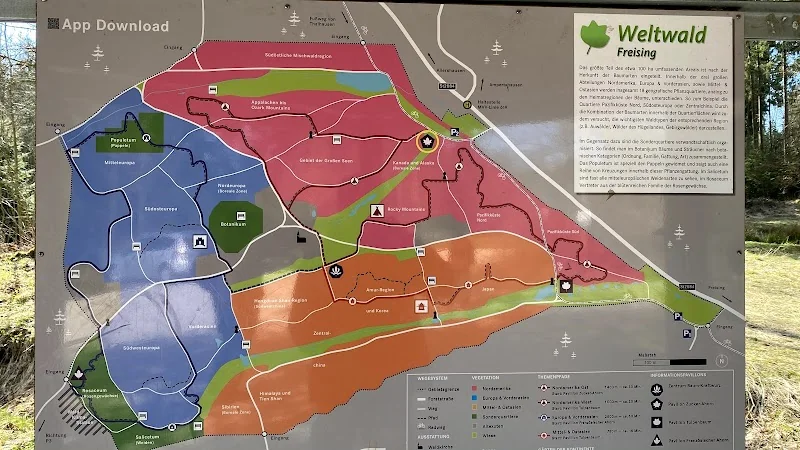
The most popular searches revolve around circular paths and maps – because this is where the strength of the World Forest lies. The marked thematic trails make it easy to plan your own circular route or follow a curated path. The area is divided into large geographical spaces: North America, Europe, and the Near East as well as Central and East Asia. Within these areas, the tree populations are divided into so-called quarters that reflect typical natural spaces of the regions of origin. The thematic paths are marked with colored symbols, sturdy wooden planks facilitate orientation at junctions, and all routes converge at the central pavilion. Those who orient themselves towards East North America will encounter species such as sugar maple, yellow birch, or two-colored oak along the way, while the western North America path leads towards the Rocky Mountains quarter, where imposing conifers and the America Garden remind one of a First Nations camp. In the Europe area, the Europe Garden can be explored, which is situated on a hill and playfully takes up the basic idea of a medieval moth castle. Viewed from above, it forms the outline of a tulip tree leaf – a motif that is also found in the logo of the World Forest. The Asia path draws attention to ancient garden art: through a red moon gate or a curved bridge, one reaches the distinctive pagoda, from which the view falls into a charming meadow valley. To maintain a good overview, there are several navigation aids. Those who plan analogously can pick up the brochure with the overview map at the info spot. Digitally inclined visitors can use the interactive map of the World Forest, which links locations, planting years, and species portraits, or the World Forest app, which offers a map-based search and offline function. Thus, a forest walk becomes a flexibly adaptable circular route that can be designed according to time frame and interest – from a short continent loop to a multi-hour tour connecting Europe, Asia, and North America. Conveniently, between the gardens of the continents, there are benches and green islands inviting one to pause. Those who want to photograph should remember the pagoda in the Asia Garden, the tipi silhouettes in the America Garden, and the willow and oak arrangements in the Europe Garden as particularly photogenic points. A tip for orientation: as a natural fixed point, the forest church St. Clemens near the central pavilion helps, as several paths converge in its vicinity.
Directions, Public Transport, and Parking P1–P3 at St 2084
Parking and directions are particularly in demand. By car, the World Forest is very easy to reach from Freising: one follows the state road 2084 towards Allershausen. After about 2.7 or 3.0 kilometers, a forest road branches off to the left into the Kranzberger Forest. Shortly thereafter, the two frequently used parking lots P1 Oberberghausen and P2 Eisweiher are located, each with info spots featuring display boards and brochures nearby. Those who choose the slightly more rustic but practical access can use parking lot P3 Kleiner Spessart on the gravel road between Freising and Kranzberg. Cyclists can easily reach the World Forest via the developed bike path that runs parallel to St 2084. For environmentally friendly travel by public transport, the MVV bus line 619 is suitable; the recommended stop is Ampertshausen. From there, it is about 200 meters to parking lot P2 Eisweiher and the nearby info pavilion. Those traveling on foot or with a stroller benefit from the network of forest roads, which alternate between paved paths and occasional trodden passages depending on the section. Helpful signage directly at the entrances indicates that the thematic paths are marked with clearly visible symbols. Info spots, such as the tulip tree pavilion at the North America West and Central & East Asia access or the French maple pavilion for the Europe path, serve as starting points. For groups, the meeting point at the central pavilion in the middle of the area is ideal, as all thematic paths can be reached from there. Those who want to combine their journey with a stop can find several recommended addresses in the vicinity listed on the official page, thus rounding off the day in nature with a restaurant visit. A note for navigation systems: the designation World Forest Freising in the Kranzberger Forest is suitable as a destination; on-site signs direct to parking lots P1 to P3 at St 2084.
Opening Hours, Admission, and Services On-Site
Among the most sought-after information are opening hours and admission – and here the World Forest scores with simplicity. The area is open year-round and freely accessible, meaning there is no daily ticket office or ticket obligation. This allows for spontaneous visits, short after-work rounds, and extensive weekend tours alike. Those coming for the first time should sensibly start at one of the info spots near the parking lots: there, brochures with overview maps are available, and easily readable boards explain the thematic paths, the gardens of the continents, and the special features of the arboretum. In the middle of the World Forest, the central pavilion marks a natural meeting point with seating; from here, the color-marked circular paths branch off in all directions. Families appreciate the clear path guidance and the integrated experience stations in the paths as well as the play and discovery areas in the America Garden. Those who value additional orientation can use the interactive map on the website – where planting years, species lists, and quarters can be accessed – or the World Forest app, which works with a map view and feature layers and also provides offline support. Helpful for planning visits are the seasonal recommendations on the event page: whether spring walk through leaf shoots, high summer in the shade of conifers, autumn tones at the pagoda and Europe Garden, or a quiet winter round – the World Forest shows a different face in every season. Gastronomically, the forest itself is kept deliberately simple, but several establishments are mentioned on the official service page in the immediate vicinity, including a restaurant in Thalhausen about 1.5 kilometers away and established addresses in Freising such as the Bräustüberl Weihenstephan or the Plantage. This allows for a straightforward combination of nature experience and culinary delights. For groups, school classes, or associations, the guided tours published in the Current section are worthwhile; registration details and meeting points are noted directly with the date.
Dogs, Playground America Garden, and Behavior Rules
The keyword dogs is particularly relevant for excursion destinations focused on families, as is playground. The America Garden in the World Forest is much more than a classic playground: it translates motifs of North American landscapes into a child-friendly experience environment. A tipi village, a small canyon passage, and a pier with viewing towers pedagogically connect to the living environments of indigenous communities, supplemented by information elements and distinctive wooden structures. Since this is a play and recreation area for children, dogs should not be taken into the play area; please follow the signage on-site. On the paths of the World Forest, it is generally important to be considerate of other visitors, observe the path guidance, avoid sensitive areas, and not disturb wildlife. Those exploring the thematic paths with a dog should stay on the marked paths and avoid particularly frequented zones during busy times. In nature-friendly areas, there may be breeding and rearing times for wildlife depending on the season; respectful behavior towards the forest fauna therefore has the highest priority. For families with younger children, it is advisable to plan the visit so that the America Garden is incorporated as a separate program point, for example after a short North America round. Those who photograph will find attractive motifs here with the silhouettes of the tipis, the interplay of wood, rock optics, and water, as well as the info stations. Impressive images also arise at the pagoda in the Asia Garden, at the Europe Garden with its willow trunks as defense towers, and at the forest church St. Clemens, especially during the transitional times of the day. A practical tip for preparation: the official flyer with the overview map marks both the gardens of the continents and the info spots, parking lots, and the location of the forest church; the interactive map helps in selecting a route suitable for both people and animals.
Events Throughout the Year: Guided Tours, Concerts, and St. Nicholas
The interest in events and St. Nicholas shows how strongly the World Forest is also perceived as a cultural and experiential space. The annual calendar regularly combines professionally guided walks – such as excursions into the world of trees – with movement formats like Qi Gong in the Asia Garden or Taiso units that connect body awareness and forest experience. Concerts, for example on Europe Day or in the forest theater at the neighboring forest experience path, complement the program in the warm season. For 2026, several specific dates are listed on the event page, including Qi Gong in the Asia Garden and a concert in the Europe Garden on May 9, 2026, guided excursions in the summer months, and the popular atmospheric afternoon St. Nicholas in the World Forest on December 6, 2026. The meeting point for St. Nicholas is the central pavilion near the forest church St. Clemens; depending on the date, the meeting points vary between parking lots P1 or P2 and particularly prominent locations such as the Asia or Europe Garden. Since some offers have a limited number of participants, registration is often required; this is noted in the event description. Convenient for personal planning: each event page lists the date, time, location, and meeting point, and if the weather does not cooperate, alternative or cancellation notices are added at short notice. For families, it is advisable to plan sufficient buffer time around a concert or guided tour to explore the respective garden area in advance and find suitable photo spots. Those who want to combine culture and nature can use the Europe Garden with its moth idea, the pagoda as a focal point in the Asia Garden, or the thematic play world in the America Garden as a quiet backdrop after the actual program point. Seasonal accents are also worthwhile: while in spring the delicate shoots and flowers stand out, late summer and autumn offer strong color values; the Advent visit with St. Nicholas adds a festive note to the forest ambiance.
History and Forest Church St. Clemens at the Center
The search queries church and history refer to a rare cultural treasure in the middle of the forest. The World Forest Freising is a younger project than most of the tree populations; its institutional foundation dates back to 1977, associated with the establishment of the Weihenstephan science and research campus. Systematic plantings starting in 1987 were crucial for the current image, transforming the area into a state arboretum with geographically structured collections. Historically, the World Forest lies on the land of the former hamlet of Oberberghausen, whose agricultural properties came into the possession of the state forestry administration in the 1880s. The areas were initially cultivated with willows – the so-called willow construction served as a raw material source for basket weaving – and later gradually reforested with spruces. The buildings of the hamlet disappeared between 1884 and 1899; the last architectural witness that remained is the small forest church St. Clemens, surrounded by a weathered cemetery with historical grave crosses. In 1903, it also faced demolition – which was prevented by the commitment of the Freising teacher Georg Klebel, who pushed for its restoration. Today, St. Clemens is located near the central pavilion and serves as a point of orientation and a place of retreat for many visitors. Around the church, there are so-called old exotics, i.e., trees from the early phase of exotic cultivation, such as Douglas firs or American tulip trees, which give the place a special character. In addition to the sacred heritage, artworks shape the World Forest: during sculpture days in 2011, 2012, and 2016, wooden sculptures were created that remained permanently in the area and thematically refer to the World Forest concept. These include works such as maple seeds, koi in the rice field, or the installation Think about it, which recalls the history of Oberberghausen. These cultural traces combine with the gardens of the continents to create a multifaceted experience space that connects walking, learning, wonder, and memory. Therefore, those who visit the center of the World Forest not only feel the botanical but also the historical dimension of this place.
Sources:
- World Forest Freising – Contact and Directions
- World Forest Freising – Thematic Paths and Quarters
- World Forest Freising – Art, Culture, and Forest Church St. Clemens
- World Forest Freising – Europe Garden
- World Forest Freising – Asia Garden
- World Forest Freising – America Garden
- World Forest Freising – Interactive Map
- World Forest Freising – Current Events and Events 2026
- Bavarian State Forests – World Forest Freising, freely accessible
- World Forest Freising – Excursions and Gastronomy Nearby
- World Forest Freising – Official Flyer with Overview Map
Show moreShow less
World Forest Freising | Circular Path & Parking
The World Forest Freising is the Bavarian State Arboretum in the Kranzberger Forest and an extraordinary place for all who want to experience nature, discover plants from around the world, and combine a relaxing walk with knowledge. Since 1987, a collection of trees and shrubs from North America, Europe including the Mediterranean, and Central and East Asia has been growing here over approximately one hundred hectares. More than 300 species are already represented, and the area is freely accessible to visitors year-round. The idea behind it is as simple as it is fascinating: in just a few hours, one can undertake a botanical journey across three continents without leaving the Freising region. Information spots near the parking lots, a central pavilion in the middle of the area, and a well-understood guiding system with colored symbols provide orientation. Additionally, an interactive map is available on the website and the World Forest app with offline maps. Three thematic experience gardens – the Europe Garden at the highest point, the Asia Garden with a pagoda, bridge, and moon gate, and the America Garden with tipi structures and viewing elements – add characterful, family-friendly points of interest to the forest landscape. Those who want to enjoy the visit more deeply will find regular guided tours, cultural formats, and seasonal highlights on the event calendar.
Circular Path, Thematic Trails, and Map in the World Forest Freising
The most popular searches revolve around circular paths and maps – because this is where the strength of the World Forest lies. The marked thematic trails make it easy to plan your own circular route or follow a curated path. The area is divided into large geographical spaces: North America, Europe, and the Near East as well as Central and East Asia. Within these areas, the tree populations are divided into so-called quarters that reflect typical natural spaces of the regions of origin. The thematic paths are marked with colored symbols, sturdy wooden planks facilitate orientation at junctions, and all routes converge at the central pavilion. Those who orient themselves towards East North America will encounter species such as sugar maple, yellow birch, or two-colored oak along the way, while the western North America path leads towards the Rocky Mountains quarter, where imposing conifers and the America Garden remind one of a First Nations camp. In the Europe area, the Europe Garden can be explored, which is situated on a hill and playfully takes up the basic idea of a medieval moth castle. Viewed from above, it forms the outline of a tulip tree leaf – a motif that is also found in the logo of the World Forest. The Asia path draws attention to ancient garden art: through a red moon gate or a curved bridge, one reaches the distinctive pagoda, from which the view falls into a charming meadow valley. To maintain a good overview, there are several navigation aids. Those who plan analogously can pick up the brochure with the overview map at the info spot. Digitally inclined visitors can use the interactive map of the World Forest, which links locations, planting years, and species portraits, or the World Forest app, which offers a map-based search and offline function. Thus, a forest walk becomes a flexibly adaptable circular route that can be designed according to time frame and interest – from a short continent loop to a multi-hour tour connecting Europe, Asia, and North America. Conveniently, between the gardens of the continents, there are benches and green islands inviting one to pause. Those who want to photograph should remember the pagoda in the Asia Garden, the tipi silhouettes in the America Garden, and the willow and oak arrangements in the Europe Garden as particularly photogenic points. A tip for orientation: as a natural fixed point, the forest church St. Clemens near the central pavilion helps, as several paths converge in its vicinity.
Directions, Public Transport, and Parking P1–P3 at St 2084
Parking and directions are particularly in demand. By car, the World Forest is very easy to reach from Freising: one follows the state road 2084 towards Allershausen. After about 2.7 or 3.0 kilometers, a forest road branches off to the left into the Kranzberger Forest. Shortly thereafter, the two frequently used parking lots P1 Oberberghausen and P2 Eisweiher are located, each with info spots featuring display boards and brochures nearby. Those who choose the slightly more rustic but practical access can use parking lot P3 Kleiner Spessart on the gravel road between Freising and Kranzberg. Cyclists can easily reach the World Forest via the developed bike path that runs parallel to St 2084. For environmentally friendly travel by public transport, the MVV bus line 619 is suitable; the recommended stop is Ampertshausen. From there, it is about 200 meters to parking lot P2 Eisweiher and the nearby info pavilion. Those traveling on foot or with a stroller benefit from the network of forest roads, which alternate between paved paths and occasional trodden passages depending on the section. Helpful signage directly at the entrances indicates that the thematic paths are marked with clearly visible symbols. Info spots, such as the tulip tree pavilion at the North America West and Central & East Asia access or the French maple pavilion for the Europe path, serve as starting points. For groups, the meeting point at the central pavilion in the middle of the area is ideal, as all thematic paths can be reached from there. Those who want to combine their journey with a stop can find several recommended addresses in the vicinity listed on the official page, thus rounding off the day in nature with a restaurant visit. A note for navigation systems: the designation World Forest Freising in the Kranzberger Forest is suitable as a destination; on-site signs direct to parking lots P1 to P3 at St 2084.
Opening Hours, Admission, and Services On-Site
Among the most sought-after information are opening hours and admission – and here the World Forest scores with simplicity. The area is open year-round and freely accessible, meaning there is no daily ticket office or ticket obligation. This allows for spontaneous visits, short after-work rounds, and extensive weekend tours alike. Those coming for the first time should sensibly start at one of the info spots near the parking lots: there, brochures with overview maps are available, and easily readable boards explain the thematic paths, the gardens of the continents, and the special features of the arboretum. In the middle of the World Forest, the central pavilion marks a natural meeting point with seating; from here, the color-marked circular paths branch off in all directions. Families appreciate the clear path guidance and the integrated experience stations in the paths as well as the play and discovery areas in the America Garden. Those who value additional orientation can use the interactive map on the website – where planting years, species lists, and quarters can be accessed – or the World Forest app, which works with a map view and feature layers and also provides offline support. Helpful for planning visits are the seasonal recommendations on the event page: whether spring walk through leaf shoots, high summer in the shade of conifers, autumn tones at the pagoda and Europe Garden, or a quiet winter round – the World Forest shows a different face in every season. Gastronomically, the forest itself is kept deliberately simple, but several establishments are mentioned on the official service page in the immediate vicinity, including a restaurant in Thalhausen about 1.5 kilometers away and established addresses in Freising such as the Bräustüberl Weihenstephan or the Plantage. This allows for a straightforward combination of nature experience and culinary delights. For groups, school classes, or associations, the guided tours published in the Current section are worthwhile; registration details and meeting points are noted directly with the date.
Dogs, Playground America Garden, and Behavior Rules
The keyword dogs is particularly relevant for excursion destinations focused on families, as is playground. The America Garden in the World Forest is much more than a classic playground: it translates motifs of North American landscapes into a child-friendly experience environment. A tipi village, a small canyon passage, and a pier with viewing towers pedagogically connect to the living environments of indigenous communities, supplemented by information elements and distinctive wooden structures. Since this is a play and recreation area for children, dogs should not be taken into the play area; please follow the signage on-site. On the paths of the World Forest, it is generally important to be considerate of other visitors, observe the path guidance, avoid sensitive areas, and not disturb wildlife. Those exploring the thematic paths with a dog should stay on the marked paths and avoid particularly frequented zones during busy times. In nature-friendly areas, there may be breeding and rearing times for wildlife depending on the season; respectful behavior towards the forest fauna therefore has the highest priority. For families with younger children, it is advisable to plan the visit so that the America Garden is incorporated as a separate program point, for example after a short North America round. Those who photograph will find attractive motifs here with the silhouettes of the tipis, the interplay of wood, rock optics, and water, as well as the info stations. Impressive images also arise at the pagoda in the Asia Garden, at the Europe Garden with its willow trunks as defense towers, and at the forest church St. Clemens, especially during the transitional times of the day. A practical tip for preparation: the official flyer with the overview map marks both the gardens of the continents and the info spots, parking lots, and the location of the forest church; the interactive map helps in selecting a route suitable for both people and animals.
Events Throughout the Year: Guided Tours, Concerts, and St. Nicholas
The interest in events and St. Nicholas shows how strongly the World Forest is also perceived as a cultural and experiential space. The annual calendar regularly combines professionally guided walks – such as excursions into the world of trees – with movement formats like Qi Gong in the Asia Garden or Taiso units that connect body awareness and forest experience. Concerts, for example on Europe Day or in the forest theater at the neighboring forest experience path, complement the program in the warm season. For 2026, several specific dates are listed on the event page, including Qi Gong in the Asia Garden and a concert in the Europe Garden on May 9, 2026, guided excursions in the summer months, and the popular atmospheric afternoon St. Nicholas in the World Forest on December 6, 2026. The meeting point for St. Nicholas is the central pavilion near the forest church St. Clemens; depending on the date, the meeting points vary between parking lots P1 or P2 and particularly prominent locations such as the Asia or Europe Garden. Since some offers have a limited number of participants, registration is often required; this is noted in the event description. Convenient for personal planning: each event page lists the date, time, location, and meeting point, and if the weather does not cooperate, alternative or cancellation notices are added at short notice. For families, it is advisable to plan sufficient buffer time around a concert or guided tour to explore the respective garden area in advance and find suitable photo spots. Those who want to combine culture and nature can use the Europe Garden with its moth idea, the pagoda as a focal point in the Asia Garden, or the thematic play world in the America Garden as a quiet backdrop after the actual program point. Seasonal accents are also worthwhile: while in spring the delicate shoots and flowers stand out, late summer and autumn offer strong color values; the Advent visit with St. Nicholas adds a festive note to the forest ambiance.
History and Forest Church St. Clemens at the Center
The search queries church and history refer to a rare cultural treasure in the middle of the forest. The World Forest Freising is a younger project than most of the tree populations; its institutional foundation dates back to 1977, associated with the establishment of the Weihenstephan science and research campus. Systematic plantings starting in 1987 were crucial for the current image, transforming the area into a state arboretum with geographically structured collections. Historically, the World Forest lies on the land of the former hamlet of Oberberghausen, whose agricultural properties came into the possession of the state forestry administration in the 1880s. The areas were initially cultivated with willows – the so-called willow construction served as a raw material source for basket weaving – and later gradually reforested with spruces. The buildings of the hamlet disappeared between 1884 and 1899; the last architectural witness that remained is the small forest church St. Clemens, surrounded by a weathered cemetery with historical grave crosses. In 1903, it also faced demolition – which was prevented by the commitment of the Freising teacher Georg Klebel, who pushed for its restoration. Today, St. Clemens is located near the central pavilion and serves as a point of orientation and a place of retreat for many visitors. Around the church, there are so-called old exotics, i.e., trees from the early phase of exotic cultivation, such as Douglas firs or American tulip trees, which give the place a special character. In addition to the sacred heritage, artworks shape the World Forest: during sculpture days in 2011, 2012, and 2016, wooden sculptures were created that remained permanently in the area and thematically refer to the World Forest concept. These include works such as maple seeds, koi in the rice field, or the installation Think about it, which recalls the history of Oberberghausen. These cultural traces combine with the gardens of the continents to create a multifaceted experience space that connects walking, learning, wonder, and memory. Therefore, those who visit the center of the World Forest not only feel the botanical but also the historical dimension of this place.
Sources:
- World Forest Freising – Contact and Directions
- World Forest Freising – Thematic Paths and Quarters
- World Forest Freising – Art, Culture, and Forest Church St. Clemens
- World Forest Freising – Europe Garden
- World Forest Freising – Asia Garden
- World Forest Freising – America Garden
- World Forest Freising – Interactive Map
- World Forest Freising – Current Events and Events 2026
- Bavarian State Forests – World Forest Freising, freely accessible
- World Forest Freising – Excursions and Gastronomy Nearby
- World Forest Freising – Official Flyer with Overview Map
World Forest Freising | Circular Path & Parking
The World Forest Freising is the Bavarian State Arboretum in the Kranzberger Forest and an extraordinary place for all who want to experience nature, discover plants from around the world, and combine a relaxing walk with knowledge. Since 1987, a collection of trees and shrubs from North America, Europe including the Mediterranean, and Central and East Asia has been growing here over approximately one hundred hectares. More than 300 species are already represented, and the area is freely accessible to visitors year-round. The idea behind it is as simple as it is fascinating: in just a few hours, one can undertake a botanical journey across three continents without leaving the Freising region. Information spots near the parking lots, a central pavilion in the middle of the area, and a well-understood guiding system with colored symbols provide orientation. Additionally, an interactive map is available on the website and the World Forest app with offline maps. Three thematic experience gardens – the Europe Garden at the highest point, the Asia Garden with a pagoda, bridge, and moon gate, and the America Garden with tipi structures and viewing elements – add characterful, family-friendly points of interest to the forest landscape. Those who want to enjoy the visit more deeply will find regular guided tours, cultural formats, and seasonal highlights on the event calendar.
Circular Path, Thematic Trails, and Map in the World Forest Freising
The most popular searches revolve around circular paths and maps – because this is where the strength of the World Forest lies. The marked thematic trails make it easy to plan your own circular route or follow a curated path. The area is divided into large geographical spaces: North America, Europe, and the Near East as well as Central and East Asia. Within these areas, the tree populations are divided into so-called quarters that reflect typical natural spaces of the regions of origin. The thematic paths are marked with colored symbols, sturdy wooden planks facilitate orientation at junctions, and all routes converge at the central pavilion. Those who orient themselves towards East North America will encounter species such as sugar maple, yellow birch, or two-colored oak along the way, while the western North America path leads towards the Rocky Mountains quarter, where imposing conifers and the America Garden remind one of a First Nations camp. In the Europe area, the Europe Garden can be explored, which is situated on a hill and playfully takes up the basic idea of a medieval moth castle. Viewed from above, it forms the outline of a tulip tree leaf – a motif that is also found in the logo of the World Forest. The Asia path draws attention to ancient garden art: through a red moon gate or a curved bridge, one reaches the distinctive pagoda, from which the view falls into a charming meadow valley. To maintain a good overview, there are several navigation aids. Those who plan analogously can pick up the brochure with the overview map at the info spot. Digitally inclined visitors can use the interactive map of the World Forest, which links locations, planting years, and species portraits, or the World Forest app, which offers a map-based search and offline function. Thus, a forest walk becomes a flexibly adaptable circular route that can be designed according to time frame and interest – from a short continent loop to a multi-hour tour connecting Europe, Asia, and North America. Conveniently, between the gardens of the continents, there are benches and green islands inviting one to pause. Those who want to photograph should remember the pagoda in the Asia Garden, the tipi silhouettes in the America Garden, and the willow and oak arrangements in the Europe Garden as particularly photogenic points. A tip for orientation: as a natural fixed point, the forest church St. Clemens near the central pavilion helps, as several paths converge in its vicinity.
Directions, Public Transport, and Parking P1–P3 at St 2084
Parking and directions are particularly in demand. By car, the World Forest is very easy to reach from Freising: one follows the state road 2084 towards Allershausen. After about 2.7 or 3.0 kilometers, a forest road branches off to the left into the Kranzberger Forest. Shortly thereafter, the two frequently used parking lots P1 Oberberghausen and P2 Eisweiher are located, each with info spots featuring display boards and brochures nearby. Those who choose the slightly more rustic but practical access can use parking lot P3 Kleiner Spessart on the gravel road between Freising and Kranzberg. Cyclists can easily reach the World Forest via the developed bike path that runs parallel to St 2084. For environmentally friendly travel by public transport, the MVV bus line 619 is suitable; the recommended stop is Ampertshausen. From there, it is about 200 meters to parking lot P2 Eisweiher and the nearby info pavilion. Those traveling on foot or with a stroller benefit from the network of forest roads, which alternate between paved paths and occasional trodden passages depending on the section. Helpful signage directly at the entrances indicates that the thematic paths are marked with clearly visible symbols. Info spots, such as the tulip tree pavilion at the North America West and Central & East Asia access or the French maple pavilion for the Europe path, serve as starting points. For groups, the meeting point at the central pavilion in the middle of the area is ideal, as all thematic paths can be reached from there. Those who want to combine their journey with a stop can find several recommended addresses in the vicinity listed on the official page, thus rounding off the day in nature with a restaurant visit. A note for navigation systems: the designation World Forest Freising in the Kranzberger Forest is suitable as a destination; on-site signs direct to parking lots P1 to P3 at St 2084.
Opening Hours, Admission, and Services On-Site
Among the most sought-after information are opening hours and admission – and here the World Forest scores with simplicity. The area is open year-round and freely accessible, meaning there is no daily ticket office or ticket obligation. This allows for spontaneous visits, short after-work rounds, and extensive weekend tours alike. Those coming for the first time should sensibly start at one of the info spots near the parking lots: there, brochures with overview maps are available, and easily readable boards explain the thematic paths, the gardens of the continents, and the special features of the arboretum. In the middle of the World Forest, the central pavilion marks a natural meeting point with seating; from here, the color-marked circular paths branch off in all directions. Families appreciate the clear path guidance and the integrated experience stations in the paths as well as the play and discovery areas in the America Garden. Those who value additional orientation can use the interactive map on the website – where planting years, species lists, and quarters can be accessed – or the World Forest app, which works with a map view and feature layers and also provides offline support. Helpful for planning visits are the seasonal recommendations on the event page: whether spring walk through leaf shoots, high summer in the shade of conifers, autumn tones at the pagoda and Europe Garden, or a quiet winter round – the World Forest shows a different face in every season. Gastronomically, the forest itself is kept deliberately simple, but several establishments are mentioned on the official service page in the immediate vicinity, including a restaurant in Thalhausen about 1.5 kilometers away and established addresses in Freising such as the Bräustüberl Weihenstephan or the Plantage. This allows for a straightforward combination of nature experience and culinary delights. For groups, school classes, or associations, the guided tours published in the Current section are worthwhile; registration details and meeting points are noted directly with the date.
Dogs, Playground America Garden, and Behavior Rules
The keyword dogs is particularly relevant for excursion destinations focused on families, as is playground. The America Garden in the World Forest is much more than a classic playground: it translates motifs of North American landscapes into a child-friendly experience environment. A tipi village, a small canyon passage, and a pier with viewing towers pedagogically connect to the living environments of indigenous communities, supplemented by information elements and distinctive wooden structures. Since this is a play and recreation area for children, dogs should not be taken into the play area; please follow the signage on-site. On the paths of the World Forest, it is generally important to be considerate of other visitors, observe the path guidance, avoid sensitive areas, and not disturb wildlife. Those exploring the thematic paths with a dog should stay on the marked paths and avoid particularly frequented zones during busy times. In nature-friendly areas, there may be breeding and rearing times for wildlife depending on the season; respectful behavior towards the forest fauna therefore has the highest priority. For families with younger children, it is advisable to plan the visit so that the America Garden is incorporated as a separate program point, for example after a short North America round. Those who photograph will find attractive motifs here with the silhouettes of the tipis, the interplay of wood, rock optics, and water, as well as the info stations. Impressive images also arise at the pagoda in the Asia Garden, at the Europe Garden with its willow trunks as defense towers, and at the forest church St. Clemens, especially during the transitional times of the day. A practical tip for preparation: the official flyer with the overview map marks both the gardens of the continents and the info spots, parking lots, and the location of the forest church; the interactive map helps in selecting a route suitable for both people and animals.
Events Throughout the Year: Guided Tours, Concerts, and St. Nicholas
The interest in events and St. Nicholas shows how strongly the World Forest is also perceived as a cultural and experiential space. The annual calendar regularly combines professionally guided walks – such as excursions into the world of trees – with movement formats like Qi Gong in the Asia Garden or Taiso units that connect body awareness and forest experience. Concerts, for example on Europe Day or in the forest theater at the neighboring forest experience path, complement the program in the warm season. For 2026, several specific dates are listed on the event page, including Qi Gong in the Asia Garden and a concert in the Europe Garden on May 9, 2026, guided excursions in the summer months, and the popular atmospheric afternoon St. Nicholas in the World Forest on December 6, 2026. The meeting point for St. Nicholas is the central pavilion near the forest church St. Clemens; depending on the date, the meeting points vary between parking lots P1 or P2 and particularly prominent locations such as the Asia or Europe Garden. Since some offers have a limited number of participants, registration is often required; this is noted in the event description. Convenient for personal planning: each event page lists the date, time, location, and meeting point, and if the weather does not cooperate, alternative or cancellation notices are added at short notice. For families, it is advisable to plan sufficient buffer time around a concert or guided tour to explore the respective garden area in advance and find suitable photo spots. Those who want to combine culture and nature can use the Europe Garden with its moth idea, the pagoda as a focal point in the Asia Garden, or the thematic play world in the America Garden as a quiet backdrop after the actual program point. Seasonal accents are also worthwhile: while in spring the delicate shoots and flowers stand out, late summer and autumn offer strong color values; the Advent visit with St. Nicholas adds a festive note to the forest ambiance.
History and Forest Church St. Clemens at the Center
The search queries church and history refer to a rare cultural treasure in the middle of the forest. The World Forest Freising is a younger project than most of the tree populations; its institutional foundation dates back to 1977, associated with the establishment of the Weihenstephan science and research campus. Systematic plantings starting in 1987 were crucial for the current image, transforming the area into a state arboretum with geographically structured collections. Historically, the World Forest lies on the land of the former hamlet of Oberberghausen, whose agricultural properties came into the possession of the state forestry administration in the 1880s. The areas were initially cultivated with willows – the so-called willow construction served as a raw material source for basket weaving – and later gradually reforested with spruces. The buildings of the hamlet disappeared between 1884 and 1899; the last architectural witness that remained is the small forest church St. Clemens, surrounded by a weathered cemetery with historical grave crosses. In 1903, it also faced demolition – which was prevented by the commitment of the Freising teacher Georg Klebel, who pushed for its restoration. Today, St. Clemens is located near the central pavilion and serves as a point of orientation and a place of retreat for many visitors. Around the church, there are so-called old exotics, i.e., trees from the early phase of exotic cultivation, such as Douglas firs or American tulip trees, which give the place a special character. In addition to the sacred heritage, artworks shape the World Forest: during sculpture days in 2011, 2012, and 2016, wooden sculptures were created that remained permanently in the area and thematically refer to the World Forest concept. These include works such as maple seeds, koi in the rice field, or the installation Think about it, which recalls the history of Oberberghausen. These cultural traces combine with the gardens of the continents to create a multifaceted experience space that connects walking, learning, wonder, and memory. Therefore, those who visit the center of the World Forest not only feel the botanical but also the historical dimension of this place.
Sources:
- World Forest Freising – Contact and Directions
- World Forest Freising – Thematic Paths and Quarters
- World Forest Freising – Art, Culture, and Forest Church St. Clemens
- World Forest Freising – Europe Garden
- World Forest Freising – Asia Garden
- World Forest Freising – America Garden
- World Forest Freising – Interactive Map
- World Forest Freising – Current Events and Events 2026
- Bavarian State Forests – World Forest Freising, freely accessible
- World Forest Freising – Excursions and Gastronomy Nearby
- World Forest Freising – Official Flyer with Overview Map
Upcoming Events
No events found
Frequently Asked Questions
Reviews
Flynn On Tour
2. March 2022
100 ha of land are filled with trees from all over the world; the first of them were planted back in 1987, and today over 400 different kinds of plants can be found there. You can park your car right at the entrance, or take the bus to reach the forest close to Freising in Bavaria, Germany. There are 4 themed paths inside the forest: East North America, West North America, Europe and the Middle East, and Central and East Asia. You can either head into the forest utterly unprepared as we did (and end up walking for far longer than necessary as we initially took the wrong path), or you can use the Weltwald-App for easier navigation and more information about the plants. There’s also a Flyer you can use, however all available ones were taken while we were there, so if you want to follow a certain path, the App might be a good choice. Not far from the parking spots are pavilions with presentation boards, and in the middle of the forest is the central pavilion filled with information, and some goats to pet close-by. The highest point of the forest is where you can find the ‘Europe Garden’, but its unique form can only be seen from above or with a drone, and from below it’s just a nice spot right in the middle and full of sunshine. It’s supposed to be modeled after a mound castle, but without reading about it, I wouldn’t have noticed it at all. A small highlight for me personally was the church St. Clemens, which is over 1000 years old and is the only building left from the village that existed there before. The small cemetery is overgrown and has lots of old crosses, curiously sometimes not even mentioning the names of the families lying there, but just overall being addressed to the people who used to live there. There are also art pieces inside the forest, and we only spotted a few of them; overall we walked around for about 2 hours, and we didn’t see everything. This may also be due to our start which led us up the hill and away from the ‘Weltwald’ area inside the forest, but there is a lot to see and explore overall. The Flyer I found online raised expectations in us all that were not really met, but if you like having a walk inside a forest filled with art, and are interested in plants from all over the world, this area is a great spot and really nice for some hours of nature and away from the road.
Anurag Ashim
7. May 2024
Quite a soothing getaway and one can see trees from different parts of the world. The hiking trails are also easy to traverse, so people even with no hiking experience would find it easy.
Timothy Hilgenberg
3. July 2022
This is a lovely space for walks. A beautiful area with tree species from many parts of the world presented in different areas. The paths are well maintained and information about the trees is presented at information points.
Paarmita Bhargava
9. July 2024
Interesting forest area with trees from various parts of the world. Went in early July, it was sunny but a lot of insects and mosquitoes.
Nichole Huntington
18. October 2023
I love wandering through the different types of gardens, but our family's favorite is the Rocky Mountain Playground. ❤️ We have gone on the weekend and found parking easily, but on the public holiday it took a bit for a parking spot to open up. You can also ride a bike from Freising.