
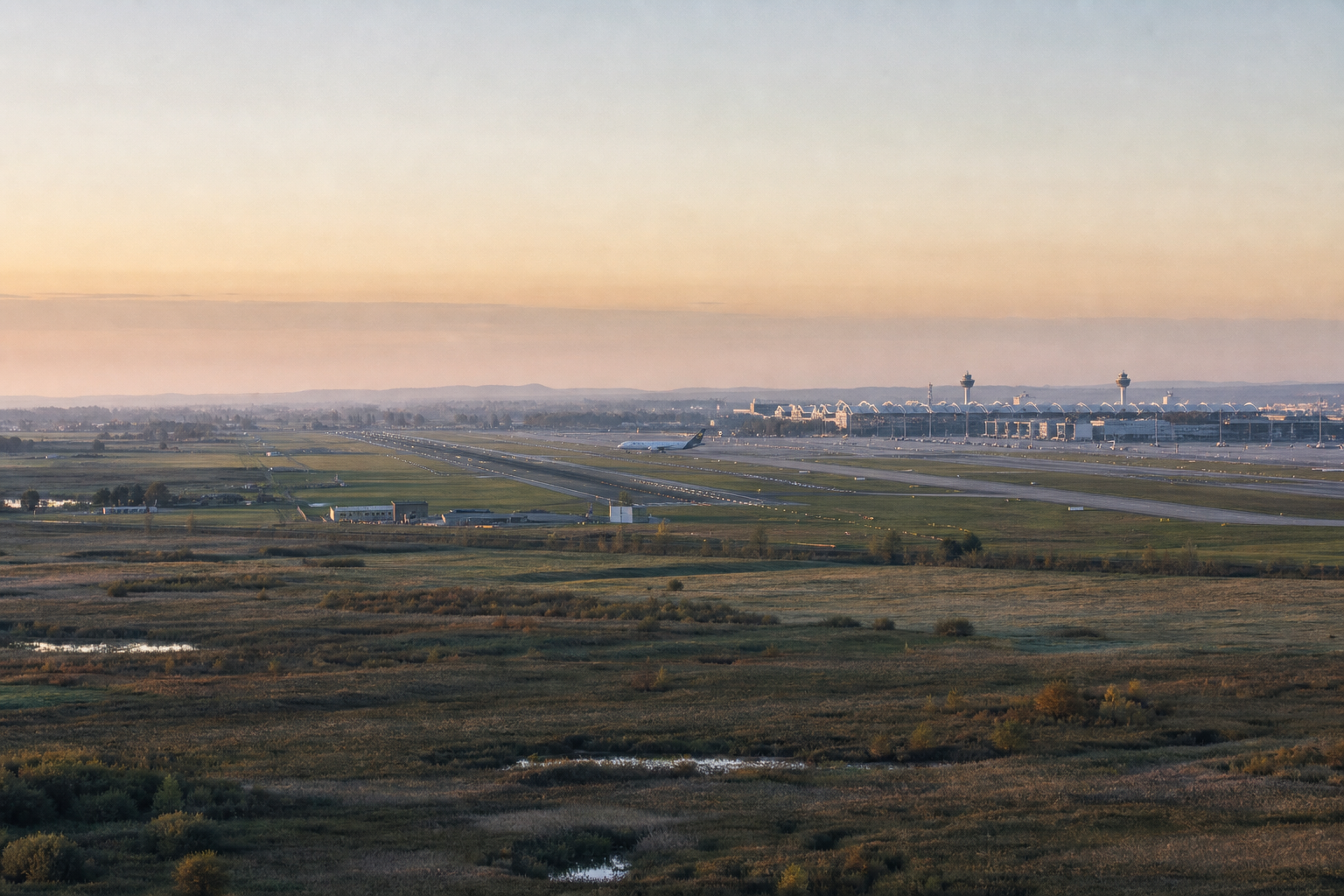
Debate on Airport Planning and Transparency
Opinion: Munich Airport – No Need for a Third Runway
The debate about the Erdinger Moos has seemed deadlocked for years: Proponents point to future growth, opponents to environmental consequences, land consumption, and the question of whether Munich Airport could not better organize its capacities without a new runway. That is precisely why the current traffic forecast is so politically explosive. Not because it automatically forces a decision – but because it is the prerequisite for being able to reliably review old certainties at all.
Transparency as a Prerequisite
Because if a new forecast exists, it may no longer be kept under wraps. Anyone planning or preventing multi-billion projects must be able to explain on what data basis this is happening. Transparency is not a side issue here, but the minimum condition for democratic control: Only when numbers, assumptions, and scenarios are on the table can it be assessed whether the previous justifications for the project still hold – or whether the starting position has changed so much that a political reassessment is imperative.
Forecasts: Indispensable, but Uncertain
Two things must be endured at the same time: Forecasts are indispensable, but they are never certainty. No one can look ten years or more into the future with one hundred percent reliability – this is especially true in air traffic. The industry reacts sensitively to external shocks: wars, pandemics, and other global crises can shift demand, route networks, and capacity utilization within a few months. Anyone arguing with a number today must therefore also disclose how robust this number is against such disruptions.
Ranges and Scenarios in Forecasts
This is precisely the crucial point for the Erdinger Moos: A traffic forecast is only as credible as its scenarios. The German Aerospace Center (DLR) explicitly works with different development paths in its long-term forecast up to 2040 and takes pandemic-related uncertainties into account. This way of thinking in ranges – not in a single supposedly precise truth – is central to the local political debate. If the new forecast merely continues with a “business as usual” approach, without plausibly depicting vulnerability to crises, changed business travel behavior, or structural upheavals, it would be a weaker, not stronger, basis for decision-making. If, on the other hand, it contains several plausible paths, it becomes politically valuable – precisely because it shows where uncertainty begins.
Reassessment Instead of Yes/No
A reassessment of the construction project is therefore something different from a yes or no to the third runway. Reassessment means: The responsible political actors would have to examine whether the previous lines of argument – demand, capacity bottlenecks, economic significance – still convince under the new assumptions. It is about accountability for the state of knowledge. Only then comes the normative question: Which consequences does politics want to accept despite uncertainty, and which not?
Political Decisions Versus Mathematical Conclusions
The fact that this distinction is often blurred is shown by looking back. Bavaria's Minister of Economic Affairs Hubert Aiwanger declared in 2020 that a third runway at Munich Airport was "not necessary at present" and referred, among other things, to political commitments such as referendums and coalition agreements. That is legitimate – but it is a political decision, not a mathematical conclusion.
Conversely, the following applies: Even if a forecast suggests rising numbers, this does not automatically mean the necessity of a new runway; it would also have to be examined what alternatives are possible with the existing infrastructure, what operational reserves exist, and what measures could alleviate bottlenecks.
Parliamentary Debate
The fact that these questions have been around for a long time is also evidenced at the parliamentary level: As early as 2016, the Bundestag, in connection with a minor inquiry about the third runway, asked, among other things, about delays due to competition for use of the existing runways and about the development of air freight volumes. The political dispute is therefore not just about “more or fewer flights,” but about the concrete performance of the system – and about how it is interpreted.
Disclosure of Forecast Data
This is precisely why it would be politically negligent to treat a current traffic forecast like an internal paper that is only cited at the right moment for tactical reasons. Anyone who wants public acceptance for a project of this magnitude must disclose the basis – including assumptions, methodology, and ranges. And anyone who rejects the project should be just as interested in ensuring that the debate is not based on outdated expectations, but on the latest state of model calculations.
Conclusion
The core question is thus clear: Without insight into the current traffic forecast, the construction project in the Erdinger Moos can hardly be seriously reassessed. However, with new data, the debate is not decided – it only begins at a higher level. Because in air traffic, every forecast remains a look ahead with reservations. Political responsibility is not shown by denying uncertainty, but by disclosing it, weighing it up – and transparently justifying the consequences of one's own decision.
Frequently Asked Questions
Sources
- https://www.sueddeutsche.de/muenchen/freising/muenchen-flughafen-notwendigkeit-startbahn-verkehrsprognose-kommentar-li.3491205?reduced=true, 31.05.262026
- https://www.dlr.de/de/blog/archiv/2021/corona-und-dann-neue-dlr-prognose-fur-den-luftverkehr-bis-2040, 30.11.2021
- https://www.bayern.de/dritte-startbahn-am-flughafen-muenchen/, 16.09.2020
- https://www.bundestag.de/webarchiv/presse/hib/201603/416442-416442, 23.03.2016