
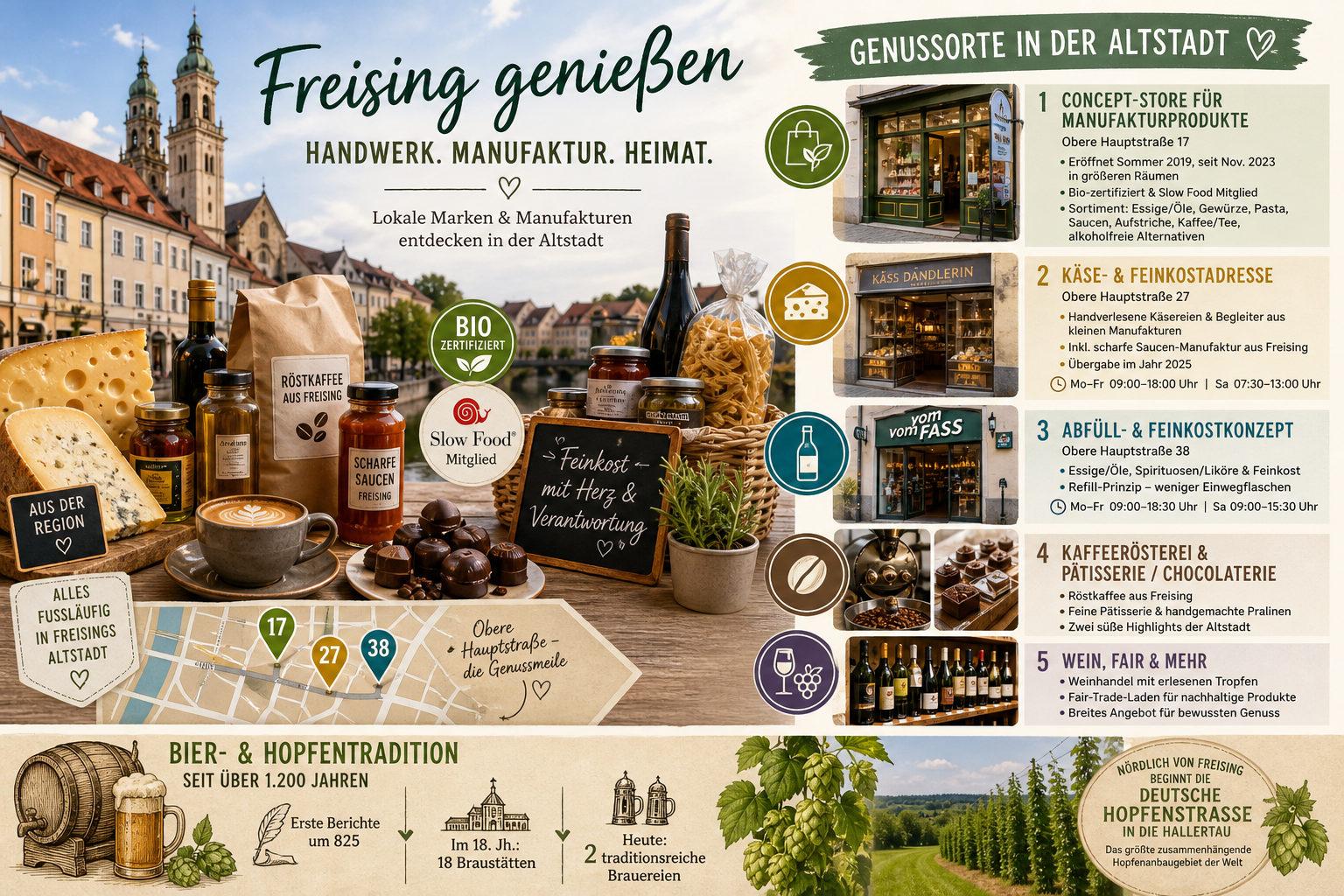
Discover Local Manufactories & Delicacies in Freising
Local Brands & Manufactories from Freising You Should Know – Your Enjoyment Plan for the Coming Weeks
If you stroll through Freising's old town in the coming weeks, you can make more out of it than “just” a shopping trip: a small day of indulgence with stops for delicacies, cheese, coffee, chocolate, as well as refill concepts for oils & vinegars. This article helps you plan your visit as a series of concrete next steps – with a focus on craftsmanship, traceable origin, and conscious enjoyment.
For whom? For everyone who wants to shop regionally, try something new, or plan a small gourmet tour in Freising in the next few days or weeks.
1) Your Old Town Route: How to Turn Your Next City Stroll into a Day of Indulgence
For your next visit, you can plan the old town as a “gourmet route”: several craft-focused stops are so close together that you can combine them in a relaxed walk. Instead of buying everything at once, you set small goals per shop – so there’s time for advice, tasting, and conscious decisions.
Suggested Schedule (flexible, no fixed times)
- Start with coffee: Begin with an espresso or filter coffee and consciously pay attention to roast profile and origin information.
- Continue to delicacies: Choose 2–3 “basics” that you will really use in the next few days (e.g., oil, vinegar, spice).
- Cheese & accompaniments: Have a small selection put together, tailored to your occasion (snack, snack plate, dinner, gift).
- Refill/filling: Only refill what helps you in everyday life – better small quantities, but fresh and suitable.
- Sweet finish: Take pralines, pastries, or a chocolate bar for your next moment of enjoyment (or as a gift).
Your advantage: You plan concrete next moments of enjoyment (dinner, invitation, weekend) – and thus shop more purposefully, less impulsively, and usually with greater satisfaction.
2) Stop “Curated Manufactory Selection”: How to Recognize Quality at a Glance
At your next stop in a curated manufactory or delicatessen store, you can quickly get your bearings with three simple questions:
- Origin: Is it clearly recognizable where ingredients and product come from (region, business, production method)?
- Transparency: Are there understandable details about ingredients, allergens, and production?
- Suitability: Does the product fit your planned occasion in the next few days (cooking, gift, stock)?
What you can specifically plan for your next purchase
- Select a “signature” product (e.g., a special oil or vinegar) that you will use at least twice in the next 7 days.
- Upgrade an everyday product (e.g., salt, pasta, or spread) so you can really taste the difference in everyday life.
- Test a non-alcoholic alternative if you want to toast more consciously in the future (e.g., non-alcoholic aperitif or high-quality lemonade).
If the store points out organic certification, traceable supply chains, or enjoyment standards, use this as a conversation starter: “What exactly is better about it – ingredients, processing, cultivation, transport?” Good advice remains verifiable and concrete, not just “perceived quality.”
3) Stop “Cheese & Delicacies”: How to Put Together a Platter for Your Next Evening
For your next evening with friends or family, you can have a small, harmonious selection put together at a cheese and delicatessen address. To avoid randomness, plan just two things in advance: How many people? and what style? (mild, spicy, experimental).
A simple structure that almost always works
- 1 mild cheese (as a starter, especially good with bread or mild chutney)
- 1 aged/spicy cheese (for depth and an “aha” moment)
- 1 special accent (e.g., blue cheese, goat cheese, or a regional specialty)
- 2 accompaniments (e.g., crackers + chutney or mustard + nuts)
If you enjoy cooking, you can also take a handcrafted sauce (mild to spicy) for the next week and plan an immediate use – for example, with roasted vegetables, burgers, tacos, pasta, or as a dip. This way, a small jar is really used in everyday life and doesn’t become a “cupboard dweller.”
4) Stop “Refill & Filling”: How to Plan Your Sustainable Shopping for Oils, Vinegars & Spirits
If you visit a refill or filling concept in the next few days, you can take a very practical step towards less packaging – without sacrificing enjoyment. To keep it simple, plan the visit like a “refill appointment” for exactly what you’re missing in the kitchen.
This is how you prepare for your next refill shopping
- Check at home which bottles are really empty or almost empty (oil, vinegar, favorite liqueur/aperitif).
- Take only 1–2 containers so you don’t get distracted on site and make a conscious selection.
- Start with small quantities if you don’t know a product yet – this minimizes bad purchases.
Typical categories you can plan sensibly for the next few weeks
- Oils (e.g., a neutral oil for daily cooking and an aromatic oil for salads)
- Vinegars (e.g., a mild fruit vinegar plus a stronger variant)
- Spirits/liqueurs (as a gift or for a planned occasion)
- Complementary delicacies (e.g., mustard, tapenade, or sweet spread for the next snack plate)
Note for trust & safety: For open filling systems, pay attention to clean taps, clear labeling (ingredients/allergens), and understandable price information. Serious concepts make this transparent and answer questions without evasion.
5) Stop “Coffee, Chocolate & Pâtisserie”: How to Turn the Afternoon into a Manufactory Experience
For your next old town afternoon, you can consciously plan a sweet stop: coffee from a roastery and artisanal pâtisserie/chocolaterie perfectly complement delicacies. To avoid just a quick “to-go,” use the visit as a mini tasting.
Mini tasting: Three questions you can ask on your next visit
- Coffee: “Which bean suits my taste at home (mild/fruity/nutty/strong) and which preparation method fits?”
- Chocolate: “Which cocoa profiles are more fruity, which are more roasted-nutty – and which bar is suitable as a gift?”
- Pâtisserie: “Which pieces are especially fresh or typical for the house today – and how do I store them until this evening?”
If you plan enjoyment consciously, it becomes easier to really appreciate high-quality products: better less, but selected – and enjoy soon.
6) Souvenirs & Gifts: Ideas for the Next Invitation
For the next invitation or as a thank you, you can put together very harmonious souvenirs in Freising in a short time – without arbitrary standard goods.
- “Cooking evening” set: a good oil + a vinegar + a spice (all chosen so they will be used in the next 14 days).
- “Snack plate” set: cheese selection + chutney/mustard + crackers.
- “Sweet break” set: chocolate bar + pralines + coffee (or tea) as a combination.
- “Non-alcoholic toast”: a high-quality non-alcoholic aperitif or a special lemonade plus suitable snacks.
If you want the gift to really be appreciated, have the shop briefly explain what the product is intended for (e.g., “for salads,” “for desserts,” “with cheese,” “for cocktails”) and how it is best used.
7) Checklist for Your Next Visit
- You plan an occasion in advance (snack plate, dinner, gift, weekend visit).
- You set a limit on products (e.g., a maximum of 5 items) so the selection remains conscious.
- You bring suitable, clean bottles for refill and prefer to fill small quantities when testing something new.
- You ask about origin, ingredients, allergens and the best use.
- You plan to use the most important products soon (within the next 7–14 days).
Sources & References
- European Commission – EU Organic Logo — Background on the EU organic logo and basic principles of organic farming (accessed 2026-05-13)
- Slow Food International — Guiding principle “Good, Clean and Fair” as orientation for food culture and responsible nutrition (accessed 2026-05-13)
- Regulation (EU) No. 1169/2011 (FIC) — Basic rules for consumer information on food (including labeling, allergens) (accessed 2026-05-13)