
Hans Gerzlich
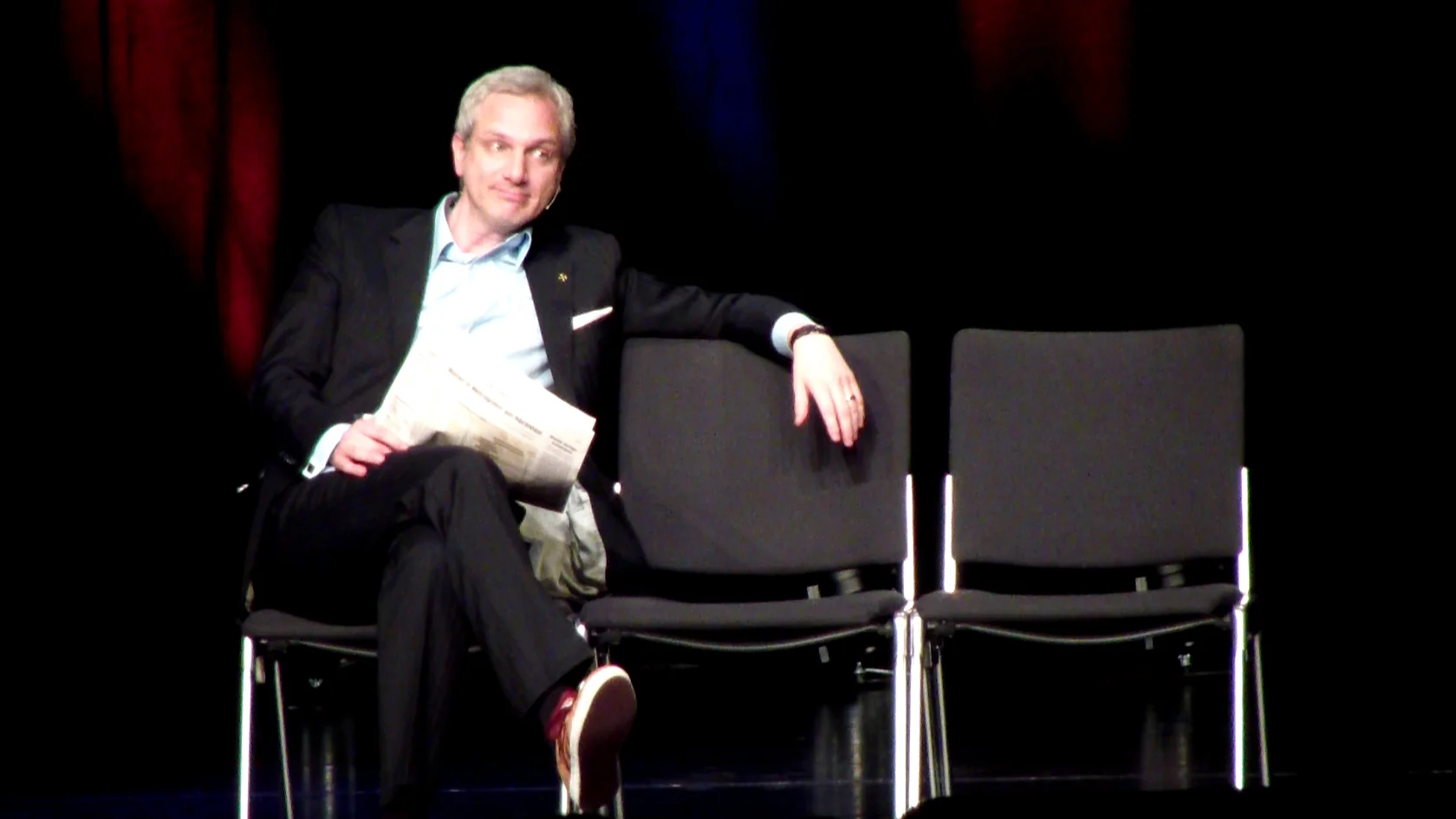
Image from Wikipedia
Image from Wikipedia
Hans Gerzlich: Cabaret with Everyday Truth, Office Humor, and a Distinctive Stage Presence
A German cabaret artist who turns the professional daily grind into great comedy
Hans Gerzlich, born on January 21, 1967, in Gelsenkirchen, is one of those artists who draw their material not from a distant fantasy world, but directly from everyday work life, meetings, cafeterias, career paths, and the minor annoyances of daily routines. As a German cabaret artist and comedian, he has established a unique profile with pointed office comedy, business-related themes, and a keen observational talent. His programs combine a satirical perspective, precise timing, and a stage presence that fosters intimacy with the audience.
Gerzlich's career is closely tied to his biographical experiences: he trained as a wholesale and foreign trade clerk, studied business sciences, and later worked as a consultant for marketing controlling before transitioning to cabaret in 2001. These experiences lend authority and credibility to his material. He does not speak about the world of work as an outsider, but from lived experience, creating the appeal of his comedic perspective.
From the world of economics to the cabaret stage
The transition to cabaret marked for Gerzlich not just a professional change, but the consistent translation of a life feeling into stage art. Since his program “Bürogeflüster!” (Office Whispers), he has primarily processed insights from his former professional life. From dry structures, he creates lively scenes, turning office communication into comedic conflict material and economic ways of thinking into a satirical panorama.
His work thrives on recognition: those who work or have worked in an office find reflections of their own daily lives in his programs. At the same time, he transcends mere insider humor, sharpening the mechanics of hierarchies, self-optimization, and work rituals to generate universal comedy. This is exactly where his strength as a cabaret artist lies: he does not only talk about work but about the conditions of modern living.
Career trajectory between solo programs, moderation, and live presence
Gerzlich's artistic career unfolds through a series of well-defined programs that reorganize his themes time and again. As early as 2000, he made an early mark with “Hart aber Gerzlich!” (Tough but Gerzlich!), followed by programs including “Im Hammer liegt die Kraft!” (Strength is in the Hammer!), “Bürogeflüster!”, “Geld für alle!” (Money for Everyone!), “Mehr Bretto vom Nutto!” and “Bodenhaltung – Käfighaltung – Buchhaltung” (Floor Conditions – Cage Conditions – Accounting). These titles accurately reflect his tone: a mix of linguistic wit, office semantics, and social observation.
In recent years, his repertoire has opened up more to personal themes. With “Das bisschen Haushalt ist doch kein Problem – dachte ich” (This Little Household Issue is No Problem – or So I Thought) and later “Ich hatte mich jünger in Erinnerung” (I Remembered Myself Younger), aging, partnership, and self-image took center stage. This step adds depth to his artistic development, as he does not stop at parodying work life but sees his own aging as a new comedic and human stage.
As a moderator, Gerzlich is also prominent. He hosted nearly 100 editions of his comedy mix show “Gerzlichs Gäste” (Gerzlich's Guests) in Gelsenkirchen and Bad Nauheim and regularly moderates the Quatsch Comedy Club in Berlin, Hamburg, Düsseldorf, Munich, and Stuttgart, as well as numerous corporate and association events. This live routine shapes his stage presence: self-assured, quick, audience-friendly, and with a sure instinct for the moment.
Discography, books, and published works
Although Hans Gerzlich primarily works as a cabaret artist and comedian, his work has a clearly documented release side. The Wikipedia page lists the CDs “Bürogeflüster!” from 2006 and “Geld für alle!” from 2008, both released by WortArt. These publications mark key points in his early artistic self-location and document the transition from live acts to permanently available programs.
Additionally, there are several books that expand upon his thematic worlds. These include “Wir danken für Ihr Verständnis – Das Bahn-Comedybuch” (We Thank You for Your Understanding – The Railway Comedy Book) in co-authorship, “GELD FÜR ALLE! Wechseljahre einer Weltwirtschaft” (Money for Everyone! Change of an Economic World), “Ich krieg die Krise” (I'm Having a Crisis), as well as the titles “50 SHADES OF BEIGE” and “So kann ich nicht arbeiten!” (I Can't Work Like This!) published in 2024. These publications demonstrate that Gerzlich articulates his office and work-comedy not only on stage but also in book format.
His program list further proves sustainable productivity. Between 2000 and 2025, he develops new evening programs that build on each other thematically while also reacting to societal changes. Thus, an artistic evolution emerges that is neither confined to pure stand-up routines nor traditional literary cabaret, but rather combines both with a strong focus on observation and current relevance.
Style, language, and comedic handwriting
Gerzlich's style is characterized by precise everyday observation, clear punchline control, and a sense of the absurdity of bureaucratic language. His texts utilize workplace vocabulary, economic terms, and situations that everyone knows: meetings, corporate parties, colleague conflicts, career pressure, household logistics. From this, he shapes a comedic sound that stands in the tradition of German-language cabaret but strongly focuses on contemporary relevance.
His ability to make role changes visible is particularly effective. In his programs, hierarchies collapse, personal and professional lives intertwine, and from the seemingly trivial, a satirical intensification arises. This mixture lends his performances high recognizability and makes him equally appealing to audiences from business, administration, and the broader cabaret scene.
The orientation of his themes also exhibits a fine sensitivity for generational experience. When Gerzlich talks about aging, it is not about nostalgia, but about identity, self-irony, and the fracture between inner age and outer perception. This gives his stage character depth: humorous, yet not frivolous; entertaining, yet never arbitrary.
Cultural classification and public resonance
In the German cabaret landscape, Hans Gerzlich occupies the position of a precise observer of the working world. His themes strike a chord in a society where work, self-optimization, and personal burdens are coming closer together. His background in business enhances his credibility and sets him apart from artists who merely fantasize about the world of work.
The accolades also underscore this presence. On his website, awards such as the Gelsenkirchen Cabaret Award 2017, the Bottrop FrechDAX 2015, Paulaner Solo+ 2014, the Swabian Cabaret Award 2013, and the Münsterland Cabaret Award 2012 are mentioned. Such honors document that his humor finds recognition not only from the audience but also in the professional world.
As a stage artist, Gerzlich also benefits from his roots in Gelsenkirchen, where he grew up and lives. This local anchoring gives his performance a groundedness that complements his content well: not an aloof artistic vision, but a clear perspective on real life. This is precisely what makes his comedy so sustainable and well transferable to different stage contexts.
Current projects and new themes
For 2025, a thematic shift is noted on the Wikipedia page: with “Ich hatte mich jünger in Erinnerung” (I Remembered Myself Younger), Gerzlich focuses more on aging and thus on a very personal, biographically condensed topic. His official website also showcases a current program landscape with titles such as “FIRMEN-FEIER” (COMPANY PARTY) and “Ihr Sünderlein kommet!” (O Come, All Ye Sinners!), which continue his satire on office and party culture. This indicates that Gerzlich remains productive, relevant, and thematically flexible.
Additionally, he is active as a speaker at business events, particularly on change management and digitalization 4.0. Here too, he connects specialized topics with humor, translating complex organizational processes into vivid, entertaining language. This dual role as a cabaret artist and speaker broadens his reach and sharpens his profile in the live sector.
Conclusion: Hans Gerzlich is intriguing because he constructs a comedic body of work from genuine professional experience, precise observation, and clear stage language, linking work life, generational changes, and personal dislocation with remarkable accuracy. His programs are close to life, his punchlines are precise, and his themes remain relatable. Anyone who appreciates cabaret with everyday intelligence and strong live emotion should definitely experience Hans Gerzlich on stage.
Official channels of Hans Gerzlich:
- Instagram: no official profile found
- Facebook: no official profile found
- YouTube: no official profile found
- Spotify: no official profile found
- TikTok: no official profile found
Sources:
- Wikipedia – Hans Gerzlich
- Hans Gerzlich – Official Website
- MB MANAGEMENT – Artist Management
- Das Kabarett-Magazin – Hans Gerzlich
- Wikipedia: Image and text source
Upcoming Events
Hans Gerzlich live: I remembered myself younger in Munich
Hans Gerzlich – I Remember Myself Younger

Hans Gerzlich | I Remembered Myself Younger